
I first wanted to call this chapter "Professionalism", then turn it into a question: "Pinpoint or spread thin?". In the end I called it "Circles of interests" and consider this the most fitting title, and I think you will agree once you have read the chapter to the end. In the previous chapter, as an example, I mentioned university professors who possess the most valuable knowledge but cannot make use of it for lack of other skills and knowledge in related fields. From what was said above it may seem that a broad outlook and the study of several disciplines is the winning option. But in reality that is far from always the case, and this question needs a more detailed explanation.
Let us take two extremes. The first: you are a very strong specialist in a very narrow direction, or at least simply in one field. People like you, on the whole planet, number in the single digits, the tens, or at most the hundreds. The second extreme: you have some specialty at which you cope no worse and no better than others. In your free time you don't mind playing the drums — even if you are only so-so at it, you are still better than a good half of those who have never held sticks in their life. You also swim fairly well, but not well enough to confidently go and be a swimming coach, because you have problems with communication. Still, you swim better than most. Finally: you cook well too, I would even say excellently, but not well enough to be the head chef of the leading restaurants in your city.
How would I describe you in the first case and in the second? In fact, I have no clear answer. It would most likely vary depending on my mood: from "a professional" to "a boring nerd" in the first case, and from "creative and well-rounded" to "a half-finished dabbler" in the second. The problem is that there is no single correct answer here, and on this topic even the most different influential people can be heard holding completely contradictory opinions — from "you need to strike at one point and study one thing in order to be a specialist in it" to "a person should always be developed in several directions".
Both cases have their pros and cons. A person who is interested in nothing except their job and specialty, and who devotes a good deal of free time to it, will most likely achieve incredible success in their field. They will be an expert and a professional. They will probably not be left without work as long as their profession is in demand, and will become one of the highest-paid employees. But they have spent too much effort and time on these successes, which means they have not succeeded in other things. Perhaps they have no family and no children, they rarely go anywhere, and they have no hobby. And if they suddenly have to change jobs because their profession is replaced by robots or neural networks, for them that will be tantamount to death.
In the other extreme one can also find advantages and disadvantages. Of course, you are not an expert in your field, which means you will have an average wage on the labour market. And in general you may be fired, because there are people who work better for the same money. If you are fired, you will have the chance to change profession, since you possess other skills and can theoretically apply for work in other fields. Of course, for the first months you will have to intern and earn significantly less than the average salary, and, most likely, study a great deal. You will have a job, although by that time you may no longer be very glad of it, because it does not bring in much money.
Which option would I advise you to stick to? It is extremely difficult, but most likely I would still recommend that you become a professional in some one area, while finding time to develop another. I understand better than anyone how difficult this is, because I myself try not to balance between the extremes, but in effect choose both at once. That takes up almost all of my personal time. Many of my goals are tied to this very balancing and to learning something new in completely different fields. Let us try to describe the main directions in which I strive to develop, and where my level is clearly above average — sometimes by 50, 70, and in places even by 90%.
1) Programming. At the moment this is, in essence, my main way of earning. I have devoted more than 15 years to this field, including study at college and university, and I am certainly among the best 98–99% of the population of our planet. However, there remain 1.5–2% of specialists who still surpass me. They have put even more hours into practice and study, because nothing except programming interests them.
2) Astronomy (cosmology). Ever since my school years I have been fascinated by the structure of our Universe and its laws. First I studied the Solar System, and then the Universe as a whole. At the beginning these were purely theoretical materials, but over time I came to understand such notions as quarks, fundamental interactions, wavelength spectra, the formation of elements in the Universe, the periodic table, and much else. Now I can confidently explain the laws of physics and understand even complex material at the first reading. At the same time, of course, I would hardly solve a problem in classical Newtonian physics along the lines of: "With what force will a banana peel, thrown toward a homeless man with such-and-such an acceleration, hit him in the face, if the homeless man is running toward the banana at a certain speed, while the wind is blowing in his face, and he has also slipped?" Such topics do not interest many people. It is far more engaging to learn what the "James Webb" or "Hubble" telescopes found in the geysers of Europa and Enceladus, how long the "Voyagers" will keep working, when sail satellites will be launched, what dark matter consists of, why the cosmic microwave background is inhomogeneous, and much else. Astronomy, cosmology, astrophysics are overlapping sciences which, unlike IT, very few people study at a professional level. Here too I can say with confidence that I am among the best 95–99% of the planet's inhabitants. For every professional physicist there are many astrologers who do not simply sit in offices, but actively look for an audience on the internet in order to promote their services. And some of them may sincerely believe in their ideas because of a lack of education. Real physicists, by contrast, quietly advance scientific progress, with rare exceptions such as Neil deGrasse Tyson, who popularizes science — which cannot be said of astrology, where every astrologer is not against gathering a larger audience.
3) Planning. For 5–7 years now I have been actively engaged in planning, I strive to raise my efficiency, and every year I analyse what did not work out last year and how to make the next year better organized. In this I have had quite a few successes, which I have written about on my blog and will write a good deal more about in the second book, when I publicly take my 2024 apart as an example. The overwhelming majority of people do not plan at all, so here I confidently count myself among those who surpass 98–99% of others.
4) Writing. For 5 years now I have been actively writing articles for the blog, and now, in addition, I am working on this book and will probably write several more. I do not know how large the number of authors is, but among my acquaintances, friends and colleagues such people are literally 3–4%. Even if I allow a small margin (since my friends are mostly IT people, not journalists or writers), I can still count myself among the people who, in writing articles and other material, are 85-90% better than the rest of the planet's inhabitants.
5) Reading books. For the last five years or so I have been reading a great many books, and I even started a special Instagram account where I briefly write comments on all the works I have read. I have no idea how many people actively read books, but judging by my last five years, I think I read more than 80–90% of the population.
6) Football. Had I been born in England, where professional leagues alone number 7–8, and then there are amateur ones as well, I would definitely have become a footballer. I cannot say exactly how successful, because even though I played football well at school, that is too small a sample. Perhaps I would not have become a star of the English Premier League, but I could have played comfortably in the 2nd–3rd division. I have been watching football since 2002 and I support «Milan». And there is a direct link between when you got into football and the choice of the team you support. Around those years «Milan» were playing excellent football and won the Champions League, so many lads who started getting into football at that time chose them. Few people know this, but however much you might want to change your favourite club in the future, it is practically impossible. You can feel sympathy for other teams, but the club that made the first strong impression on you stays with you for life. You do not choose your parents, nor your favourite football club. It becomes part of you, and no circumstances can change that. I consider that I know football fairly well. From time to time I may miss my team's games, but I always know its lineup and even the lineups of other clubs. As a child, when there were not yet modern entertainments, I knew the lineups of many teams, and I only got the internet at about 13–15. A great many people are into football, it is the number one sport, but I suppose that I know it better than 80% of others.
7) Travel. I started travelling abroad relatively recently — to be precise, since 2019. I have already been to more than 10 countries. And these trips cannot be called standard tours through a tour operator. Almost all of them, except one, were fully planned by me and my friends with whom I went abroad. We often used car sharing, and changed several places of stay or even countries in a single trip. Of course, everyone who has money and the desire can travel. But I count myself among the people who travel more than 80% of the rest (thanks first of all to China, India and the countries of Africa), where the population is large and the population is poor, so as to make such trips.
8) Cinema. I very much like watching good films, digging into their details, looking for the director's meaning and message. At the same time I do not spend my time at all on cheap series (though in most cases not on expensive ones either), but with films it is completely different. I have watched all 250 best films according to IMDb and 250 films according to Kinopoisk. These lists include very old black-and-white films by Charlie Chaplin, Buster Keaton and Akira Kurosawa, slightly less old films by Alfred Hitchcock, Sergio Leone and Stanley Kubrick, and modern films by such directors as Christopher Nolan, Martin Scorsese, Guy Ritchie, Hayao Miyazaki and Quentin Tarantino. Consider that I have just listed my favourite directors (though there are favourite actors too, but that is a separate topic). Every year I gladly go to a couple of dozen new films at the cinema. Moreover, I try to remember the directors whose work I especially liked, and to watch their earlier films. And if it is their debut, I add them to my bookmarks so that in the future I can watch their other films. I also don't mind watching Oscar nominees or the Cannes Film Festival. And I pay attention not only to the plot, but also to the details: how the film begins and ends, what colour accents predominate in the frame, how long a given take lasts, how the camera is placed during dialogue, and so on. I suppose that I know cinema 70–80% better than most people. So to some extent I could do film breakdowns. If anyone is interested in a detailed analysis of the top 250 films according to IMDb or Kinopoisk, on my site https://shitik.com/ there are two separate articles on this topic.


9) Learning English. Although at school, college and university I studied German (which I now hardly remember at all), for the last few years I have been actively trying to learn English. I know for certain that I will learn it to a fairly good level. True, at the current pace I will need another 2–4 years to reach the result I want. An enormous number of people speak English fluently, and for many it is their native language. Nevertheless I can say that I now know English better than about 50% of the population (in large part thanks to India and China, where a significant part of the population does not speak English fluently). If it were not for them, my percentage would be significantly lower.
10) A driving licence. Finally I will note that I have a driving licence. Because one way or another this too sets me apart from others — let us say for certain, better than 50–60% of the population.
I did not describe all the skills I have just recalled, including even a driving licence, for no reason. We can draw up a kind of table of my skills.
| Field | I am better than % of the population |
| 1) Programming | 98-99% |
| 2) Cosmology | 95-99% |
| 3) Planning | 98- 99% |
| 4) Writing | 85-90% |
| 5) Reading books | 80–90% |
| 6) Football | 80% |
| 7) Travel | 80% |
| 8) Cinema | 70-80% |
| 9) English | 50% |
| 10) Driving licence | 50-60% |
I drew up this table not in order to boast about the fields in which I am better than others, but in order to:
1) show you that you too need to systematize your professional skills and hobbies;
2) on that basis draw up a table of this kind with approximate scores;
3) analyse what you have drawn up;
4) look for intersections;
5) think about how to extract benefit from this.
So, the first two points we have. Let us try to analyse everything listed above and place ourselves in one of the categories: professional or amateur. We remember that the greatest amount of money is always paid to professionals, which means we should strive to be professionals in one field or another, and perhaps even in several fields. I will say at once that being a professional in several fields is practically impossible, because the effect of "spreading" your time across different directions tells on your level of preparation. While you have smeared your education over 3–4 fields, someone has invested it in one and become better than you. That is precisely why, even in programming, I cannot consider myself an engineer who leads the whole IT industry: I do not give myself to this work 100%. And even though my percentage here is very large, a difference of even one and a half percent in numerical terms is still a great deal. So it is no surprise that there are people smarter than me. More surprising, perhaps, is how enormous programming is: even inside this field I am a full expert only in several very narrow areas, which nevertheless intersect successfully. This allows my knowledge of one area of development to be extremely valuable for another, and the other way round. Cosmology on the whole is difficult, and it has never brought me money. In football, despite my competence, there are hundreds or even thousands of analysts and experts who are better than me, which means there is nothing for me to catch there. Things stand in practically the same way with all the other categories — from travel to a driving licence. Perhaps the exception may be writing, because it is the least competitive environment. Here simply high-quality and unique work may well allow one to achieve something.
So, we move on to the fourth point, which will at the same time intersect with the fifth. We will finally look for intersections and think about what we can do with them.

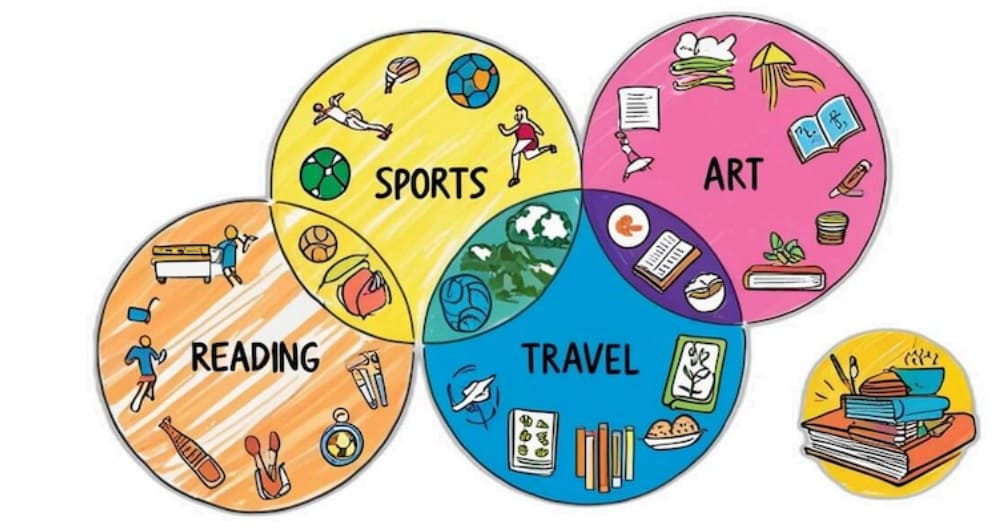
To visualize the intersections we will use Euler circles. As an example let us take three skills: A, B, C. But in reality there can be as many of them as you like. They may intersect, and they may not. Why do we do this? In order to understand which fields intersect and create new areas. At the intersection of fields you can become the most valuable and narrowly focused specialist, whose value will be significantly higher than the sum of your skills without these intersections. Moreover, your hobbies will most likely end up in such schemes as well. And that means intersections of a hobby with something else, which can theoretically bring you income, are not ruled out. A hobby that brings in money is far more pleasant than a job that brings no pleasure.
Let us try, using my interests and education as an example, to understand whether there are intersections here. I will list them once more:
1) Programming
2) Cosmology
3) Planning
4) Writing
5) Football
6) Travel
7) Cinema
8) English
Generally speaking, at first glance there are no intersections in my list. I deliberately did not include a driving licence here, because it is far from a hobby, that is, not an area whose intersections would interest me. In other words, I do not want to work as a driver. For you, however, this point may well be important, and its intersection with something else will give you the best of the possible solutions. In exactly the same way I did not include reading books in the list. It does not give me any particular pleasure, and I do it rather to broaden my outlook and level up my mind. So, let us return to my list: programming, planning, cosmology, football, travel, cinema, writing, the English language. You will agree that this looks more like some strange and unconnected mishmash. Of course, I can try to program space simulators or formulas for physics. I can create a high-quality site for football or for travel. I can also write about all of this — about space, about football, about programming, about travel, about productivity. That is, in fact, what I am doing now. This is one of the few intersections where I can call myself an expert. After all, someone is simply a writer, someone is simply productive. But productive writers, or writers about productivity, are far fewer. So if you want to occupy a unique niche, combine different fields. Perhaps in the future I will acquire one more hobby that will intersect perfectly with something I already have. That means that in this new area I can succeed as well. By the way, I chose the English language not because I have nothing to do or because I like it. It is the language in which the whole planet communicates. It is the language of opportunity, which creates a heap of new intersections among my pursuits and professional skills.
I would also be glad to get feedback on this, because about half of the methods and practices I found in other books and simply carried over into this book, explaining them in my own words and using my own examples. This method, however, is purely my own development — at least, in none of the books on planning and productivity have I yet come across anything of the kind.
