
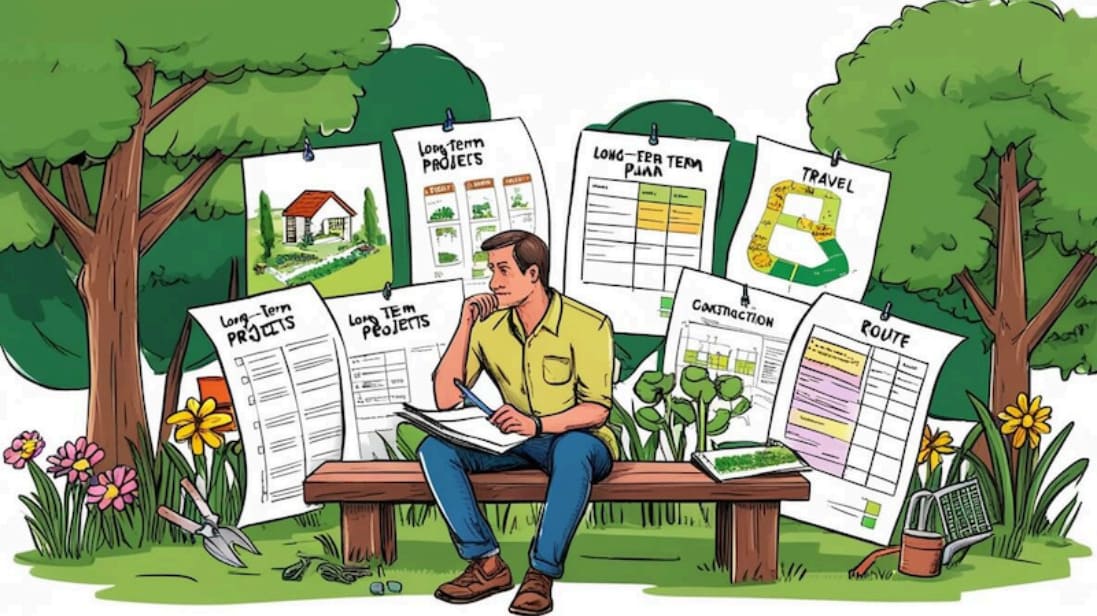
Let's talk a bit about long-term projects. First, what do I mean by that? Goals, tasks and undertakings that can run continuously from two weeks to several months or even years. The clearest way is to show by example. Say in one slice of your life you've planned a lot, and together with everyday tasks and chores you end up with quite a list:
- You're planning a trip abroad and need to plan it in detail.
- The bosses from another city are visiting work, and you need to do more than usual.
- You have renovation going on at home and you're overseeing the whole process.
- Your daughter is in driving school and you promised to help with practice and theory.
- You're going to buy her a car and are looking at options, actively going to viewings from ads.
- You're into football and there's an amateur tournament on right now where you and your friends are playing.
In broad terms all of this can be called projects. Or big tasks, or something else — the label doesn't change much. What matters is that they will all end sooner or later. You'll take the trip, the bosses will come and go, the renovation will be done, your daughter will pass her test, you'll buy her the car, and the tournament will finish. Of course some things may repeat: the bosses may visit again in six months, you may plan another trip, another football tournament may come up.
As it stands you have six agendas to keep under control and switch between regularly throughout the day. There's a real risk that by switching between these tasks and effectively operating them all at once you'll forget something important in one of them. Forget to book return tickets, deliver a weaker report for the bosses, furniture gets put in the wrong place, your daughter fails first time for lack of practice, you buy a suboptimal car because you didn't check it well enough, you're knocked out of the tournament early because you're unfocused and out of shape. Doing big tasks poorly isn't the worst that can happen. Worse is when you start ignoring signs and signals from your tasks and start underestimating the problem. I'll come to that in the next chapter.
So how many big tasks should you take on at once, and what do you do when you have too many things on at the same time? On the first part I'm not going to give you a specific number. It depends on the person and how many contexts they can hold in their head at once over weeks and even months. For some, six is too many and they'd rather run no more than 3–4 big long-term projects at a time. Others might handle ten. On the second part — what to do when you have too many concurrent projects and it's not working and you're falling behind — first ask yourself whether something can be paused for now and returned to later. If not, I'm afraid you may have to live through this period under strain with all tasks, if they can't be moved or dropped. On the other hand, it's a lesson: plan more carefully in future.
