
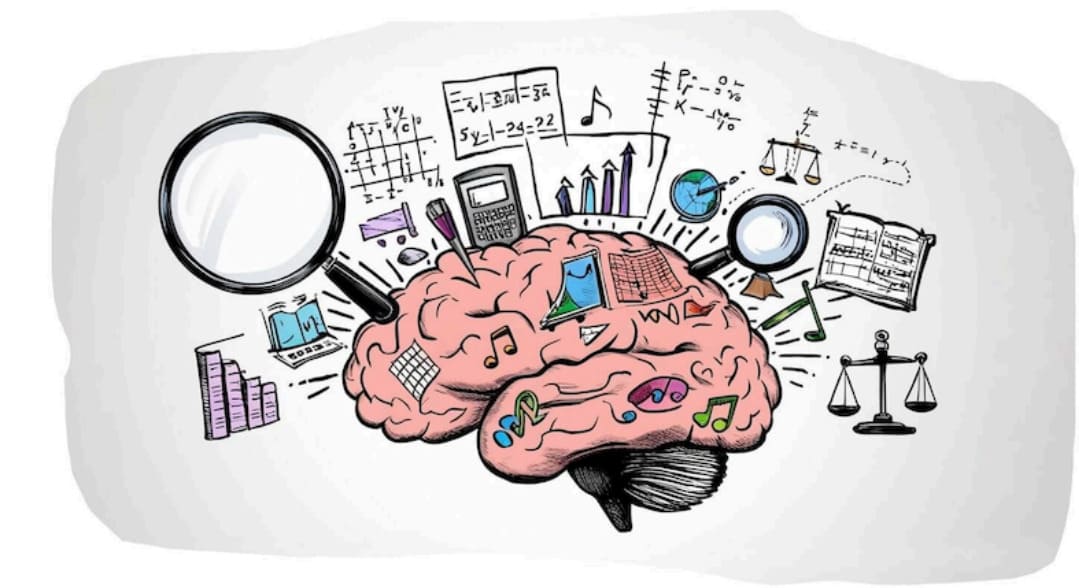
The topic of thinking is so broad that this chapter may not be the shortest. I want to cover several things: first, what types of thinking there are; second, that you probably don't have perfectly logical rational thinking; third, intuition; and fourth, how this affects productivity.
So let's start with the first question, though keeping to a strict order will be hard. There are many kinds of thinking and many ways to classify them.
By nature, thinking can be (a) theoretical or (b) practical. By degree of explicitness: (a) intuitive or (b) analytical. By degree of novelty and originality: (a) reproductive or (b) creative.
Classifying thinking is tricky. I went through a lot of sources and couldn't find the same categories twice. I've seen simple lists: scientific thinking, critical thinking, creative thinking, logical thinking, intuitive thinking, abstract thinking.
We'll stick to two classification dimensions: "by degree of explicitness" and "by degree of novelty and originality". By novelty and originality there is reproductive thinking — what you've seen somewhere and copied — and creative thinking, which is more unique. Creative is valued more because repetition interests few. So always try to lean toward creative directions in your development. That said, if it's hard, you can try to get by with good, diligent work using reproductive thinking. Here I'm reminded of the musical "West Side Story", whose creators combined existing genres: they took the idea from Shakespeare's "Romeo and Juliet", added strong choreography, wrote good music, came up with an interesting plot — and got something new and engaging. So engaging that the musical was filmed twice, the second time by Steven Spielberg, who's always on our generation's radar.
By degree of explicitness, thinking is either intuitive — i.e. trusting your intuition — or analytical, which means using your reasoning skills. Analytical thinking can include many other kinds, such as systems thinking: breaking big tasks into small parts, working with them and getting a result while allowing for all nuances. That's what I often do at work on medium and large projects. I even read a book called "Systems Thinking". I won't recommend it though — it's dry university theory. Analytical thinking also includes critical thinking, which I believe 99.9% of people on Earth don't have, or have very weakly. Lack of critical thinking easily breeds another type — conspiracy thinking. If you tend toward conspiracy thinking, you probably have weak critical and thus analytical thinking. Some conspiracy topics are very hard to verify (e.g. whether an IT company leaks our data). Others are easier: "Did Americans land on the Moon?" or "Is the Earth flat?" If you know people who ask such questions but can't answer them logically, keep your distance. People who strongly lean toward conspiracy thinking usually achieve much less. Their beliefs are distorted and their logic and justifications are odd. I have no scientific proof for that — just my observations of acquaintances and others.
We won't go deep into the details of analytical thinking. Let's treat it as a general idea and talk about it and intuitive thinking. I'll refer a lot to Daniel Kahneman's book "Thinking, Fast and Slow". In short, he calls intuition System 1 and deliberate analytical thinking System 2. In the vast majority of cases System 1 makes our decisions. System 2 is meant to monitor System 1 and step in when System 1 doesn't know the answer. If System 2 were on all the time, we'd get tired quickly. So System 2 doesn't kick in that often and a lot is left to System 1 — intuition or the automatic decision system. Call it what you like. The problem is that System 1 is wrong more often than you'd think. It often errs when it comes to statistics or information presented in a slightly wrong form. Even on exam questions, the wording can matter. In one case System 1 may think it knows the answer and answer a similar question (but not the actual one). In another it will call in System 2. So it's crucial to engage System 2 more often and double-check System 1's choices.
I also want to add a quote from Asya Kazantseva's book "Someone Is Wrong on the Internet!":
"So under social pressure we're ready to believe implausible things. We become especially credulous when we're influenced not by random people but by our reference group — the layer of people we consciously or unconsciously compare ourselves to and use as a guide when making decisions."
To sum up: imagine you're someone with weak critical thinking and strong conspiracy thinking, who easily follows System 1 (intuition) and rarely engages System 2 (analytical thinking). On top of that, everyone around you — colleagues, family, neighbours — is from the same social level and group. With all that combined, you've formed certain beliefs on which you base your life decisions, plans and goals. But with wrong (or at least distorted) beliefs, your goals will be wrong (or distorted) too.
