
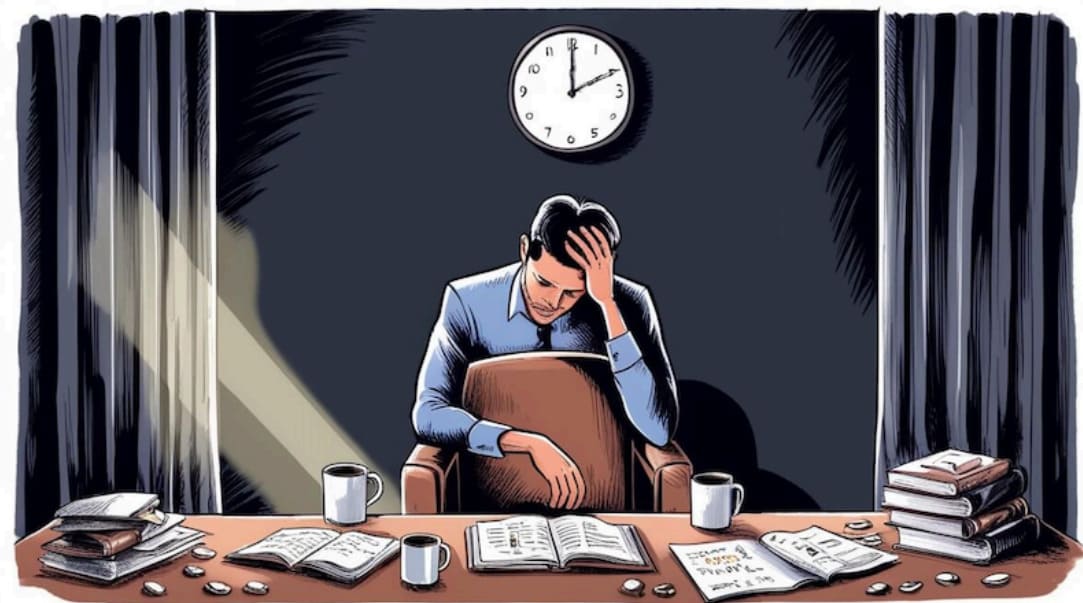
It makes sense for a chapter on fatigue to sit next to the one on sleep and wakefulness: short-term fatigue is best treated with sleep, unlike long-term (or accumulated) fatigue, which can lead to depression and burnout — and the ways to deal with that are different, e.g. a holiday.
In this chapter we'll extend the previous theme from the angle of sleep and talk about fatigue. It may be an obvious topic, but it will still be useful to some.
At 20 I liked to stay up till 3 a.m. studying or working. Now I limit night-time work and study to 1 a.m. at the latest, though I very rarely allow myself to sit up much later. What changed in 10 years and why did I stop studying and working so late? First, my body is 10 years older and I find it more comfortable to go to bed by 1 a.m. at the latest rather than 3. I can imagine that in another 10 years I'll be comfortable going to bed by midnight. Second, a careful reader will have noticed that this section is about study and work, not e.g. watching films or doing jigsaws.
I'd roughly divide everything you can do into consumer activities (reading a book, watching a series or football, being on social media) and generative ones (writing code, writing a book, loading and unloading a van, even cleaning the flat). Consumer activities are mostly mental: both watching a film and reading a book only engage your mind. In other words you're not producing something new; you're consuming content — a match, material from a book, an interesting YouTube video. Generative tasks are a bit more varied: they can be mental or physical. Writing code is first and foremost a mental process where even routine code has to be thought through. Loading and unloading a van I'd also call generative — in the end you have a full or empty van, so you're a creator, e.g. building a neat stack of goods. You could refine or change this split, but for our purposes it's enough. The main point: consumer tasks are usually mental; generative can be mental or physical.
Now imagine: it's midnight or nearly. Your brain has worked hard all day and you feel a bit tired. You can choose from: read a book, watch a video, wash the dishes. Which should you do?
There's no single right answer — or rather, not in that form. The question is too abstract; I left it that way so we can look at each option in more detail.
Remember the setup: late evening, you're a bit (or more than a bit) tired. First option: reading a book. That's a consumer activity, so it's mental. It matters what kind of book. If it's learning material, you shouldn't read it at this time — your brain won't take it in as well as it would by day or after a short rest, but not right before sleep. It's different if it's e.g. an adventure novel — for entertainment, not learning. Forgetting in a couple of days what you read that evening is fine. With learning material you want to absorb it; a tired, sleepy head retains it worse. Second: watching a video. Same logic. You need to know the genre — entertaining/relaxing or educational. In the first case I'd say go ahead; in the second, no. Some say you shouldn't watch video or use phones and laptops in the last couple of hours before bed. There may be something in that, but we're only using this as an example. If we're talking about the harm of screens before sleep, the main issue is blue light from gadgets; it can disrupt sleep. But that's easy to fix with apps that filter blue light as bedtime approaches. I have one such app but don't find it very effective. Third: washing the dishes. Here too it's not black and white. On the one hand I've written in the section on household tasks how much time they eat, and that you should automate what you can — so you could put the dishes in the dishwasher (if you have one) and use the time for something else. On the other hand, washing dishes is a generative physical (not mental) task that you can do even when tired and sleepy, so you could perfectly well do it before bed.
To sum up: don't plan serious work, especially mental or intellectual, when you're tired. Our brain and body are such that before sleep or when very tired, the effectiveness of mental consumer tasks and even some generative physical ones is much lower. Remember that effectiveness is at the heart of productivity. We shouldn't just do planned tasks but do them as effectively as possible — so plan your day with this in mind. Don't plan anything mentally demanding before sleep, don't do learning before sleep, and don't do responsible physical work before sleep either. Plan your day properly and effectively!
