
To help you better understand what I mean by the right environment, I will briefly describe my own story of creating such an environment.
I lived with my parents for quite a long time — about 23 years. And only then was I able to move into a place of my own. Living with my parents, I found no motivation or desire to develop. Yes, I did well with formal education — school, college, university. But self-improvement, which was necessary to find a decent job, was extremely important. Don't think I was a bad student: if it hadn't been for the first years of college and university, where I had average (but not bad) grades, I might well have graduated with honours. I don't know why, but in theory I could have achieved more if I had tried harder.
After college (or, if I had gone straight to university, even without it) you come out with an utterly empty bag of knowledge, and no one will hire you, or if they do, it's for a laughable 100–200 dollars a month. Perhaps much has changed in 10 years — including the devaluation of the dollar — but that was the situation then. I am inclined to believe nothing has changed: after graduating from college and university, student friends periodically sent me tasks that were no different from what I had solved during my studies. That says they too left without experience or up-to-date knowledge. Such is the nature of education in state IT colleges and universities. And the various courses that promise to turn you into a programmer in a month are an even shakier story. Although I never attended such courses myself, from my own experience I can say that a month is definitely not enough. On the other hand, four years in college or university are not really needed either, especially given that you leave woefully unprepared.
Sitting at home and working remotely (or perhaps even in an office for the same 200 dollars), I realised I needed an intellectual breakthrough. At some point I found the strength and began to actively pursue self-education. That was probably the starting point for my development. It may not have been very efficient then, but I went through many courses, wrote several thick sets of notes and, at least to some extent, prepared myself for the realities of my profession.
My parents' flat was large and I had my own room, but there were too many distractions. We had a family dog, young and active, a sister who was at school and demanded attention when she got home, lunches with my father, discussions with my mother and my mother often coming into my room at weekends just to "have a chat". And that wasn't all. Among all the relatives living nearby (grandmother and grandfather, two aunts and two uncles with families), almost everyone was poorer than us and constantly called to ask for a loan or a lift somewhere, since we were the only ones with a car. I had had a driving licence since I was 19 and often couldn't say "no" when my father couldn't help, so I had to spend personal time on relatives. Besides, the neighbours knew nothing about phones and computers, and since "you're the programmer", you were expected to service and repair everything — from the kettle to the neighbour's computer. Of course, many paid for it, but it was peanuts compared to what I earn now. And not always in money: sometimes it was sweets and treats. The strangest "thank you" for installing Skype from the neighbours was a frozen mackerel. In such an environment, self-directed learning was practically impossible. Nevertheless, I managed to find time and study a lot of material.
Later I moved to Minsk and rented a flat where I lived alone. By now I have already changed environments several times. First, at work I had driven colleagues; second, the friends and acquaintances I started spending time with turned out to be clearly more intellectual than many relatives and neighbours. Many of my friends were actively learning about technology, which strongly pushed me too. I will write more about the right kind of environment in the next chapter.
Besides an environment of "right" people, I got what was most important for me at that time — peace and solitude. I could focus on whatever I wanted for as long as I wanted. There were no distractions. That was (and still is) a time of real, productive development.
Now I live with my spouse, and sometimes I have to sacrifice personal time for shared time, which can be just as rewarding. In the future there will probably be children too. But thanks to the habit of learning and developing that I picked up after moving to Minsk, I am unlikely to lose it. I may have to spend even more time with family, but I am confident there will still be time to read a book, watch a video course or write a blog post.
Since moving to Minsk I have periodically visited my parents when I can. I used to be able to stay with them for a week, though now I usually only visit at weekends. But however much time I spend there, whether a weekend or a full week, I cannot learn properly, and sometimes even work. As if their flat, linked for me rather to childhood memories, games and conversations with my parents, does not let me sink into work. Yet I feel nothing of the sort when I return to Minsk, whether I live alone or not. That is what the right environment means to me — one in which I could develop further.
After we have looked at the right environment through my story, I should describe this phenomenon in more general terms.
If you have no chance to move somewhere for more productive work, you will at least have to prepare your environment at home. You will need three things:
- Physical space
- Personal space
- Rituals
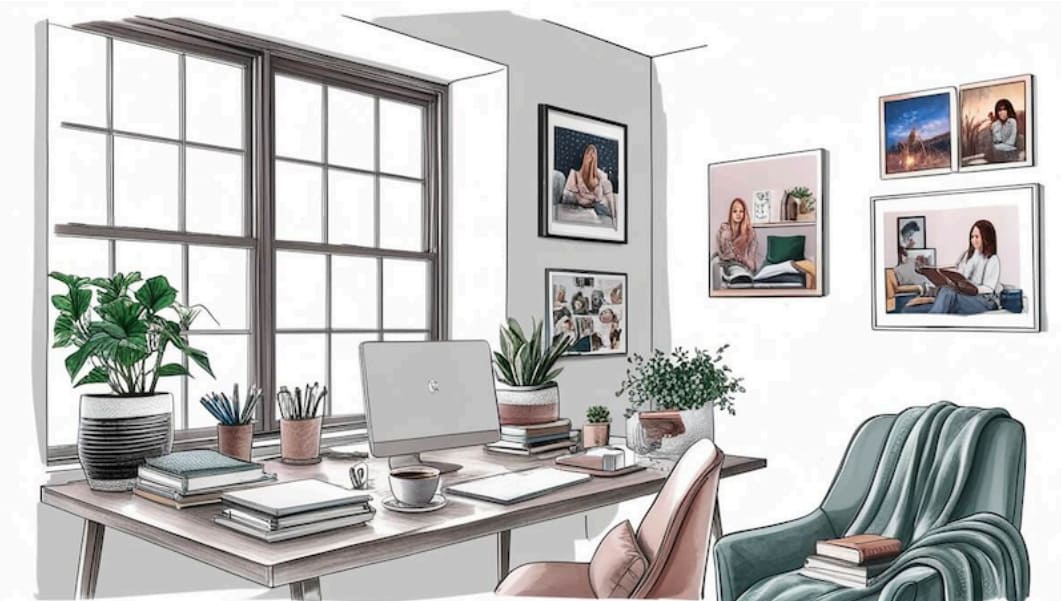
As for your environment, ideally you should have a clearly defined physical space where you can be alone with your work tools and do important things. This place should have two characteristics: first, be as comfortable as possible, and second, isolated (no one should distract you when you don't want to be). So a separate room with a comfortable computer chair and desk is exactly what you need.
Physical space is closely linked to personal space. You will probably get nowhere if you are regularly interrupted and not allowed to concentrate. Often you just need to think and focus.
Rituals are not a must, but many people who work remotely have them. In my work and in reading about remote work I have come across many different rituals. For example, some get up early, take their bicycle and ride somewhere for 10–15 minutes, then return home and start work. At the end of the work day the ritual is repeated and the person "commutes home from work" in the same way. During work they try not to get distracted and mentally immerse themselves in the task. There are also many odd rituals I read about during COVID-19 when everyone went remote. Do I have rituals? Probably not. Though if a morning cup of tea and a glazed cheese curd help me wake up and get into work, then perhaps that is my mini-ritual.
Some politician said that all revolutions begin in the capital. The authorities understand this and do their best to organise life in the capital so that as many of its residents as possible are satisfied. There are always more opportunities in the capital, both for leisure and for business. You are more likely to meet successful people and form your right kind of environment there.
