
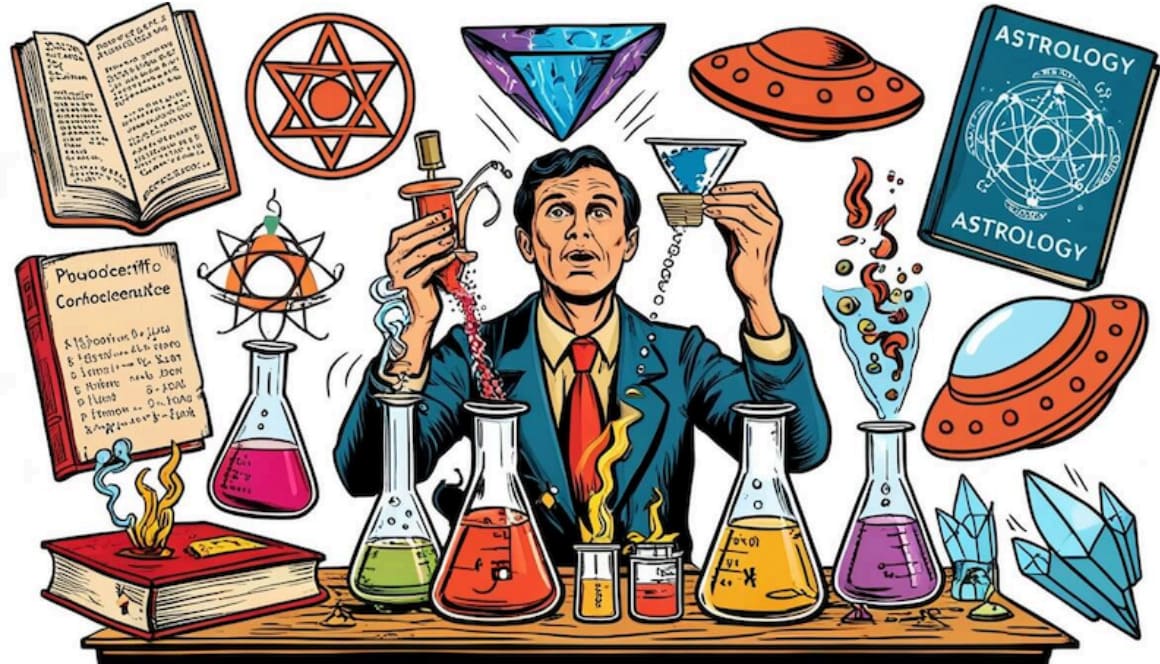
Girls, this is going to hurt. We are going to talk about pseudosciences, and for some reason it is you who are most inclined to believe in them. There are quite a lot of pseudosciences in general, but let us talk about the most important one, and the one with the greatest influence on people's minds (or the absence of them). Let us talk about astrology.
Tell me, how much is 2 + 2? If you can read, you can most likely count as well, and you will say that it is 4. This is obvious to you, you know it for certain. To a child in kindergarten, it is not. He will stop and think, start counting on his fingers, doubt the answer. He certainly does not know it. I like to give one more example. It relates to my work and to the subject of programming, but I am sure a similar analogy can be drawn in almost any profession. So you finish an educational institution in your specialty, you write code, the program works and really helps someone, making their life easier. Time passes, and as you level up your professional theoretical skills and gain experience, some 5 years later you open that same code and you are very ashamed of it. Now you would never have written such code — it is not secure, it can easily be hacked, it runs only on certain operating systems, and making changes to the code and maintaining it is hard. What fool wrote it? Ah, it was me! But what happened over these 5 years? I became more experienced in every theoretical and practical skill, and now it is obvious to me that this code is terrible. Just as obvious as it is obvious to you that 2 + 2 equals 4. Admit it, architects, artists, musicians, and people of other professions and fields — is this feeling familiar to you? Has it happened that you are ashamed to show someone your creations from 5–10 years ago? I think yes, and now, when you are smarter than your past self, it is obvious to you.
With astrology, things are in fact exactly the same. A person who, first, understands the exact sciences (physics and astronomy) at least a little — and a school course is quite enough — and, second, has critical thinking, is capable of understanding that astrology is the wildest nonsense. This is as obvious to me as it is obvious to adults that 2 + 2 equals 4. But the majority of people, on this question, still remain those same kindergarten kids who hesitate to recognize astrology as a pseudoscience, even try to give astrologers a chance or, what is even worse, believe in astrology and horoscopes.
Why do people believe in astrology at all? In short, as I already wrote above, they lack knowledge of the exact sciences, and they also lack the logic to start looking on their own for the inconsistencies between astrology and modern knowledge of how the Universe is arranged. And also because on Channel One there is an entertainment show, "Let's Get Married", where a woman in all seriousness draws up compatibility charts for a couple. After all, they can't lie on a federal channel, can they? Especially in entertainment content? Isn't that so? Or can they, after all? One can find endlessly many such "and also". So astrology has filled every possible niche — from television to the internet — and that is no surprise, since there are no bodies at the state level that would regulate this. And then there will also turn up celebrity idols with millions of followers who, in a difficult moment, turned to astrologers for help. These are well-known and authoritative people, as far as you are concerned, aren't they? And if they are well-known and authoritative, and rich besides, then they have probably seen life from different sides, earned their own living, and that means they can be trusted. But nobody asks the question that they earned their living and became popular not thanks to logic, but thanks to other skills: music, acting in films or, what is even worse, video content on the internet. As a result, astrology is very popular in the world and practically impossible to eradicate.
As a rule, in the simplified version, astrology is most often understood as the influence of celestial bodies on a person, or else as relationships between people (again on the basis of the position of celestial bodies, since the date of birth and, especially, the month has a great influence on this, according to the logic of people who in fact have no logic at all).
We will go through both myths: about the influence of celestial bodies, and about relationships. Although the second rather follows as a consequence of the first, so we will not dwell on the second for long.
The logic of astrologers is that there exists some mysterious force which, proceeding from the position of celestial bodies, strongly influences our fates and characters. Surely many have heard how astrologers love to drag in Jupiter, Mars, Neptune and other objects of the Solar System. So let us stop here in more detail.
In the world there exist four types of forces, or rather interactions:
- electromagnetic,
- strong (responsible for the binding of particles in nuclei),
- weak (responsible for the decay of particles),
- gravitational.
The strong and weak interactions manifest themselves at vanishingly small scales, for example in atoms, so there is no point in considering them. That leaves the gravitational and electromagnetic interactions. The electromagnetic interaction exists between particles that possess an electric charge. Since there are no quasars in our Solar System, and in general there are none even within a couple of thousand light years of us, we do not consider electromagnetism. One could, of course, consider, for example, a railway line or household electricity, but astrologers are clearly unable to calculate the influence of electrical cables on a person. So we set electromagnetism aside and move on to the last force — gravity. By the way, gravity is a weaker force than electromagnetism (that is simply for general knowledge). Although if astrologers "can" calculate the influence of attraction, then they could probably also calculate the influence of electromagnetic forces, since it is stronger and affects people more strongly. But they are unlikely to know anything about this, because for them 2+2 = 3. So, gravity, known to many as the force of attraction. Yes, yes, it is that very force because of which you land on the Earth when you jump, and because of which apples fall from a tree — also onto the Earth. They say that one apple fell on Newton's head, and after that he discovered his famous law of universal gravitation. Whether it fell or not is not very important to us. So, we are attracted to the Earth, and the Earth is attracted to the Sun (only, unlike us, the Earth is constantly rotating at great speed, and it is precisely for this reason that it does not fall onto the Sun, the way we fall onto the Earth after a jump). Generally speaking, all bodies possess a force of attraction. Or rather, the correct way to put it is this: between any bodies one can measure a force of attraction. There is a formula for this. It is correct, and it has long worked reliably. With its help (and, of course, with the help of a great many other formulas as well) the most precise computer simulations are created. We can model exactly, for example, how far the Moon will move away from us in a million years. And this formula is the following:

Where G here is the gravitational constant, that is, in essence, a constant number, m is the masses of the objects (please do not confuse this with weight), and r is the distance between them (or rather, the distance squared).
The greater the mass, the greater the attraction. It may seem that Jupiter, being many times larger and heavier than the Earth, "interacts" with us very strongly, but the formula also says that the farther the attracting objects are from each other, the weaker the attraction. Because of the incredibly enormous distance to this planet, the force of attraction and, as a consequence, the influence on people from the Earth are utterly negligible. It is close to zero! And here it does not matter in the least when and where a person is born — the position of Jupiter relative to the Earth will never in a lifetime be able to exceed the influence of an iron or a computer chair standing nearby, or of a neighbor who walked past the window. In essence, there are no instruments or computers that could register this mysterious "astrological force of attraction and interaction". And if there are not, then it does not exist either. The same can be said of Mars — even though it is significantly closer to us, it is much smaller. Moreover, one can say that a car on the next street attracts you to itself far more strongly than Jupiter or Mars. The mass of a car is, of course, much smaller than that of the "king of the planets", but the car is closer.
It was not for nothing that, after the example with Jupiter, I wrote that there are no instruments capable of registering the force of attraction, and therefore there is no such force. Of course, astrologers will now start defending their "science" and will say that such equipment simply has not been invented. But I will hasten to disappoint you — you cannot even imagine the capabilities of modern apparatus. For example, they are capable of learning that every second trillions of neutrino particles fly through a person (and through the Earth as well) at near-light speeds, without in any way affecting the person or interacting with them. Or imagine that you are sailing on a ship across the ocean, and the shore is 1500 km away. On that shore stands a lighthouse with a bright lamp, or, more correctly, a searchlight. And in front of this searchlight, mosquitoes are flying. Well, thanks to the technologies, you can easily make them out. The lighthouse will not wash the mosquitoes out at all, and you can see them while you are far from the shore. That is precisely the sensitivity of the coronagraph (a special instrument) on the Nancy Grace Roman telescope. Modern space instruments, especially paired with neural networks and mathematical models, are capable of working real miracles in the study of space, miracles you cannot even imagine. And believe me, scientists know more about space than you can picture to yourself, and one could go on for a long time about interesting ways of studying space — from spectral analysis, which makes it possible to learn the chemical composition of a celestial body located trillions of kilometers from us, to the use of entire galaxies as enormous magnifying lenses for the study of distant space.
But is there anything in space that has not yet been studied? In fact, there is. For example, dark matter and dark energy. But one should not, under these terms (especially under energy), understand something mysterious and feed illusions: these are simply the names of terms that account for the constant expansion of the Universe, while dark matter, for its part, accounts for that very missing mass thanks to which the formation of galaxies and galactic clusters is possible in the Universe in the first place.
Let us not pass by the Moon, and let us talk about it. Is it capable of influencing us in some way? Let us first ask ourselves a logical question: how exactly could the Moon, even in theory, influence us? First, the increased moonlight at full moons; second, tidal forces — and here, at least in part, gravitational forces do work. Speaking of moonlight, to this day there is no clear and indisputable evidence of its influence. Someone may perhaps write that the number of murders or other crimes increases, but most likely this is due to the fact that, during one event or another (both good and bad), people are inclined to build associations. Associations at a full Moon are always easier to build than at an empty one. So you looked at the sky, and the first thing you see at night is a large Moon. From then on, perhaps, you will think that this influenced things somehow. But at exactly the same event in the absence of the Moon, you will have other associations. So the light has nothing to do with it. With gravity, things are a little more interesting. The Moon is capable of arranging tides, that is, of influencing water, and a person is 80 percent water, the conspiracy theorists will say. In principle that is so, except that tides work over super-enormous distances, on seas and oceans, that is, in a single united water system — the world ocean. Have you ever seen tides at a pond or a puddle? No? Neither have I! A person is that same puddle in terms of the volume of water, so there is no need to drag the Moon into it. It does not influence people.

https://youtube.com/shorts/O27PMa-2gIc?feature=share
(The influence of the Moon on the tides)
Continuing the theme of the study of space, one has to understand in general that our Solar System is in fact studied inside and out. Yes, there are still quite a few mysteries in space as a whole, but all of them, as a rule, are connected with a more distant part of space. Yes, perhaps right now we do not know whether there is any life at all under the water on Europa (a moon of Jupiter), and we do not even know for certain whether there once was life on Mars, but these are all strictly local problems. But the foundations of astrology and of "predictions" are built not on distant galaxies and black holes, but on our own familiar planets, and they are well studied.
When I pointed above to many objects of our sky — from the Moon and Mars to Jupiter — I deliberately said nothing about our own Sun. And I hope you will now understand why. Let us first try to solve a riddle. Suppose we have a balance. A measuring balance of enormous size. We take everything that there is in our Solar System. On one pan of the balance we place the Sun itself, and on the other — everything that is left. And that is: the planets (Mercury, Venus, Earth, Mars, Jupiter, Saturn, Uranus, Neptune), their satellites/moons (if the Earth has one Moon, Jupiter has 67 of them, Saturn 63, Uranus 27, Neptune 14, and Mars 2), the dwarf planets (Pluto, Eris, Ceres, Makemake, Haumea), all trans-Neptunian objects (for example, Sedna), all asteroids, meteoroids, comets, and cosmic dust. And now the question: which is heavier — the Sun, or everything else taken together? The Sun is heavier. Do you want to know by how much? The Sun accounts for 99.866% of the mass of the entire Solar System. That is, everything that was on the other pan of the balance accounts for only 0.134% of the mass of the Solar System. Yes, yes, friends, your retrograde Mercury is in there too. Your Mars, Jupiter, Uranus, and all the rest of the "nonsense" you tell fortunes by is in there too. Speaking of Mercury, by the way. There is a moon of Saturn, Titan, which is larger than Mercury, but for some reason you do not take it into account in your analysis. Or, for example, a moon of Jupiter, Ganymede: it is even larger, but it does not take part in the forecasts either. And do you know why? Because 10 centuries ago, when astrology and astronomy were a single science, these objects simply had not been discovered. That is why, since then, astronomy has stepped far forward and can now make out mosquitoes against the background of a bright searchlight, far off on the shore, while astrology continues to use medieval databases. Well, at least you do not burn witches at the stake.
So, what was I talking about? Ah, yes! The Sun is an incredibly heavy object compared with the other planets, however far from us it may be. A photon (a ray/particle, call it whichever is more convenient for you) of light flies from the Sun to the Earth for a whole 8 minutes, and nevertheless the Sun exerts an enormous influence on us. And I am not even talking now about magnetic storms, but about the role of the Sun in our life in general. If it were suddenly to disappear, we would discover this already after 8 minutes, and our planet would begin to freeze. In the end, every living thing would perish from the cold. And if the Sun were to disappear because of a sudden explosion, every living thing would perish in exactly the same way, but even faster than from the cold. Therefore this is the only object in the Solar System that influences us and on which our life depends wholly and completely. And note: on the list of influencing objects there are no planets such as Neptune, Mars, Jupiter, or Mercury, nor distant stars.
There is a wonderful book by Sergey Yazev, who understands physics and astronomy far better than I do, since this is his specialization, on which he has worked for many years, and not simply an "amateur astronomer-physicist" like me, who, already after school, has been actively studying space at an amateur level for 15 years. Nevertheless, I hope I have quite convinced you as well, and if not, then be sure to read this book. It is called, by the way, "Myths of the Bygone Century". I recommend it very strongly; you will not regret it. First, it is not only about astrology, but also about UFOs, Nostradamus, water healers, and other interesting delusions. Second, on that same astrology he has a fifth of the book in the form of logical examples and proofs. And all of this is set out in quite understandable language. The only thing you need is logic, but even if you do not have it, Sergey will help with that too. In short, if I had been asked to write a scientific book on pseudosciences, I would have written something similar, of course with far fewer examples. So clever people have already done this for me, and it will be right to recommend this book.
Up to now we have discussed at great length the branch of astrology connected with the influence of the heavenly bodies. But let us talk a little about people's fates. Here it is important at once to separate clearly two things that are in no way connected with each other. Particular events in the lives of people, or of the entire population of the Earth, really can influence a person's character and physical abilities — you will understand a little further on what I mean, from real examples. And the second thing, which should not be woven into the characters and physical skills that people form, is any celestial bodies, and the idea that they can influence people's fates in any way at all. By the way, the stars in the constellations of the night sky that are well known to us may, as of today, not even exist, since we are observing the past of the starry sky, which was thousands and millions of years ago, because the light from the stars takes exactly that many years to reach us (this is one more brief fact for you to study). That is, if near one of the stars of our galaxy there were a developed civilization which looked into a super-powerful telescope right now, it would see mammoths or dinosaurs walking the Earth, not people. Since they, just like us, observe the past of space, because the light that reached their telescopes traveled for thousands or millions of years and set off from the Earth when mammoths were still running around here. In other words, what I wanted to say is that some central star of the constellation Pisces could long ago have died, and in fact the constellation itself no longer exists. I took the constellation Pisces purely as an example, since there are stars relatively close to us, for example the triple system Alpha Centauri, only 4.5 light years from us, but there are also very distant stars. And besides, when studying space, scientists do not operate with the notions of constellations. They understand better than anyone that this is nonsense, and they give stars clear names in the form of letters and numbers. Often the year when the object was discovered is present in the name. So instead of "the third star in the constellation Virgo" they would say something like JK-023-SP-11, or else the name of a planet in honor of nearby stars, for example Kepler-186 f (this, by the way, is a real name). Once again I have gone off toward space, but I only wanted to show that neither the objects of the Solar System, nor still less the stars of the horoscope constellations, which are even farther away than our planets and the Sun, influence us in any way. Moreover, some of the stars may no longer even be alive.
At the beginning of the previous paragraph I described how some events can influence the character, health, and physical abilities of people, and I promised to give examples. Well, let me do just that. At first these examples may perhaps speak in favor of astrology. But even they are quite easy to explain. In all the examples, in order to save my strength, I will refer to three different authors and to completely different stories in different parts of the Earth.
1) The first case I took from my favorite book, already familiar to you from this chapter. Sergey Yazev — "Myths of the Bygone Century". It will be about people (soldiers) born in different months.
"Studying the questionnaire data of 21000 New Zealanders mobilized during the Second World War, the English demographer Fait, at the end of the 1980s, discovered a curious pattern. The tallest men (and the questionnaires recorded the height and weight of the recruits), as a rule, were born in January, the shortest — in June. In December the fattest were usually born, in June — the thinnest. And it was not only height and weight that differed: differences were found in the size of organs, in reaction speed, and in certain biochemical indicators. Speaking in the language of astrology, we can say: people born under the sign of, for example, Capricorn differed in the sense indicated from people born under the sign of, for example, Gemini…"
2) And here I will turn to the book by Alexey Markov, "The Frog, the Elephant, and Broccoli", and it will be about athletes born in different months.
But there is something interesting. I was struck by a self-fulfilling prophecy concerning Canadian hockey players. The author noticed that the birthdays of professional players are strongly skewed toward January–February and partly March."
So, both examples are from different geographical places and from different times. It may seem that there exists a connection with the influence on people born in different months. But in fact no astrology is needed here, and still less the influence of the stars. Once again, logic, common sense, and a little statistics are enough.
The explanation of the first case is fairly simple. It has to do with the fact that at different times of the year a mother receives a different amount of vitamins and, on the whole, more proper nutrition. And this means that when a mother is pregnant and carries a child at a moment when her nutrition is worse, there exists a probability that the child too will be a little less healthy compared with what would have been the case if she had eaten perfectly in the season of fruits and vegetables. A mother's poor nutrition can even affect the child's height. But this is not the worst of it, because after the second example I will give one more example about nutrition.
The explanation of the second case is also quite simple. And no, it does not mean that the lads born in January and February are stronger. A pity, by the way, since I was born in January, and I have no complaints about my health either. I likewise trust the explanation of this phenomenon to the author of the book. In essence, it is simply a continuation of the thought.
How does the growth of hockey players' skill proceed? The coach selects the best, takes them onto the team, they play more, they train more, they move up to the next league and — they get cooler coaches, they train more, they play more... and so on. By the age of 13–14, their 'less gifted' peers can no longer compete with them, however hard they try. But the 'talents' were chosen not because they played better, but because they were older! When one is 6 years and 1 month old, and the other is 6 years and 11 months old, there will be a difference between them in coordination, strength, and endurance — solely by virtue of age.
Thus one can observe that here too everything is quite banal and simply explained.
And the third example I will take from the book by Robert Sapolsky — "The Psychology of Stress". It will be about the year 1944, known in the Netherlands as the hunger winter.
All winter the Dutch starved. People consumed fewer than a thousand calories a day, they were forced to eat tulip bulbs, and 16 thousand people died of hunger. The embryos that were busy that winter programming their metabolism received, for their entire subsequent life, cruel lessons about the availability of food. As a result, half a century later there appeared a large group of people with a 'thrifty' metabolism and a high risk of metabolic syndrome. Apparently, various aspects of metabolism and physiology are programmed at different stages of embryonic development. If during the famine you were an embryo of the first trimester, this programs you for heart disease, obesity, and an unhealthy cholesterol level, and if you were an embryo of the second or third trimester, this programs you for an elevated risk of diabetes.
In this case we see that it is not only children born in certain months who have some differences, but even entire generations.
Does this, in all three cases, influence their fate and their horoscopes in any way? Of course not. Perhaps someone was born taller, someone shorter, someone healthier, someone less so. All these people received an upbringing, and their character was formed on the basis of the environment in which they grew up (family + kindergarten + school + then work), in combination with preprogrammed genetic features inherited from their parents. But no stars and no horoscopes have influenced or do influence their fates. The most interesting thing is that my friends and acquaintances whom I follow on Instagram, and who sometimes, whether as a joke or not, post posts and stories about astrology and horoscopes, are lonely people. And in life one cannot say that they have succeeded very greatly either. Consequently, knowing astrology and orienting oneself by it does not improve their life. Moreover, they miss many opportunities, both at work and in their personal life, since they wait for a period that is favorable from the point of view of astrology.
It is time to wrap up this chapter, because it has turned out enormous as it is, compared with the others.
If a person believes in horoscopes and astrology, that is a rather dangerous person. As we established earlier, they lack logic and knowledge of the basic sciences (in the 21st century I do consider the fundamental laws of physics, by which the world we live in works, obligatory to understand). You do not know what else can be expected of this person, and where they might slip up, like that same child from kindergarten who does not yet know that 2 + 2 = 4. Such a person is easy to lead into error, and what this can lead to was shown excellently by Alexander Panchin in his book "Apophenia".
Astrology, unfortunately, leaves an enormous mark on the lives of many people. A simple pseudoscience, but capable of instilling ideas in millions and of zombifying them. Someone does not get married, someone hesitates to ask for a raise, does not do important things, and so on. And yet all of this is not true.
I am not going to set out here all the arguments that this is a pseudoscience, because there are plenty of them in the book I recommended. Besides, if you are a "flat-earther", then no one can help you anymore. But if you are even a little interested in a continuation of this subject — "Myths of the Bygone Century" is for you.
To close the chapter, I will repeat the main conclusion of everything you have read above: do not believe in astrology, do not believe in horoscopes, and do not let "astrologers" and their "predictions" fool you. You yourself have the right to decide when to do something and what to do, and for this you do not need the permission of any stars. There will be no better moment than now!
