
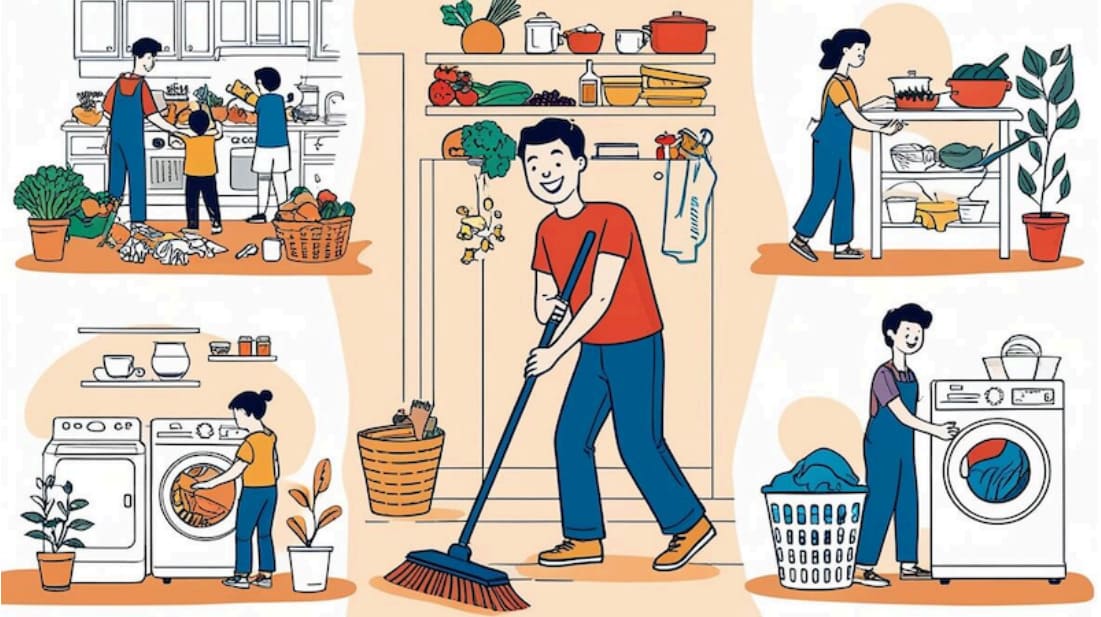
Time to talk about the everyday — household tasks. Unfortunately I have bad news: throughout this chapter I'll be criticising the importance and value of housework.
Let's go back to one of the opening chapters and recall where our time goes: sleep, work, and the roughly 8 hours left for ourselves and our families. But here's the catch: in that remaining time we keep spending it on cooking, cleaning and other household tasks. I didn't mention laundry on purpose — in the 21st century a washing machine isn't a luxury and it can save up to 95% of the time that used to go on washing. Still, even with vacuum cleaners and plenty of cooking gadgets, that time isn't much reduced when it comes to cooking and cleaning. A slow cooker won't peel or chop the onions, and a vacuum won't wipe dust off the cupboard. Of course these are the most common categories. In the countryside you can add chopping firewood, regularly fetching drinking water, clearing snow, feeding animals and plenty more.
If you've chosen to be a good homemaker for life, then there's nothing wrong with housework for you and you can skip this chapter. But the problem is that homemakers don't go down in history and usually don't leave any significant trace. And besides, I hardly know anyone who actually enjoys all of this. Everyone would rather do a hobby or at least work they love, not clear snow, fix the car in the garage, make soup or feed livestock. People do it not because they want to but because they have no other choice — no spare money to take the car to a garage, to buy ready-made food, to skip the homestead and buy farm produce instead of growing it themselves. Why people end up in that situation is for other chapters: early marriage, fears and prejudices, or a whole mix of issues. Here we only note that household tasks literally eat up people's personal time.
If you want to become successful or even great, you should definitely rethink your approach to housework. Nobody discusses whether Churchill was tidy or a slob, or how clean or dirty Pushkin's house was, or whether Lincoln was always perfectly shaved and trimmed. Or not. These people are known for other things: politics, writing — certainly not housework. The same will be true of you. Nobody will remember you as the person who cooked the perfect turkey (except maybe your very closest relatives), so it's time to rethink your approach to household tasks.
I'm not saying you shouldn't do housework at all. On the contrary, I regularly wash dishes by hand, mop the flat once a week, clean the bathroom when needed. I try not to let things slide and to shave and get my hair cut on time.
Does that mean you should drop all housework? Not at all. You should keep doing it. I'm only trying to help you do it more efficiently. And I'm not talking here about buying every automatic device — robot vacuum, dishwasher. We'll come back to chapters like "Time fragmentation" and "Fatigue".
Household tasks badly fragment your truly important tasks for the day and wedge themselves into your planned schedule. Try to avoid that and group housework together, preferably shifting it to the evening. Ideally, group it so you don't have to do it every day or every evening but at least every other day, or better still just 1–2 times a week on a set day, if you can. For me that day is Sunday. I've partly given up that day to housework and can do it even during the day. On other days when I need to do housework I try to do it in the evening, because that's when you're most tired and information from other tasks would be absorbed worse than during the day. If you need to spend the evening productively on something important, better sleep an hour or go for a walk in the park. Otherwise your uptake won't be 100%. That's why I recommend doing household tasks in the evening.
