
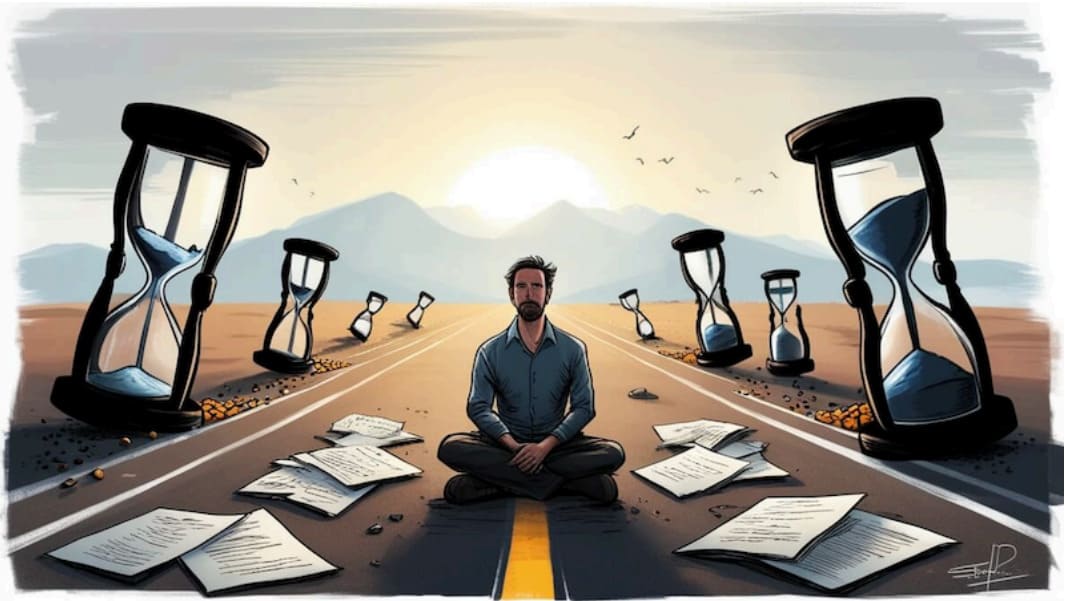
In the previous chapter, we figured out that human life is too short. I think this will give you a reason to think about how you spend your time and what you do in life. Continuing to reason about time, in this subsection we will deepen this topic and see what human life consists of.
So, the first thing it consists of is sleep. It's hardly a secret, but a person sleeps about a third of their life. There are 24 hours in a day, and a person needs about 8 hours of sleep for good well-being. Of course, some sleep less, some more — this is not so important. The main thing is that sleep takes up a significant amount of time.
Next. The second thing that takes our time is work, where we perform tasks for others, not for ourselves. Some work for the state, some for private companies. Usually this takes 8 hours a day, 5 days a week. Of course, there is shift work, after which there are more days off, but this is also not so important, because there are norms of working hours per month that a person should not exceed by law (at least, theoretically should not). Thus, our work also takes up a third of our time. Adding up the time allocated for sleep and work, we get ⅓ + ⅓ = ⅔ of our time going to these activities. This is terrible, but unfortunately, these are the harsh realities.
So, we have approximately ⅓ of time left — the remaining 33 percent — this is free time that we can use for something important, useful and interesting. During this time, you can engage in hobbies, visit or travel, finally, watch series and play games. And, of course, rest from work.

So, we have approximately the kind of diagram shown in the figure above. It is fairly conventional, since we have holidays and days off, and different people sleep different amounts. However, for the purposes of our average breakdown it is quite sufficient.
Time is the most valuable resource that a person has at their disposal. Yes, yes, it's time, not money, although we'll talk about the importance of money later.
To achieve our goals and life plans, we may not have enough of that one third of free time from work and sleep. To be honest, I myself use only one third of my time, although I could consider the possibility of increasing it to at least two thirds, but I'm not even close to being ready for this yet.
Now let's consider options for how we can increase our personal time. The first thing that comes to mind is to "borrow" time from sleep. Sleeping less can indeed help solve time shortage problems in the short term. You can try sleeping less for a couple of days, weeks, months, or even years. But then, most likely, you will develop some chronic disease or simply burn out. You cannot constantly borrow from sleep, and even for short periods I would not recommend disrupting your sleep schedule and "borrowing". Let me repeat an important point: when we "borrow" from sleep, we "borrow" from our health, and that is a different game altogether and far from pleasant.
There is another way to get time — this is work. In general, this is a complex issue for several reasons. When you are the owner of a well-organized and stable business, the need to devote 8 hours a day, 5 days a week to work practically disappears. In fact, you get rid of this point, and this third of time can be used for personal needs. Of course, not all time can be fully devoted to yourself, since from time to time you still need to immerse yourself in business and make sure that employees continue to work effectively. Bosses who are more involved in their companies' affairs certainly spend more time on work, but it is still less than the third of time that, say, an employee working for them spends.
Another way to reduce working time is to have passive income that brings money without the need to spend time on work. Human nature and competition are structured in such a way that people do not stop at what has been achieved and strive to earn even more. However, in some cases, you can be content with a stable income without racing and growth. In essence, company bosses can also partly be seen as having passive income in the form of profit from the work of employees who work to preserve and grow the company's means.
Summing up the analysis of working time, we seem to conclude that there are no ways to get rid of this third of time — unless, of course, you are a company owner who can afford a more flexible schedule with less focus on work. And that is indeed the case. I have bad news for you: if you are an ordinary worker employed by someone or the state, you have practically no way to optimize this part of your time. Nevertheless, I will try to highlight where working time can be saved.
- Commuting to and from work. Overall this does not directly relate to working time, but it is still work-related. As someone who has worked exclusively remotely for the last seven years, I can say it saves me 1–1.5 hours a day, 5–7.5 hours a week, 20–30 hours a month and 220–330 hours a year. Impressive, isn't it? Try switching to remote work if you have that option.
- Automation of processes and tasks. This point is not for everyone, and I have to admit that in my job there are not that many tasks that can be automated. Still, I should mention it, as it may help some of you free up a lot of time.
- Rise to a managerial position. This is a rather odd piece of advice, given that from all sides I hear: the higher the position, the more irresponsibly people behave at work and the less they work. This may apply first and foremost to state-owned companies, but given the volume of work and projects in my job, as a fairly influential person and manager I cannot afford to relax and do nothing. First, transparency of processes will make itself felt. Second, not everyone is comfortable with this from an ethical and moral standpoint. Third, along with freedom comes great responsibility for projects and subordinates. So in such conditions you not only cannot work less, but you also try to always be on call in case of emergencies. The only major plus of a managerial position that I still feel is the ability to delegate boring work to someone on the team, as well as the freedom to choose the technologies you want to use in projects.
So, we have found that you cannot "borrow" from sleep, and that there are effectively no ways to save on work. For achieving our goals and tasks, there is still one third of our time left — this is personal time. It is about the rational and correct use of this time that will be discussed in the rest of the book. We will try to squeeze the maximum out of it without depression and strong tension. Although in some places you will still have to strain.
