
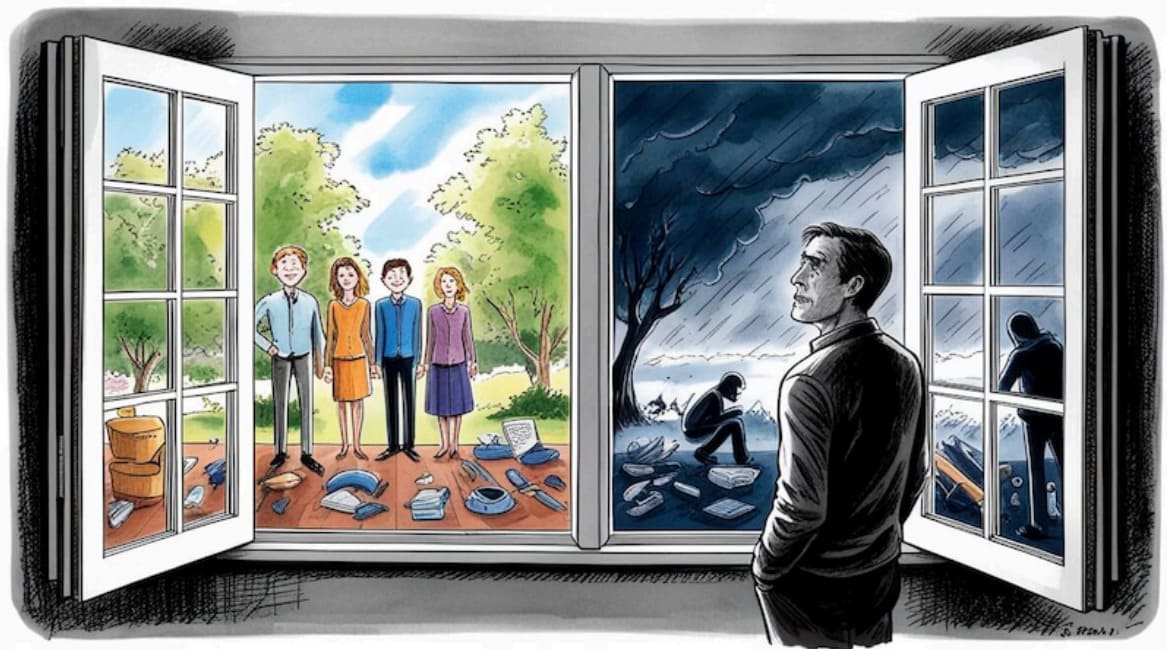
As we go through life, we constantly face choices and decisions. Sometimes the choice seems obvious; sometimes we take time to think through which option seems most right or beneficial. Whether the choice is simple or complex, we lean on our own life experience and the experience of people close to us. We learn from our own mistakes sometimes, and sometimes from others', and in the end we form a certain life experience that we use, as we see it, to choose the better option in similar situations. The problem is that life is not an exact science where everything can be calculated and the right decision chosen for certain. Of course, we could turn to physics as an exact science and say that our future is predetermined — that if we could feed into a supercomputer every particle in the universe, their past and present positions, spins and all other properties, we could simulate the future and thus predict it and choose the optimal path. But obviously no such computer exists, and we don't have the capacity to build one, just as Laplace's demon doesn't exist — a being that, knowing the state and position of every particle at any time, could predict your future. So whenever we choose for ourselves, we always have to pick one of several options. And that choice will be based purely on our past choices and on the experience of our circle: family, friends, colleagues — everyone we interact with. And if the problem is very personal, we're likely to choose from an even smaller set of options — only from our own experience or at most that of the people closest to us.
By repeatedly choosing certain options, we become more likely to choose the same again in the future — unless that option turns out to be a failure. It's entirely understandable why we keep choosing the same options in similar situations even when they don't bring the greatest benefit. Human psychology works that way: for our own safety (or our family's) we usually choose the option with the least risk — one we've already chosen before or one our parents or close friends chose. So we form a prejudice that our choice is the right one and that everyone should act the same way.
There are many kinds of prejudice. Some are imposed on us from childhood; others we impose on ourselves as we age. Jokes about "Johnny" or internet memes about "Dave" seem to write off the intellectual abilities of people with those names. Racial discrimination was long embedded in many people's minds so that one nation or people was presented as superior to another, even though biologically the intellectual and physical traits of such groups are on average the same.
But the strangest prejudice to me is the one tied to age. It's terrible that older people have convinced themselves that they somehow understand life better, have more experience, and therefore have the right to impose their prejudices. To dispel this myth, consider two numbers: first, how many people live on Earth; second, the age of the Earth. For greater precision, let's even reduce the second to the age when life appeared, or better yet, when intelligent life appeared. Take two people: one 40, the other 80. The second has lived twice as long as the first and therefore, in his view, has more life experience that he feels entitled to impose on others. About 8 billion people live on Earth, and in forming their life experience and thus their prejudices, the average person is guided by the experience of their acquaintances and friends — as a rule, at most about 100 people. 100 out of 8 billion is a vanishingly small share — about 0.00000125%. So his experience against all possible experiences is practically zero. As I wrote earlier in the chapter on choosing the right environment, it may be that all 100 — the relatives and acquaintances on whom his prejudices are built — are from the first or second group, the ones we shouldn't take as a model. So the life experience and prejudices of such people are likely badly distorted and out of line with current norms. We've looked at prejudices based on family, friends, acquaintances and colleagues; but there's another parameter I only mentioned in passing. Recall one of the opening chapters about the age of the Earth and when intelligent life arose. Remember the "clock" in the illustration? On that scale, an 80-year-old was born only a couple of milliseconds earlier than a 40-year-old. 80 years against the time since intelligent life appeared on Earth — 200,000 years — is 0.04% (and against the age of the whole universe it's 0.00000058%). That's the life experience of an 80-year-old on Earth who in their lifetime has interacted with 0.00000125% of the people on the planet. Very small numbers, aren't they?
Prejudices are like an extremely stubborn substance superglued to your brain. They always get in the way of decision-making. I'm not saying that decisions based on our prejudices are necessarily wrong, but they can certainly be less than optimal. Had we chosen differently in life, we might still have reached our goals but done it faster. You may have seen the image online of a geometric shape that casts different shadows. Which shadow you get depends on which side you look from. If you stand on one side, you only ever see one shadow and will argue to the death that your answer is correct. But as that picture shows, that's often not the case: you may be only partly right, half right, or plain wrong.

Over the past few pages I've tried to convince you that relying only on your own prejudices when making decisions is wrong, and that your life experience can safely be multiplied by zero, since it's built on a tiny sample and a tiny span of time. Does that mean you should reject your life experience entirely and flip a coin at every choice? Actually, no. Often your personal experience, especially in your professional field, really is greater than that of many advisers, and maybe in life too. You will always have to decide for yourself how to act; I'll just suggest three small tips that I hope will help you make more balanced decisions.
1) In any argument or decision, allow and consider the thought: "What if I'm wrong?" Because of overconfidence, most people never even ask themselves this, though it's always useful to have something to weigh against your own view.
2) I read a lot of books and hardly any novels or fiction; I prefer professional and scientific literature and, of course, autobiographies. Why do people read that kind of thing? Some say to get smarter, others to get to know someone's work — but that's not the full answer. Sure, I find it interesting, but when I read books about experiments on oneself or simply about someone's life, I'm adding that person's life experience to my own store. Remember, I said that the average person is in close contact with at most about 100 people and bases their decisions and views on theirs too. Autobiographies are a great way to study someone's life and take something valuable from it. Such books are usually about worthy, strong and intelligent people, so their experience is far more valuable and sound than the average person's. Unfortunately, I can't really count novels and similar fiction as life experience, since the characters and fates there are usually made up.
3) Look to people who have already achieved something, especially if they did it quickly. We want to live a happy life and build it so that we get pleasure from it. But we also have to admit that often life boils down to material things: your own flat, a car, money in the end. Yes, we can add children, though some families barely raise theirs and leave them to the mercy of life — so we certainly shouldn't take them as a model. Still, the saying "Build a house, raise a child, plant a tree" is true to some extent, and I tend to agree that this is the average life goal for most people. People reach these things at different ages. Some have their own flat, or more than one in the capital, by 30 (if I don't praise myself, no one will), while others at 50 still rent in small towns. Probably both had getting a flat among their goals, but some have already reached it and others are still on the way — if they haven't given up. So we're back to efficiency. Whoever achieved these things was more effective than those who did much later or haven't yet. So their life experience and the decisions they made are more effective and more correct. I'm not downplaying luck — there's a whole chapter on it — but you can't get far on luck alone. So when you can, look to more successful people, read and study their biographies to see what decisions they made in different situations.
To sum up: most of the decisions we make every day, from small everyday matters to important ones at work, are based on personal prejudices. No doubt some of them are correct, but another part is likely wrong at the core. You can be an expert in financial markets but a bad father, and because of the first set of prejudices you'll assume the second set is right too. Always allow that you might be wrong about something. Don't be afraid to give up your prejudices in favour of other views.
