
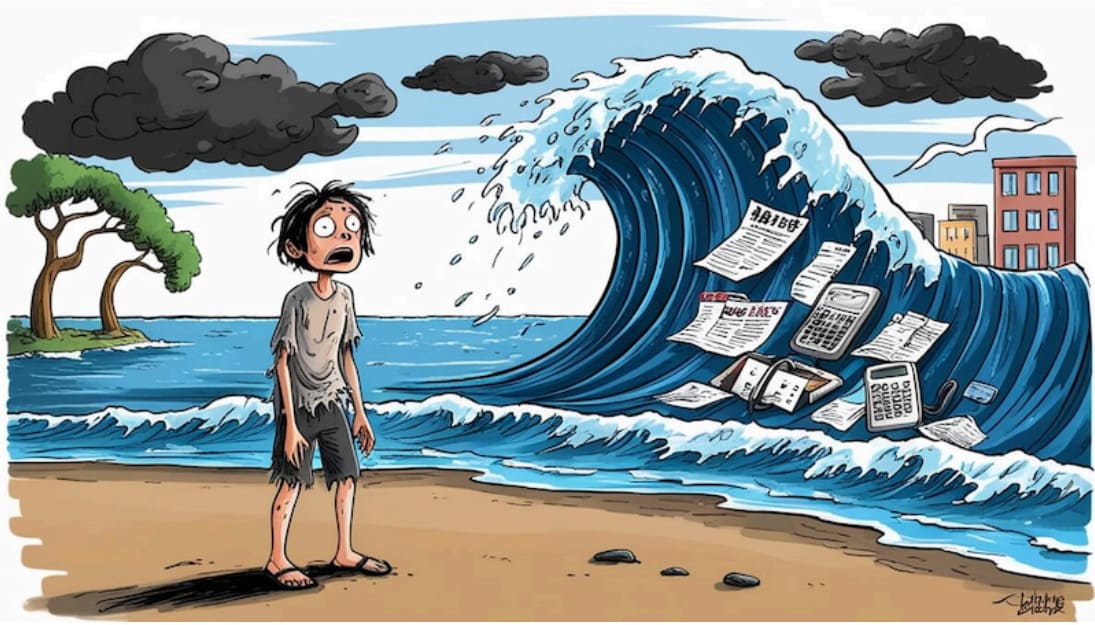
Do you believe in black streaks? Not the marks left on the floor by your shoes — the real ones in life. Do I believe in them? It's a tricky question, and I even wrote a whole blog post about it. Back then I concluded that there are no black streaks as such, but there are convergences of situations where all your problems activate at once. For that to happen, a lot has to align. In my whole life I can recall perhaps two "black streaks." I wrote about one in that post. I had trouble with the bank and it froze about $10,000 until I provided the right documents; my car broke down and I couldn't even start it to get to the garage; and one day, when I was still renting, the neighbours flooded my flat near the sockets and I had to cut the power to the whole place. So at one point I was left without a car, without money, and without electricity. Gradually it all got sorted. The sockets dried out, I got the car to the garage, and the bank sorted things out too. None of it might have happened if I hadn't ignored the signs that pointed to these problems. The bank had rung me repeatedly before that, but I often left my work phone at home when I went out, or simply didn't answer unknown numbers, which led the bank to take the ultimate step: freezing my accounts. The car was basically old by then, and there had been signs and warning knocks that it needed repair. With the neighbours, of course, you can't know in advance when they'll flood you — but agree, without the other problems, that one alone would have seemed a minor nuisance.

The second black streak, if you can call it that, happened oddly enough this very year, in March. About five or six problems piled up and came to a head at the same time. Most of them were problems I knew well and could have expected — I just hadn't expected them all in one month.
It doesn't matter whether you call these black streaks or just a bunch of half-finished problems that happened to catch up with you at the same time. Of course some problems are random and impossible to foresee, but half of them are likely tasks done poorly or old problems completely ignored. Don't be surprised when, on the way to pick up your child from nursery — who got sick because it's been too cold in your flat for weeks — the suspension goes on the car that's been knocking for weeks, and you can't even call for a tow because your phone died and you've been meaning to replace it or at least the battery for two months. That's a perfectly plausible situation with perfectly plausible and, above all, foreseeable factors — factors that in other circumstances either didn't show up or showed up one by one. And on top of foreseeable problems you can get spontaneous ones: terrible weather, a minor crash, or anything else.
The events above — the child, the phone, the suspension — are made up but they show how easily your situation can be destabilised when you're trying to keep everything under control 24/7, 365 days a year. These "black streaks" are a bit like being laid low by illness: they knock you off your track and your plans and force you to drop things and adapt to a rotten situation. But why let it happen if it could have been avoided? Pay proper attention to each problem, or at least to half of them, and the situation won't look so bad.
Besides eating up a lot of your time and possibly money, this kind of situation also takes a psychological toll. People react differently. Some sink into depression and ask why this had to happen to them now; others, sensing trouble, switch into extreme-thinking mode and try to brainstorm all sorts of solutions — and many succeed and turn the situation to their advantage. What's more, the same person can react very differently to black streaks at different times in life: in one case fall into depression, in another draw lessons and move on quickly. Black streaks are unpleasant and I'd rather avoid them. They don't throw me far off my intended route, but they do demand extra energy to deal with the problems on top of everything else. So to close this chapter I'll repeat the main point: don't neglect problems that may come up later. Do your best to do well everything you take on, and don't put it off. A partial fix is usually not a fix but a postponement. And no problem will ask you when it's most convenient for you to close it. Either you control it and close it, or it will come back later — with friends: other problems.
