
Superstitions and religion always go hand in hand. I described part of this in the previous chapter. You could write a whole chapter on religious superstitions — for example that you can't work on some Orthodox holiday while Catholics and Muslims can do whatever they like that day, even though everyone says God is one for all. In this chapter we'll talk about superstitions in general: everyday ones, astrological ones and many others.
To be honest, there are so many thoughts I'd like to put in this chapter that I can hardly lay them all out, let alone structure them properly. And anyway, how do you structure human foolishness? There are people, for example, who believe that lots of suicides happen at full moon and that the full moon somehow mysteriously affects people. The explanation is quite simple: when a suicide happens on another day, when there's no full moon in the sky, nobody notices whether the moon is small or half — it doesn't catch the eye. Even if suicides are mass, nobody thinks of the moon. But as soon as such a case happens at full moon, people immediately look for patterns and connections. The first thing they notice is the bright moon. The absurdity is that everyone will say "The suicide happened at full moon, so the moon must have affected the person" — but nobody will say that in the previous hundred full moons everyone stayed alive and healthy and nothing strange happened. People never notice the ordinary norm; they always notice the extremes.
A second strange and at the same time common superstition I've come across is that a person's date of birth somehow affects their fate. I described this astrology example in more detail in the section on pseudoscience, but I had to mention it here too. The most interesting observation I can make from my own notes: having been subscribed for a long time to female acquaintances from school, college and university, I've noticed that those who believe in astrology and zodiac compatibility are the only ones who are still single among my friends and acquaintances. I'm sure you have such people among yours too.
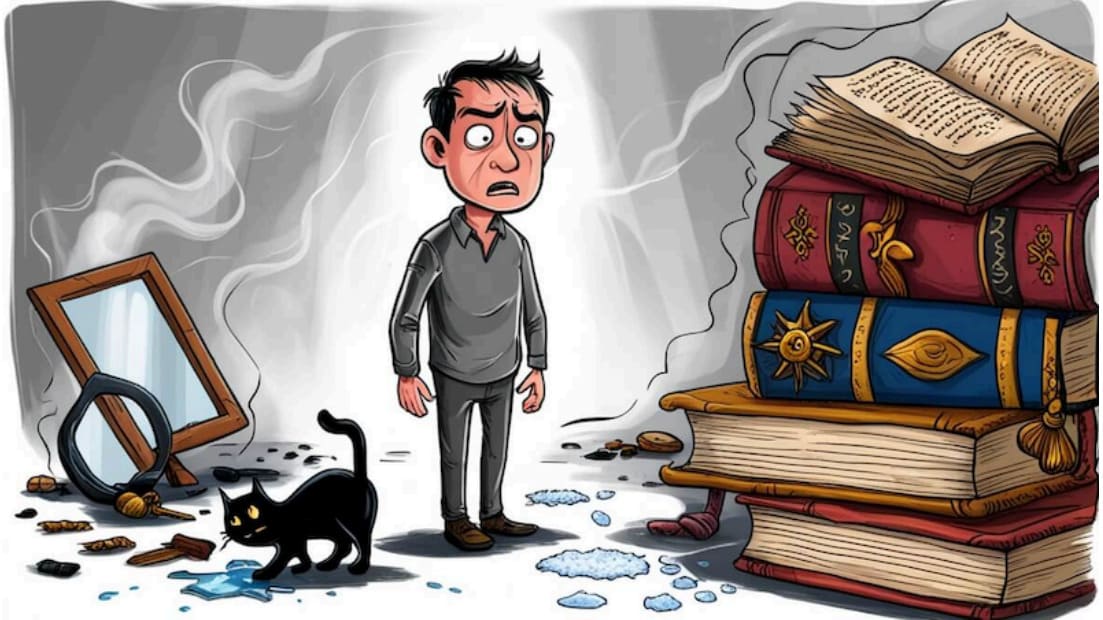
Everyday superstitions are a special kind of distortion: sitting on the corner of the table before you're married, throwing away breadcrumbs, spilling salt, letting the cat go in first when you move in, several knives on the table, crossing the road with empty buckets, a black cat and much else. Can anyone who believes in them (a) remember anything that happened to them or their loved ones when they once didn't follow the superstition, and (b) explain from a scientific point of view how any of this could actually affect anyone?
Why are superstitions still everywhere and why do so many people believe in them? I think there are several reasons. First, they've come down to us from our grandparents, and to them from their grandparents, and so on almost to infinity. Grandparents are supposed to be respected and their opinion taken as true, their life experience as the only right one. Never mind that they have three or four years of schooling and haven't read a single science book or heard about experiments in the last 40 years. Second, the lack of proper modern education, especially with a science bent — that's a problem not only for grandparents but even for the modern generation, our parents and children. Combined with the first factor this has a reinforcing effect. And from "first" and "second" comes "third" — fear. Fear that if I don't follow these superstitions something bad will happen to me or my loved ones. It's even worse when superstitions get "confirmed" by some real example — that is, coincidences. Remember the suicide at full moon example? So a careful grandmother will say that one of her sons always sat on the corner of the table and still isn't married — but she probably won't mention that the other three sons who also sat there are long since married. Or she'll say that a girl a black cat crossed in front of nearly got run over — but she won't tell you about a real accident she witnessed where there was no black cat nearby.
I probably wouldn't notice superstitions or write this section if it weren't for one "but". Unfortunately superstitions are so deeply rooted in our lives that they can completely wreck our plans. In the chapter "Be able to say no" I wrote that you shouldn't let other people create your plans. Here I'll continue that thought: don't let superstitions wreck your plans.
