
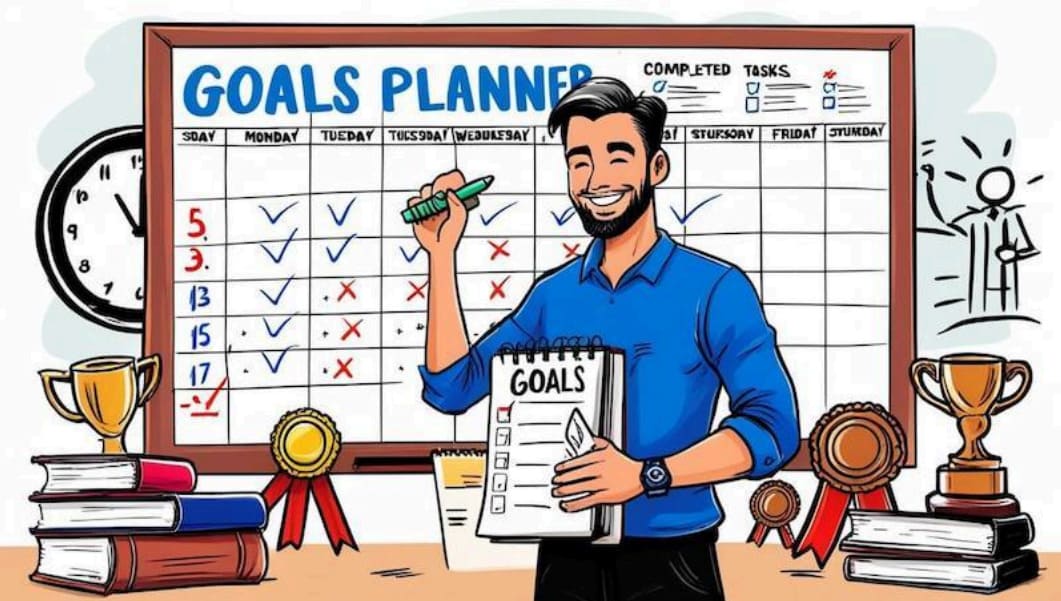
So, this is the most important habit from the previous chapter. It could of course be singled out as a subchapter among other habits, such as visualisation, public contract and other important aspects I spoke about in the section on habits. But these things deserve separate attention.
Roughly speaking, the essence of my productivity method, which I will describe in the second book, consists of two stages: 1) define your goals, writing them down in detail; 2) follow the plan strictly, constantly checking what you have done against what you planned.
For now let's abstract from what exactly you need. Say you already have step one: you have drawn it up yourself or with someone's help. Say you have a list of 20–30 tasks for the week, or you have gone further and written down exactly what to do on specific days. This list sits somewhere to the side and lives its own life, and you — yours. Who said that by writing tasks on paper or in an electronic medium (for example, a notes app or calendar), you will definitely do them? Nobody! Most likely you will forget about this list. At best, if you use an electronic calendar, you will get reminders that it's time to tackle the planned task. But it's not always possible to do that task at the scheduled time, and you simply postpone it or, worse, forget it.
You need a regular check of what you have done during the day. For this to happen on a constant basis, you need to make it a habit. As soon as you unlock your phone, if you let your brain launch any app, it will immediately open your most frequent social networks and messengers. If you don't believe it, shuffle the icons on your home screen — and you will see how for another week after changing the usual icon layout you will still reach for exactly that corner where the icon of this or that messenger was. You need to develop the same habit with your task list. It is to this that you should turn first when you unlock your phone screen. This should become an automatic action. If you spend more time at the computer than on the phone (like me), then the task list should be on the computer. Ideally, all of this should be synced across devices and kept in one place. We will talk about the importance of keeping everything in one place in a separate chapter below.
I won't give an exact number of how many times you should look at your daily task list, but it should clearly be more than 1 or 2 times a day. The most useless advice I've heard in this area went roughly like this: "Make a task list for tomorrow before bed, and in the morning, when you wake up, read it and do the tasks. In the evening check what you've done and plan tasks for the next day." This practice is ineffective for two reasons:
1) First, where is the guarantee that the task list you make is important to you? Most likely it is detached from the context and the overall goal you are trying to achieve, and in the end you will spend time on non-essential and possibly non-urgent tasks. Goals are formed once, and then they should be written out so that you know in advance what and when you will do. And tasks planned from evening for the next day don't take you anywhere and don't move you forward. Yes, you will do them, and well done, but were these really the tasks you needed? Most likely not. By the way, we will talk about classifying tasks, their importance and urgency in another chapter.
2) Second, the "morning-evening" approach, where you check in the morning and evening, has a serious drawback. A whole day passes between these events. In the morning you looked at and "approved" this list, but by evening anything can happen: many spontaneous and important unplanned tasks and calls, trips to the shops, conversations with colleagues or relatives. In this mode any person will forget some of their tasks, or even all of them. So we can conclude that the "morning-evening" mode definitely doesn't work, and you need to check your tasks much more often. How much more often? As often as your circumstances allow. Some can check every hour, others — only every 4–5 hours. That's already better than morning-evening or nothing at all.
Say you work it out and lunch time suits you. During lunch you have no chance to do personal tasks, but you can simply open the list and reread it. While you eat, your brain will mull over what you read and may suggest a solution to this or that problem or a better approach for some task. Going for a shower? Similarly, read the task list, and your brain will keep working on it. The shower and bath are great places to rest and reset your thoughts about your tasks. And, as you may have guessed, there will be a separate section on this below too, though it will be called slightly differently and will be more about idleness.
If you're interested in how often I myself check my daily tasks, I can share that. From early morning I usually don't give time to my personal goals, because however early I get up, at that time the office is already in full swing and my thoughts are more about work. In finance there is the principle "pay yourself first", and I think it can be applied to personal life too. But I have never used it, and in the morning my priority is always work and going through messages from colleagues. Next, as I said, my acquaintance with the task list begins closer to lunch, when I go to eat. Though "acquaintance" isn't quite the right word, since the planned tasks are usually a daily routine that leads me step by step towards my goals. So I'm well acquainted with the tasks for the day, they're almost always in my head. And yes, there will be a separate chapter on the importance of routine and how to perceive it.
The main part of doing (and checking) my weekly tasks begins at the end of the working day. One of my advantages is that I like my job, I don't get tired at it, so I can switch straight to personal tasks. I do some tasks through the evening and check the list every 1–2 hours. Before bed, of course, I don't deny myself the pleasure of opening the task list for tomorrow once more — just in case my brain comes up with some solution that will let me do tomorrow's tasks faster or better. At weekends the checking mode differs from weekdays: from early morning I'm full of resolve to "eat the frogs" and do everything planned, finish off any tails from the week if there are any, so at weekends I check perhaps 7–10 times a day.
Daily review of your tasks and the day's work is a fundamental part of the whole planning process. Think about your goals as much as you can. Check your planned tasks at least 3–4 times a day. What's more, from time to time it's important to check your planned tasks for the week and month, but that doesn't need to be so frequent, so we'll talk about the regularity of that check in the second book.
To end the chapter I'd like to quote a paragraph from the book "The Frog, the Elephant and the Broccoli. How to live and how not to" by Alexey Markov, with which I fully agree:
The best in their field always know what matters now. Do you know what their priority is? Setting priorities. So they always do what matters most. Any other action means they've been distracted.
