
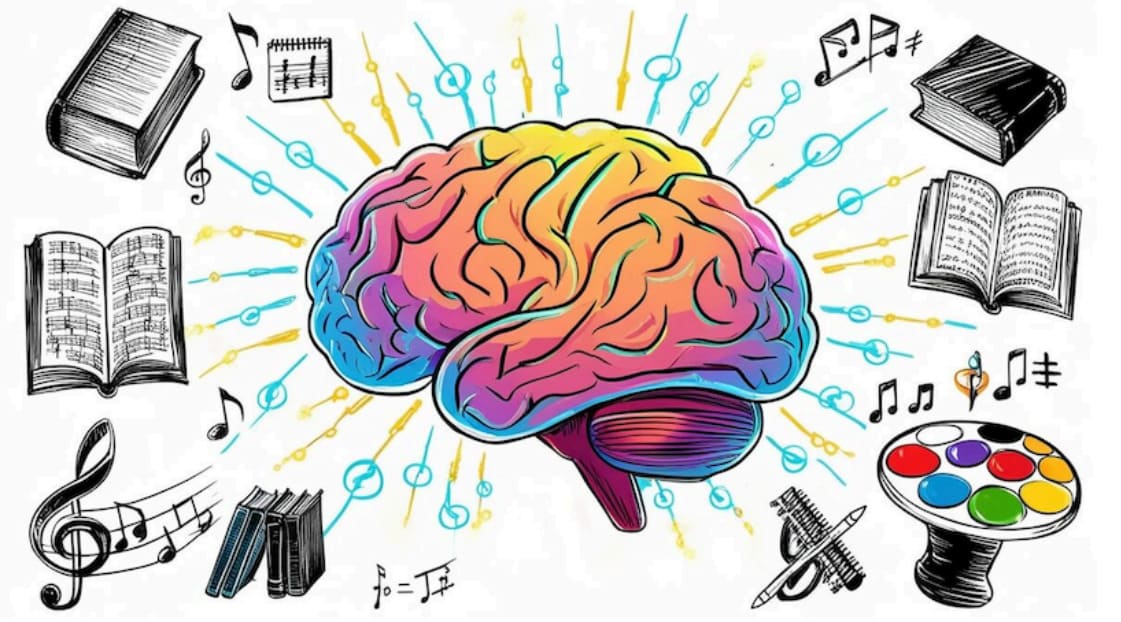
I originally assigned the text of this chapter to the topic of thinking, but in the end I decided to put it in a separate chapter for two reasons. First, the previous chapter had already drawn certain conclusions. Second, although thinking and intelligence are closely related and complementary concepts, they are not quite the same. Intelligence can be seen as the capacity for thinking, while thinking is the active process in which intelligence is put to use. So it might even have been more logical to place this short chapter before the topic of thinking.
In this chapter I would like to talk about the terms general intelligence and practical intelligence. To briefly explain what they are and where they come from, I think a quote from Malcolm Gladwell's book "Outliers: The Story of Success" works very well:
"Where does practical intelligence come from? We can trace the origins of analytical intelligence. It is determined—at least in part—by genes. Chris Langan started speaking at six months. He taught himself to read at three. He was born smart. IQ is a measure of innate ability. But practical intelligence is knowledge, or rather know-how, that has to be acquired. It has to be shaped by external influence, and that influence usually comes from the family."
And it is no less important to quote the author's conclusion:
"In scientific terms, general intelligence and practical intelligence are orthogonal to each other: having one does not imply having the other. You can have analytical intelligence without practical intelligence, and vice versa. Or, if you're lucky like Robert Oppenheimer, you can have both."
As a further note, the author of the book compares Chris Langan (one of the highest IQs on the planet) and Robert Oppenheimer (yes, the one Christopher Nolan recently made a film about—the American genius and martyr, our counterpart to Sergei Korolev. I find the lives and work of both Korolev and Oppenheimer very interesting, and I do consider them among the greatest scientists of their time) over several chapters. So: Chris Langan had an exceptionally high IQ. That made him famous and he gives interviews from time to time, but he has not contributed to the development of physics or any other science, unlike Robert Oppenheimer.
Continuing Malcolm Gladwell's line of thought, it is important to remember that general intelligence and practical intelligence often do not correlate at all. You can be an expert in one area yet clumsy at basic tasks and in dealing with colleagues or friends. Moreover, we can go further and note that even within a given type of thinking we can distinguish subcategories and subtypes. For example, training and memorising long sequences of numbers—dozens or even hundreds—does not improve your intellectual abilities in neighbouring categories of thinking. The average person can hold about 7 numbers in mind, while research records reach dozens or even hundreds. Yet when experiment participants were asked to switch from numbers to letters, their outstanding performance disappeared—they scored around average. Those people had trained only on numbers, and working with letters was a completely different task for them.
Another example is chess players who can hold whole games in their head and play virtually without a board. But as soon as you replace chess with another task and ask them to memorise something else, their results become average. So merely solving detective puzzles is unlikely to add much to a person's analytical, let alone critical, thinking. Writing with the left hand (I do practise this regularly myself) is unlikely to develop any ability in me beyond that specific one. For any type of thinking to develop in a meaningful way, you need to train across all the relevant subcategories that belong to that type. Only then might thinking gradually begin to develop.
