
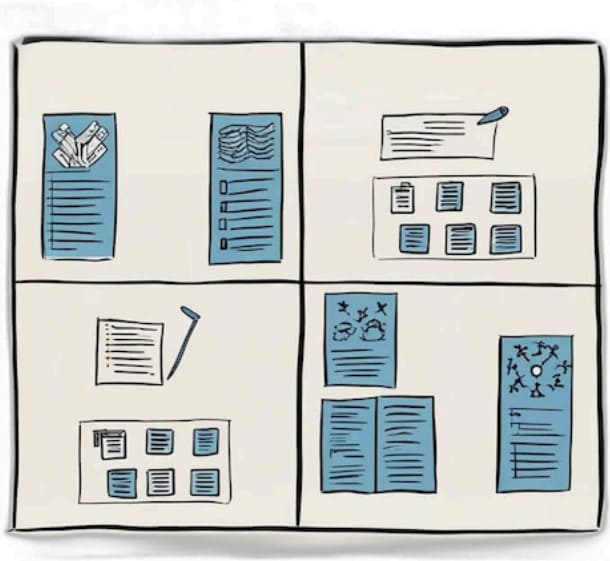
The Eisenhower Matrix is another useful planning tool. It's quite simple and easy to apply. They say this matrix was invented by US Army General and 34th US President Dwight Eisenhower. Whether that's true or not — it doesn't really matter, but whoever came up with this principle, in any case it deserves to be covered in productivity textbooks.
You rarely meet a person who has only one goal in life. As a rule, everyone is ambitious, everyone wants everything at once. But you can't get everything at once. We're all limited in time, and most of us are also limited in money. We all always have many goals, tasks and simply things to do. Although, of course, I've met people who, out of boredom and not knowing what to do, suggested themselves to start watching some series or other. I sincerely feel sorry for such people, but I'm not talking about them now. For most people, as a rule, life is boiling: everyone is rushing somewhere, everyone has a million things to do. In principle, there's nothing wrong with that: life is short, so you need to manage both to rest and to work well. So how do we then choose the most needed from our million things? The Eisenhower Matrix comes to help with this.
The Eisenhower Matrix is a 2 by 2 table. An example of such a matrix can be seen in the figure below.

Generally speaking, the form doesn't necessarily have to be tabular. The main thing is to distinguish 4 groups:
- Urgent and important tasks
- Urgent and unimportant tasks
- Not urgent and important tasks
- Not urgent and unimportant tasks
When working with this matrix there are two pieces of news. One good, one bad. The good one is that you can (and, ideally, should) classify all your tasks and goals according to this matrix. This will help you remove "noise", for example, unimportant and non-urgent tasks, and concentrate first of all on important and urgent ones. The bad news is that no one will do this classification for you, and you'll have to do it yourself at your own discretion. If you have experience in assessing the importance and urgency of tasks (though I don't think it's very difficult), there shouldn't be any problems with this. However, if you have no experience and find it hard to classify your affairs, you'll most likely put them in the wrong groups, and as a result you'll be doing the wrong tasks, spending time where it's not needed.
When classifying tasks, always ask yourself various questions: "Do I need to do this task at all?", "What will happen if I don't do it?", "Can I postpone it for later?" If it's not about your personal life but work, you can also add other questions, such as: "Is it worth involving someone else for prioritisation and asking for an alternative opinion?", "Can I delegate the task to someone?"
Most people choose urgent, not important tasks, so it's extremely important for you not to deceive yourself and do truly important tasks. And, of course, first of all — important and urgent. I hope that when thinking about this or that task, you'll now keep the Eisenhower Matrix in mind, assign it to one of the four groups and, based on that, make decisions regarding this task.
