
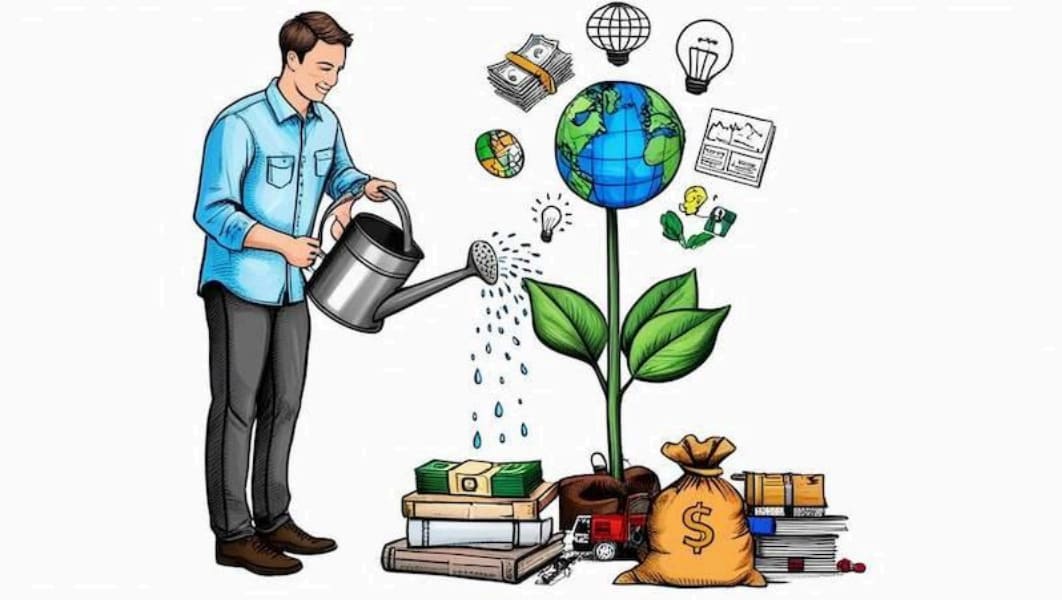
So, get ready: this chapter will be long. There is one good reason I decided to make it so — habits have a huge influence on our lives. If you think the chapter has turned out long, I'll remind you of James Clear, the author of "Atomic Habits. How to Build Good Habits and Break Bad Ones". That book is really good, and from time to time I will borrow ideas from it.
If you want your life to change for the better and become more effective and productive, habits are the first thing you should look at in yourself. You can ignore some other points in this book about slowing or favourable factors, but not habits. To make it easier for you to follow the structure of this chapter, I will first describe in broad terms what habits are, then talk about bad and good habits. In each of these groups I will explain in detail why you should get rid of some habits and acquire others, and most importantly — how to do it. So, let's go.
Throughout the day a person does many different things. These include daily repeated actions such as brushing teeth, washing, going to work, watching TV and working out, as well as rarer one-off things — for example, speaking at meetings, trips to relatives in another country, deep-cleaning the flat and so on. Some things are done easily and without a second thought, others cause a lot of anxiety, difficulty and inner resistance. We don't spend much physical or mental effort on the things we do every day and are already used to. We just take them and do them, often quite calmly and even without emotion, thereby saving our resources. In essence, all of this is our habits. Some of them we picked up by chance (for example, always eating at the computer), others we took from our parents (swearing) or, copying classmates, started using filler words. From earlier chapters we know that the environment we grew up in has a huge influence and imposes certain habits on us.
When people say "habit" they usually mean bad habits. We've often heard "bad habits", meaning for example drinking and smoking. In fact smoking and alcohol are only the tip of the iceberg of a person's bad habits. Yes, they affect health, but in this book we more often talk not about health but about time. About how precious it is to us and how short our lives are. Of course alcohol and smoking shorten an already short lifespan. What's more, my grandfather died of cancer that he developed after smoking all his life, but at least he lived to 70. In the world of bad habits there are even more destructive ones than smoking and alcohol — habits linked to wasting our precious time. Social networks, series, computer games and television are the main drug of our time. They sometimes take 5–7 or more hours a day, making us neither happier, nor smarter, nor more successful.
Note that I did not put the internet on this list as a separate item. The internet as a whole, when used properly, can do people good. All the world's knowledge is stored on the internet. You can also quickly order food, buy tickets for the train you need without going to the station or to a shop. With moderate use the internet can become a powerful helper. What's more, for many people work — the way they earn a living — is directly tied to the internet. So there's nothing wrong with the internet in itself; the main thing is that you know how to use it.
Coming back to our main time-wasters: series, games, social networks and television — imagine how much time you would free up for something more useful if you stopped doing them. For example for travel, visits to family, walks (I'll write about their importance later) or simply for work. Of course many people see games and series as a way to relax after work. But if you spend your personal time resting that way, I would rather recommend that you change to a job that leaves you less tired, or at least one after which you wouldn't want to spend your personal time on that kind of rest.
In principle I might not see anything wrong with television or series if it weren't for the fact that many people intellectually degrade because of them. Or at least stop developing. What doesn't grow rusts. If that scenario suits you, carry on as you are.
I still hope that since you've picked up this book, you're ready to change. And that means you'll have to give up bad habits. This is the right time to turn to James Clear and his method. He has several rules both for getting rid of bad habits and for forming good ones. Since we're looking at bad habits and trying to get rid of them, here are his recommendations in brief. It's easier to give up a habit if:
- The behaviour requires effort. For example with the TV, move the remote to another room so that when you're on the sofa you have to make an effort to turn the TV on. For social networks you can log out every time so that when you want to read your feed you have to enter your login and password again. All these actions require extra effort from you, so not every time your brain wants to watch TV or go on social networks will you actually do it.
- It's invisible. Make an effort to make your bad habit less visible. If your phone is always in sight, you may reach for it more often. Try putting it somewhere less obvious. In the book the author goes further and suggests putting the TV away in a cupboard. That's a radical approach, but it might work for some.
- It's unattractive. Highlight the benefits of giving up the bad habit so that it seems unattractive. Remember how harmful smoking is and that it slowly kills you from within.
- It's difficult. If certain actions are too hard for you, you won't be able to do them. Increase the number of steps between you and the bad habit.
- It doesn't give you pleasure. Make it so the bad habit doesn't give you pleasure. Try making a public contract with someone. You can read about what that is in one of the chapters below.
To become a more successful version of yourself you will certainly need new habits. Which ones exactly you'll decide for yourself based on your goals, though I'll present one main one at the end of the chapter.
Now let's turn again to James Clear and look at his recommendations for building good habits. A habit will become part of your life faster if:
- It's obvious. Say you've decided to exercise more often. Put your sports kit or equipment in the most visible place so you always see it. Use concrete wording for the new habit: "I will [action] at [time] in [place]". Even better if you attach the new habit to an existing one, i.e. do it during (or right after) a habitual action. For example the author suggests learning one new word in a foreign language while brushing your teeth.
- It's attractive. Make the habit something you really want to do. Surround yourself with people for whom the behaviour you want is the norm, i.e. who already have that habit. Try to combine the pleasant with the useful by pairing something you want to do with something you need to do. As a last resort, think of a small ritual you'll do before the difficult habit.
- It's simple. Though in the original the advice is simply "make it easy". For example reduce the number of steps between you and the habit or don't tie it to a long time; limit yourself to two minutes at first.
- It's satisfying. Use a habit tracker or any other visualisation. I have a separate chapter below on the importance of visualisation. Another option is to use praise — there's a section on that below too. Say in the sport example, when you don't want to exercise, treat yourself to something nice after each workout. That could be temporary idle time with a game or series (though many allow themselves that without sport too) or putting 10 dollars aside into a personal account that you can spend on anything. Think of any reward that feels good after a workout. Make it a ritual: first the workout, then the reward.
It's very hard to change habits without changing the beliefs behind them. Throughout the book I stress how important it is to set goals. That's true, but in this chapter I'll focus not on goals but on habits. Goals always have an end point, and people often return to where they started after reaching them. Lose 10 kg? Okay, done. But what then? People relax and start putting the weight back on. Save a certain sum? Okay, done. But what then? They quickly spend it (hopefully on something worthwhile) and go on living as before in spendthrift mode. Complete an internet info-gypsy marathon? Okay, done. But what then? Life goes on as before the marathon. So it's better to set not goals but habits. Goals are reached and forgotten; habits stay.
Now a word on how many days it takes for a practised action to become a habit. For example Benjamin Franklin thought he couldn't master all 13 virtues (temperance, silence, order and others) if he gave only one week to each. Whether he ever mastered them I don't know. Even if he did, we're not Franklin and we probably need more time. On the internet and in productivity books you'll find all sorts of figures — from several weeks to several days. That's why so-called habit or wish marathons are often based on a 30-day calendar. After reading Clear's book it became clear to me that this is mostly nonsense, because first, different habits need different numbers of days, and second, you can shorten the time to adopt new habits or drop old ones a lot if you follow the author's rules: make the habit obvious (for good habits) / less obvious (for bad ones), make it easy (for good) / hard (for bad) and so on.
Did this book help me and did I adopt at least one habit using this method? I think so — I adopted at least one habit, clearly following the book's approach. At 30 I passed a small kidney stone, which I even wrote about on my blog. Don't worry, my kidney and I are fine and I've been to the doctor and had ultrasounds several times since. So one of the causes of the stone was not drinking enough water. Yes, I drink a lot of tea but almost no fizzy drinks so as not to harm my stomach and other organs. But you can't drink that much tea and coffee, and unfortunately I harmed my kidney. I didn't really like water: how can you like it? Tasteless liquid that's no pleasure to drink (unless you've just come home from a run). But anyway, since then I've been drinking water regularly and a lot. I made the habit obvious: I almost always have a cup of water on my desk. What's more, sometimes I drink water after washing my face in the morning, thus attaching the new habit to an old one.

Now let's draw the main conclusion of this chapter. What should you do? You should strongly try to get rid of bad habits such as watching TV, series, reading social networks and computer or mobile games. By getting rid of at least some of these bad habits you won't automatically become more productive or get closer to your goals. However, at least you will free up part of your time. To become more successful you'll need new good habits. Perhaps after reading this book or a book specifically on habits you'll take up several or even many good habits at once, but in reality to reach your goals you only need one. So I will ask of you just one single habit that should become part of your daily life. That habit is a daily check of your tasks against your written plan of goals, which we'll talk about both in this theoretical book and in the next practical one. It's thanks to this habit that I moved to a completely new level of planning and achieving goals.
