
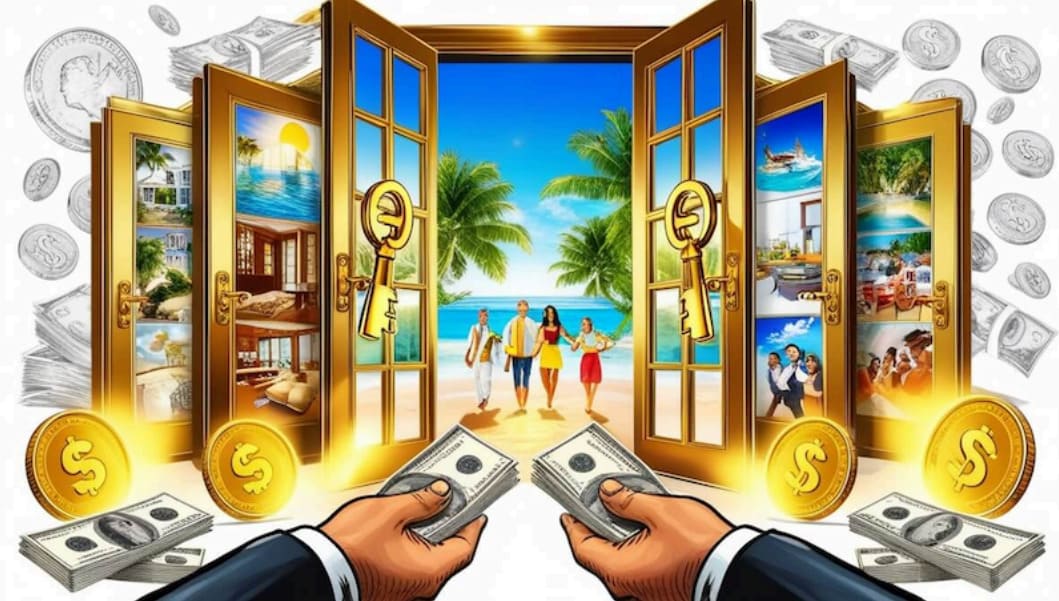
"Happiness isn't in money" — this is perhaps the most common phrase I've heard, and which is actually wrong. I've never heard this phrase from rich people. On the contrary, I've heard it and periodically hear it rather from poor people, who try to justify their current position in life with this phrase. Perhaps they even deeply believe it. But how can they check whether this phrase works or not when they've never been rich?
Of course, you can take the other extreme — a seriously ill rich person whose days are numbered. He'd gladly give away his entire fortune just to live longer and enjoy at least a simple life. However, in more standard and average situations money really does make you happier. Of course, not the banknotes themselves, but the opportunity to exchange them for something important and valuable that makes you happy: an unforgettable trip abroad, buying a new car or house, buying a PlayStation or at least a full subscription to some service that interests you.
In the practice section I'll show how to classify goals into two groups: those that require your time, and those that require your money. If among your money goals there's something you can buy right now, consider that you can achieve that goal already now, not in six months or a year. And that means you can set other goals and boldly move forward. The more money you have, the more money goals you can afford, the faster you'll achieve them. Of course, as your wallet grows your goals will grow too — there's no way around it, that's how humans are built, but there's nothing wrong with that. New goals appear that you strive for next. Imagine if it were the opposite: a person bought everything they wanted, and then their life would lose all meaning. Perhaps that's exactly how it is with the richest people on the planet: they have everything, but besides the desire to buy what they want, they're driven by other goals too. With fortunes like Musk's or Bezos's, billionaires strive to bring something completely new and breakthrough into our lives. They want to improve everyone's life and thereby go down in history. Improving someone's life is of course not free, since nothing is free, so you have to pay for their innovative developments. People pay, making them even richer, and they in turn receive money and can invest it again in something else. And so it goes round. Each of them already has everything anyone could dream of. Any of the richest billionaires could stop, but they don't. The mutually reinforcing desires to become even richer, go down in history and change humanity for the better push them to new goals.
Another plus of having money is that you can always invest it not only in physical things but also in further education, which is already a big plus for a person's growth as an individual.
Having money means the opportunity to take trips and travel. And that in turn is personal experience that will help in the future when comparing various indicators, for example where you want to live and whether life is the same everywhere. And of course, unforgettable emotions and memories.
When you have enough money not just for primary needs like food, clothing, basic education, you already think about multiplying money (well, at least you should, if your brains are pointed in the right direction).
You most likely don't have spare money right now. By spare I mean of course not 300 dollars you've saved over six months, but a significantly larger sum you could have. Although on the other hand, 300 dollars is already not bad. A lot also depends on how old you are, your social status, your education and much else. If you have an early marriage before 27–28, it will be significantly harder for you (I'll write more about early marriages later). Nevertheless, whoever you are, if you want to multiply your existing, albeit small, capital, you'll have to do at least two things:
- Rethink your approach to life, namely — income and expenses.
- Live more economically and restrained for some time (for example, several months a year).
I'll write more below about economy, money and squandering. As for rethinking, if I started describing everything needed here, it would take another 30–40 pages minimum. For rethinking your financial poverty I recommend reading the book "The Richest Man in Babylon". Briefly, the book is about getting rid of liabilities and acquiring assets. And of course, including about economy (saving 10% of your income), about the fact that a person must get their own housing, since paying rent is extremely unprofitable in the long term, about the fact that you need to pay yourself first, and only then others, and some other valuable advice.
There's another interesting thought I decided to include in the book as a quote. I first encountered it in the book "How a Good Developer Can Avoid Becoming a Bad Manager", and it goes like this:
That is, if a person from their salary of 100 thousand roubles spends 90 thousand on things they need, it's enough to raise their salary by just 10 thousand for them to feel twice as rich.
So think about how much you spend, how many times richer you want to be and, accordingly, how much you need for that.
Remember that if happiness isn't in money, it's certainly in the things and emotions you can acquire with that money. And the more money you have, the more opportunities and paths in life you can open for yourself.
