
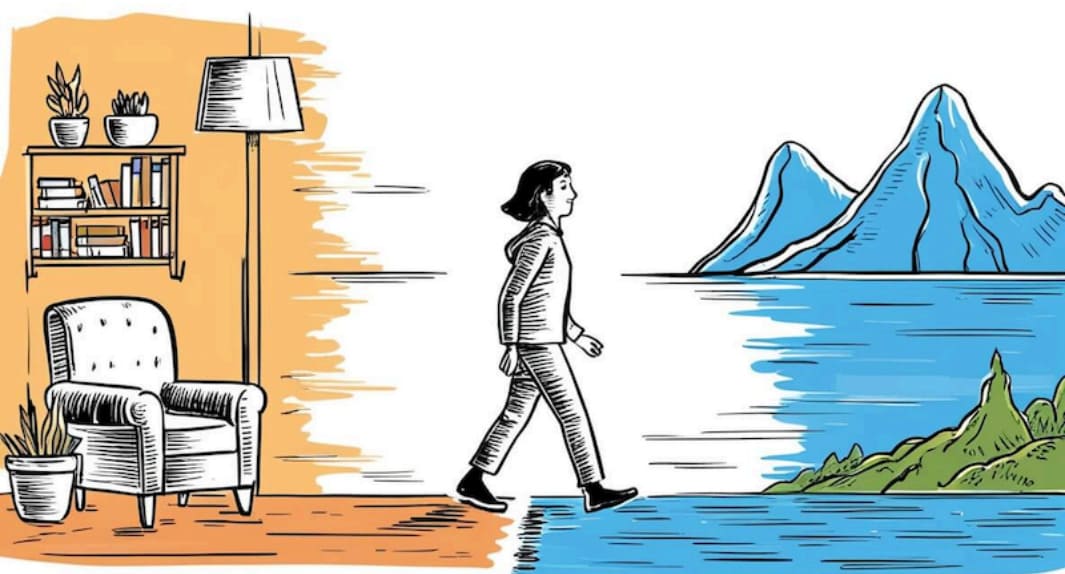
Continuing the theme of the previous chapter, let's talk about the "comfort zone". And let's start, of course, with a definition. The best way to describe this term is with an example.
If you look at someone's life from the outside, it consists of certain actions we perform almost every day:
- morning wake-up,
- breakfast,
- commute to work along the usual route,
- work from 9 to 5, including lunch,
- commute home along the usual route,
- dinner,
- evening pastime.
When a person does this day in and day out for a long time, they get used to such a life. It's convenient for them, and ideally it should stay that way forever. Why change anything? All the steps listed above are the comfort zone of a hypothetical person, where they live peacefully, having grown accustomed to the routine, the people around them, the family, even the work route they know like the back of their hand. When something happens that rarely occurs in their routine life — for example, a work trip to another city or a meeting with distant relatives — that already makes the person step away from their usual way of life. In that case we say the person has stepped out of their comfort zone.
Stepping out of the comfort zone can be either deliberately planned by the person themselves or the result of external factors and circumstances beyond their control. And most often, in the vast majority of cases, people very rarely want to step out of their comfort zone on their own. And if they do, it's clearly not of their own free will. And why step out? After all, that would disrupt the emotional balance and idyll. Moreover, if you step out of your comfort zone unsuccessfully, you can lose your job, get hurt, be embarrassed or even die. Look at our mothers, grandmothers, aunts, and even fathers and grandfathers. Most of them always worked the same job, lived in the same place, had the same people among neighbours and colleagues. Did they achieve much in life? Unfortunately, no. Of course you can blame it on different times, different values and norms, but making excuses isn't the best human trait.
Returning to stepping out of the comfort zone, generally speaking, for personal growth and productivity it's essential. Perhaps to some extent it's even risk and stress. And I've already written above that it's crucial to avoid stress for good health. That's true, but unfortunately there are no universal "pills" for personal growth. Paraphrasing the quote from "The Matrix": either you take the red pill, step out of your comfort zone and get new experience, emotions and knowledge, or you take the blue pill and the whole daily routine stays in place, and you get nothing new.
But even if you've decided to overcome the entire routine way of life and constantly step out of your comfort zone no matter what, you should do it carefully. First, stepping out of your comfort zone on all fronts of your life isn't the best idea. If you change the usual rhythm of life in personal affairs, at work, in relationships, with friends, becoming so-called "easy to get going", that's an easy way to burn out quickly and fall into depression. Or to miscalculate and mess up somewhere. Remember that stepping out of your comfort zone is not only stress but also risk. So you need to decide in which directions you want to step out of your comfort zone and in which you don't. That's exactly why stable work that can cover you in other areas of life is significantly better than temporary side gigs. You can step out of your comfort zone in any sphere of life, but not in all at once. Leave yourself at least something where you'll have at least a little stability and confidence in tomorrow. By the way, even with permanent stable work you can step out of your comfort zone there too. Then it can lead to faster career growth and improvement of your professional skills. However in that case I'd recommend slightly reducing the intensity of change in your personal life.
Until now I've divided the areas of life space into the comfort zone and the zone of fear and stress, or simply everything else that doesn't belong to the comfort zone. I did that more for simplicity and minimalism. However Jeff Colvin, author of the book "Talent Is Overrated! What Really Separates World-Class Performers from Everybody Else?", referring to Professor Noel Tichy, explained that for learning there's a special zone that's called the "learning zone". I'll quote the important paragraph verbatim:
Noel Tichy, professor at the University of Michigan Business School and former director of the famous GE leadership development centre Crotonville, illustrates this by drawing three concentric circles. The inner circle he calls the 'comfort zone', the middle one the 'learning zone', and the outer one the 'panic zone'. Progress can only be achieved by choosing activity from the learning zone. Here are the skills and abilities whose development involves a certain difficulty for us. We'll never achieve success in the comfort zone, since that's where we find what we can do with ease, while tasks from the panic zone are so difficult we don't even know how to approach them.
Whether you use the usual classification — "comfort zone" and "other space" — or Tichy's circles with "comfort zone", "learning zone" and "panic zone", perhaps doesn't matter so much. The conclusion you should draw: the comfort zone is harmful to your growth, and when stepping out of it you shouldn't overdo it and drive yourself to stress.
