
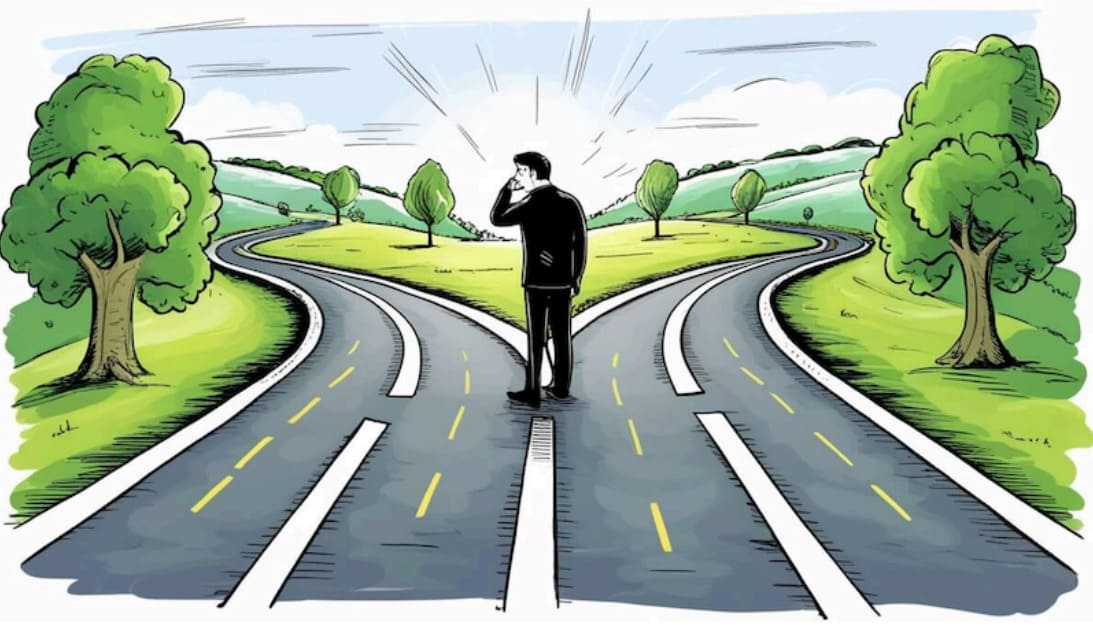
Decision-making plays a key role in people's lives: the more effective this skill, the more successful the person. In the section on favourable factors of productivity I wrote that it is crucial to have several scenarios (plans) for your actions — forgive the tautology. Conceptually and at a high level, such scenarios can pursue the same goals but be achieved by different paths and at different times, allowing for various nuances that you expect may arise with high probability in a given year.
Continuing the theme of multi-scenario planning for your year, it is worth mentioning the approach known as probabilistic decision-making or probabilistic thinking (in the context of decisions). As usual, I will turn to a book for a quote that, in my view, explains the essence of probabilistic thinking very well. Here it is from "Smarter Faster Better: The Secrets of Being Productive in Life and Business":
"This is probabilistic thinking — the ability to hold several conflicting possibilities in mind and assess their relative probability. 'We're not used to thinking about multiple futures,' said Barbara Mellers, head of the Good Judgment Project. 'We live in only one reality, so imagining the future as a set of possibilities can feel uncomfortable, because in that case we are forced to think about different things, including those we hope will never happen.'" … "Whatever method we choose, the goal is always the same: to see the future as a set of possibilities, not a single predetermined outcome; to establish what is known and what is not, and to find the option that offers the best odds. Predicting the future is not realistic. No one can predict tomorrow with absolute certainty. So some people avoid making any forecasts at all: their craving for certainty is too strong, and the fear of doubt is unbearable."
The aim of probabilistic thinking is to teach people to turn intuitive and analytical thinking into statistical probabilities and work with them. Probability theory, despite its seeming abstractness and distance from everyday life, is an extremely precise discipline. It is already more accurate and reliable than the predictions of fortune-tellers or astrologers.
The more we know, the more accurate our forecasts become. Yet often at the moment of planning we do not have access to all the information we need. That means we will receive some of the data only after we have drawn up our plans. So adjusting plans as new information comes in is normal and good practice. I plan to give more attention to this aspect in the next book. In a sense, both drawing up several plans and adjusting them are called the Bayesian approach. It is a method of statistical analysis based on Bayes' theorem, which allows you to update the probability of a hypothesis as new data arrives. The Bayesian approach is widely used in economics, statistics, machine learning, programming and other fields. So why not apply it in personal life too?
