
Let us finish reviewing the practice with one more year. This time not an abstract example of an annual plan, but a real one that I am living by at the time of writing this book.
The first thing worth noting is that I always pick the most important goal for myself for each year and work toward achieving it, and I also name my entire year after that goal. For example, starting from 2015 I had the following years:
2015 — the year of web programming theory
2016 — the year of advanced web programming theory
2017 — the year of web programming practice
2018 — the year of socialization
2019 — the year of travel
2020 — the year of reading IT books
2021 — the year of buying my first apartment
2022 — the year of buying a new car from a dealership
2023 — the year of buying my 2nd and 3rd properties
2024 became for me the "year of backlog items." In the pursuit of a better life and success, I cut corners here and there, shelved some tasks on the backlog shelf, and carried them over from year to year because more priority goals existed at the time. In 2024 I finally decided to pause slightly and take on what had long been sitting in my head or backlog and what I had not gotten around to for a long time — no time or not enough money.
At the moment I still do not have a life goal (although closer to the end of the year it seems to have started taking shape), so I will build my goals for the year based on my current tasks, problems, and wishes. By the way, the names of all my previous years also confirm that I have no global life goal. There is no single direction — everything is strictly different.
So, returning to the "year of backlog items," the first thing I did was gather all the most important tasks I wanted to include in the coming year. The first part of the list includes those very backlog items, and a bit lower — other goals. So, here is the entire list:
Backlog items:
— Property 2: renovation 
— Property 2: pay off **** of the loan
— Parents: renovation
— Parents: pay off the remaining mortgage
— Parents: buy a new car
— Registry office ceremony 
— Travel
— Tax: save up 50%
Passive income:
— Launch a test website ****
— Property 2: rent out for 6 months
— Property 3: rent out for 12 months
Trips abroad: 2 times
Learning (general):
Read books: 18
Learning (English):
— Duolingo: complete 40 sections
— Read books in English: 1 book
— Course: Dragunkin
— Course: Pimsleur
— Number of new words: ?
Learning (programming):
— Read books: 8
— Video courses: 3
— Podcast: radio-t
— Podcast: web standards
— Link review
— Other podcasts and videos?
Learning (space):
— Podcast ****1
— Podcast ****2
— Podcast ****3
— Other podcasts and videos?
Knowledge sharing:
— Write a book
— Launch an Instagram account about the personal website
— Launch an Instagram account about the personal website in English
— Launch an Instagram account for the books in English
— Write articles for the website: 12
— Give a presentation on space
Ambidexterity
— Fill copybooks with the left hand: 4 notebooks
Sport and health:
Running: 32 runs
Get lab tests: 2 times
******** ******** ********
******** ******** ********
What can be said about them in general:
1) There are many of them, which is neither bad nor good in principle.
2) I grouped some of them into separate groups for easier handling, and it is actually very important for you to do this too.
3) Almost opposite each one I marked the type of resource expenditure: money or time.
4) Goals I did not want to reveal in this book, as well as some details about other goals, I decided to hide and put asterisks in their place.
5) I described goals in whatever way was convenient for me and far from always fully used the SMART methodology.
As you can see, far from all my goals are related to money. I would even say that the smaller part of them is related to money. From this one can conclude that money is certainly very important in achieving goals, but it is not such a decisive factor as it may seem at first glance. Although, strangely enough, my top-priority goals were precisely related to money, and that is why I named all of 2024 the year of "Backlog Items." Before moving on, I will still describe some goals in more detail.
So, backlog items are more or less clear — these are goals that have been sitting for more than a year and that you would like to take on. The travel item here is rather marked as a reminder that I have not traveled anywhere for several years and it is time to resume active trips. However, this item will partially be duplicated further, and I see nothing wrong with that. The same kind of "duplication" can be found in the books item: I set myself a goal to read 18 books, of which at least 8 must be about programming.
There are also items, for example, the number of podcasts, for which at the time of compiling the list I decided not to specify a concrete number. The podcasts I listen to come out weekly. There are 52 weeks in a year, and if you consider that they come out once a week, the conditional final number is 52. So I could simply put that number. However, at this stage it is not important at all. Besides, on some days they may not come out, and it is easier for me to record a missed day so that at the end of the year, for greater accuracy, I subtract podcast misses from the total number of weeks in the year (after all, the misses were not my fault — I listened to all that came out, which means the final number of a given podcast will equal the number of episodes released during the year).
So these are the goals listed above that I marked as priority and important for me in 2024. But what about other tasks that require your intervention? Which may include, for example, cleaning. And so, through many years of planning experience, I included the following tasks in this list:
Car:
— Pass the inspection: 2 cars
— Car wash: 3 times
— Vacuum: 1 time
— Oil change: 1 time
— Renew insurance: 2 times
Leisure and entertainment:
— Go to the movies: 16 times
Make backups: 2 times
Cleaning:
— Run the vacuum: 104 times
— Mop the floor: 52 times
Taxes and finance:
— Pay monthly taxes
— Pay annual taxes
— Enter income in the app
— Send documents to the bank
— Fill in the tax return
— Pay the tax return
— Pay utilities, internet and phone
— Set aside for an emergency fund
— Check when online-service payments or validity dates expire
Other:
— Look through the birthday calendar of close ones and friends.
A few comments about the second list (with routine tasks). First on the list is a large group of tasks related to the car. Two cars are registered to me (although at the beginning of 2025 there was a brief period when I gave my parents a new car and they had 3), but in fact I drive only one. This means that cleaning, vacuuming, and other car-related details for the car my parents drive fall entirely on their shoulders, and I certainly am not responsible for how many times they washed and vacuumed the car — that is not as important to me as how I do it with my own car that I drive myself. Therefore the car wash and cleaning items refer to one car only. However, the second car is registered to me, and it is important for me to keep track of insurance and inspection expiration, since fines after expiration will come to me, not my parents.
Moving on. I love going to the movies as my main form of leisure, so I decided to include a certain number as a goal for the year. Looking ahead, I will say that in my 2025 leisure I also included restaurant visits, because sometimes my wife says we go there too rarely.
There are also 2 items about backups in the list. What that is and why they are important to do — I already wrote about in my first book "How to Master Productivity and Planning?".
Next come items about cleaning. Anyone might ask: where do these numbers come from? Here too everything is very simple. There are 52 weeks in a year (although the exact number of days may be slightly more or less depending on leap years and what day January 1 falls on, however for averaged statistics the number 52 (weeks) is more than enough for me). I always run the vacuum on Thursdays and Sundays. And we mop the floor on Sundays absolutely always, even if it is a church holiday or we spent the whole weekend at my parents' and only just got back. The only exceptions may be vacation weeks when we are physically abroad for several weeks.
Taxes and finances are an item you cannot neglect at all. Most likely, everyone's will differ, however I marked my own items, and for the most part they will likely overlap.
The last two items about reconciliation, I confess, I added only when writing the book in the spring of 2025. The first item implies checking and timely payment of online services. Nothing will happen if you miss a Yandex Music payment due to no money on the debit card, but it is quite another thing to miss hosting or a domain name payment. In your case this may be car insurance (if you did not put it in a separate item). Besides, far from all items auto-renew, and as with a domain name, so with car insurance, everything must be done manually. The last item concerns birthdays of close ones and relatives. I will show how not to miss birthdays of close people.
So, now we take these 2 lists and transfer them into some spreadsheet — Excel, Google Sheets, or any other. At first it may look like this:
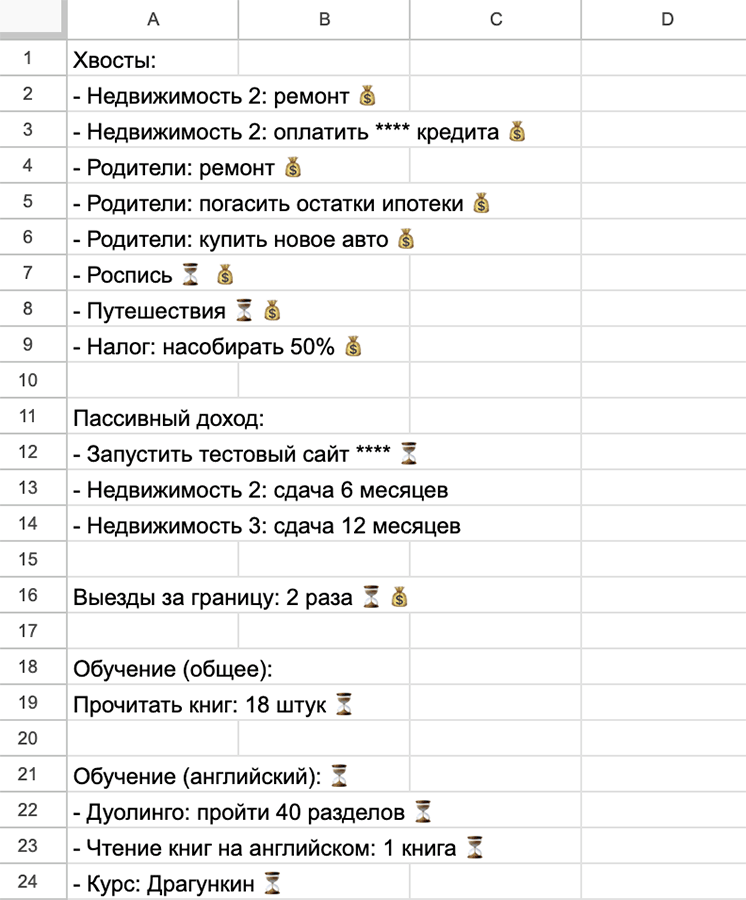
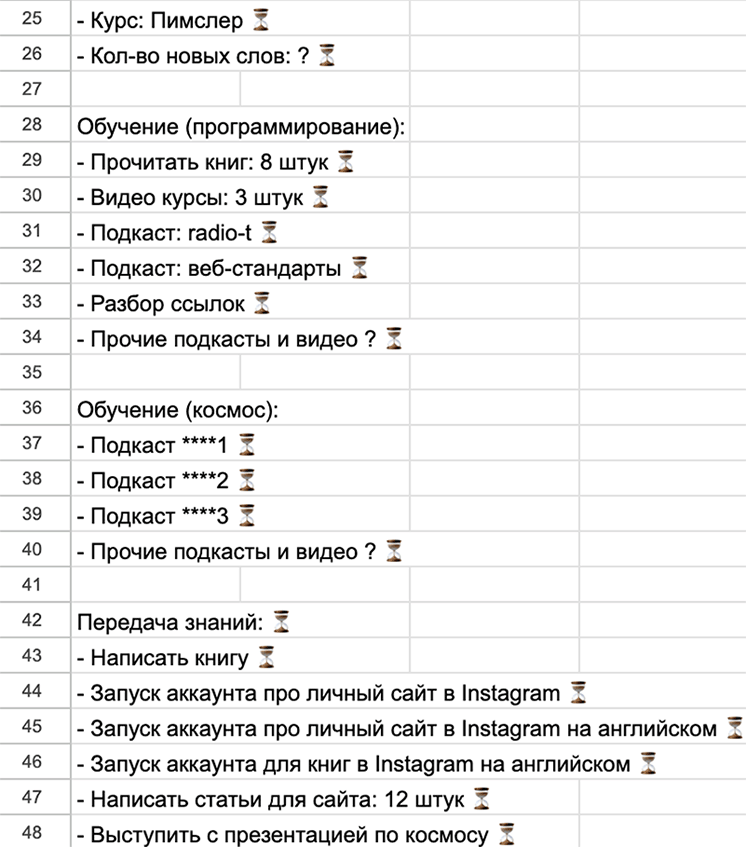
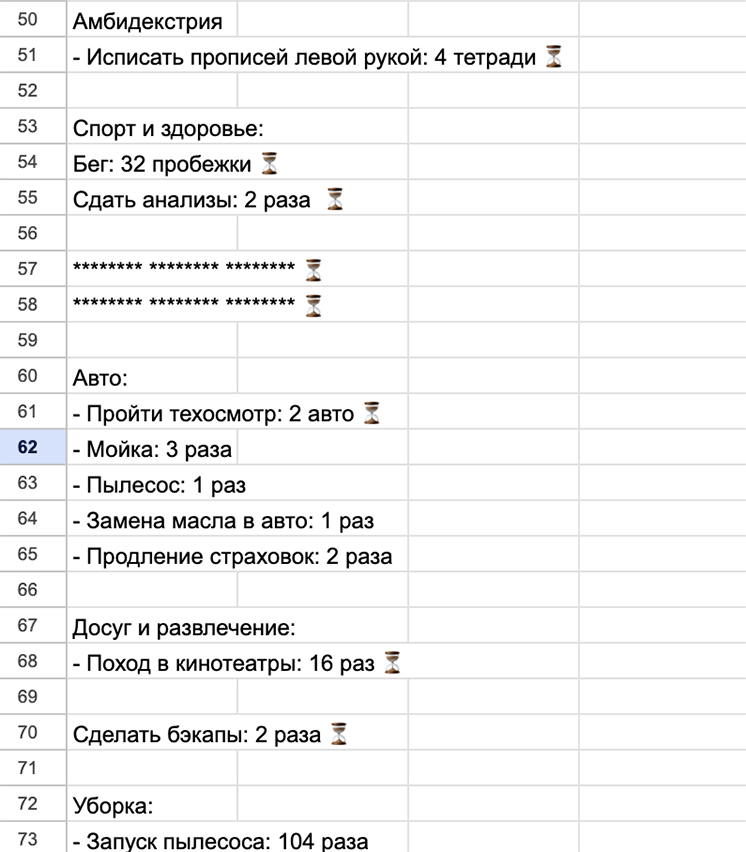
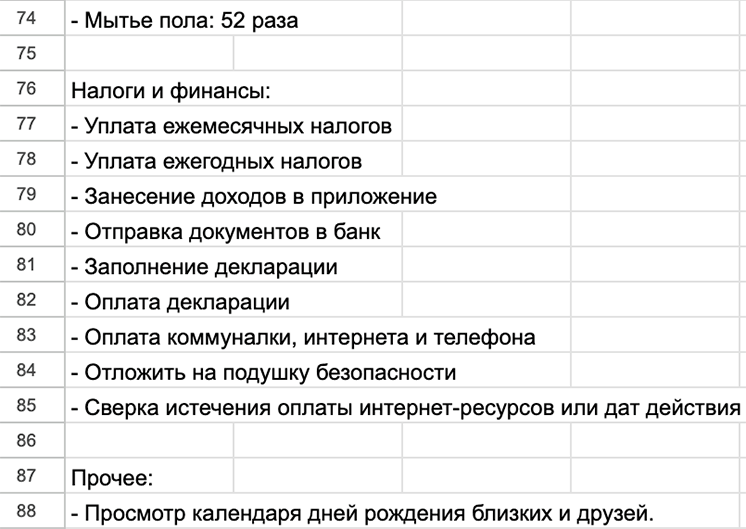
About 90 cells of the spreadsheet are occupied by some tasks. Does this mean I will have about 90 tasks to do in 365 days? For now, rather not. At least until I format this spreadsheet better. After the next stage of formatting it will look like this:
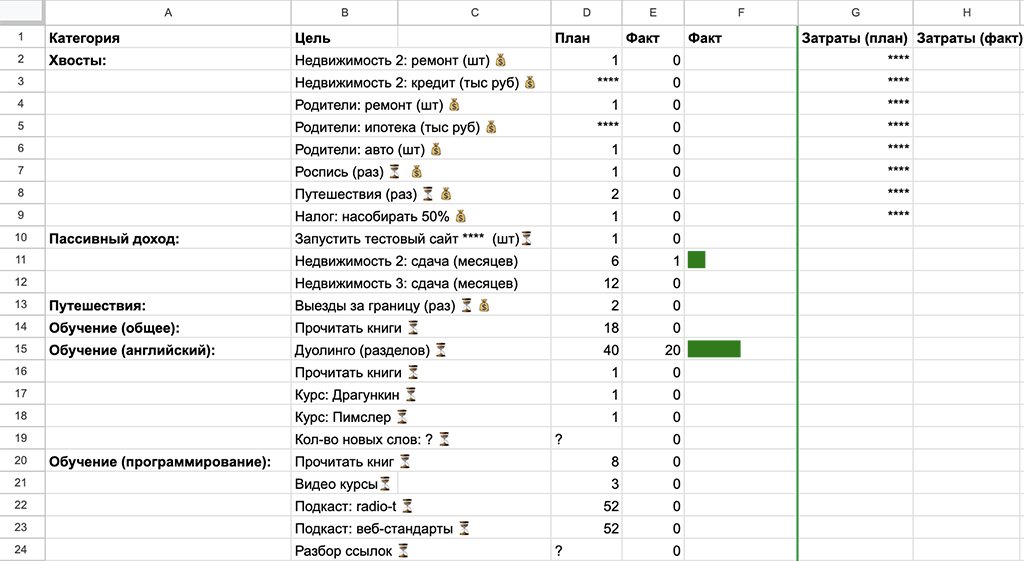
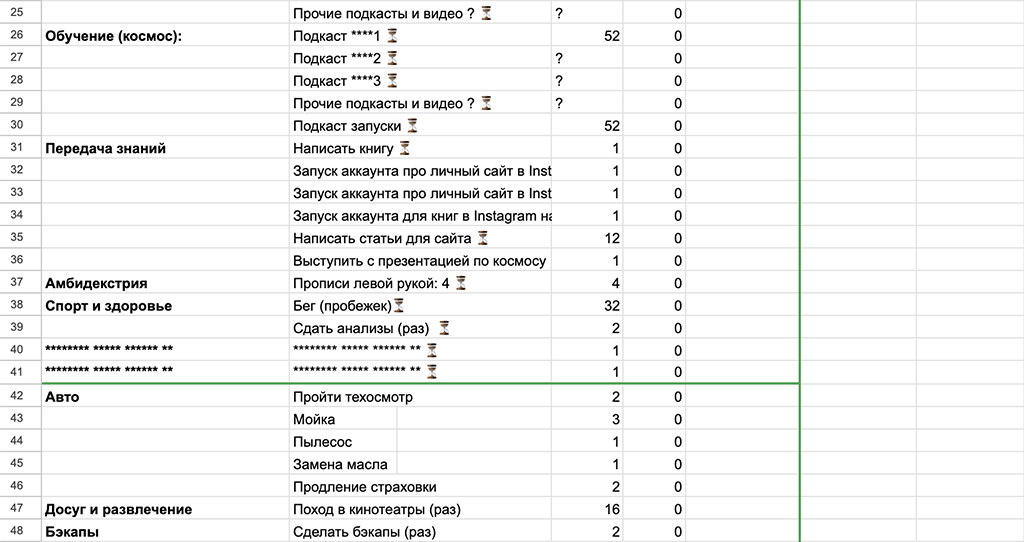
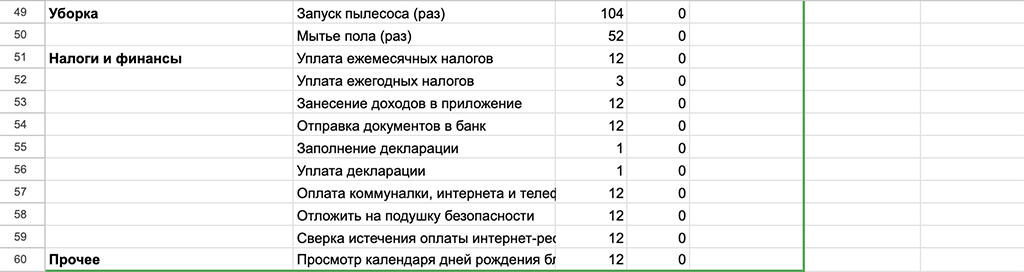
So here is what I did:
1) Removed extra rows and kept categories (groups).
2) Built a full spreadsheet and added fields such as:
— group name,
— goal name,
— goal plan in conditional units of measurement, which may be days, levels, sums of money, number of times, books, and other units,
— goal actual in conditional units of measurement,
— progress bar,
— possible expenses,
— actual expenses.
3) Adjusted some goal names (rather shortened names for convenient display and moved the quantity into a new field).
4) Added a progress bar and made a formula for auto-filling the bar. I will leave the formula for filling the bar in Google Sheets in case someone wants to do exactly as I did: =SPARKLINE(E2/D2*100;{"charttype"\"bar";"max"\100;"color1"\"green"}). Also for example I marked 2 goals as filled to demonstrate what the visual representation of the goal list will look like over the course of the year (the bars will fill very slowly but steadily as various goals are completed).
5) Separated main goals from routine ones.
6) There are several goals that cannot be counted, or at the moment their measurable value is not so important to me, so I temporarily put a question mark there.
It still looks quite intimidating. Especially with that many items. This is rather ideal planning that I arrived at after many years. You should simplify these plans for starters: first, by including far fewer goals in the main list, and second, I suggest not compiling the routine list at first at all. Besides, as you could see, examples from the "Annual Guru" section do not include them either.
In total there turned out to be 40 rows of main goals. That is quite a lot. For time and financial tasks, before launching them you need to understand — am I taking on too much this year? With financial tasks this is fairly easy: take approximate income for the coming year (if you have stable earnings and can do this), subtract average living expenses, as well as taxes. What remains is the sum you can dispose of at your discretion. Next roughly estimate each financial goal in monetary terms (for this I use the "Expenses (plan)" column in the spreadsheet). After such an estimate it became clear to me that I still cannot accomplish part of the monetary goals this year and therefore move some tasks to next year. With goals that require your personal time, everything is a bit more complicated. In theory here too you can subtract from your personal time (including weekends and vacations) time for family, unforeseen situations, etc. and understand what is left. However, even if you know how much personal time you have, you should not forget that you will have to estimate how much time each time-based goal will take — which can sometimes prove very difficult. The overwhelming majority of managers at work require subordinates to estimate time for various tasks, and they can almost never give even rough estimates. Therefore understanding your real capabilities in terms of free time is largely an intuitive indicator that with each year of planning you will be able to assess more and more accurately. Therefore I do not recommend calculating each time-based goal directly. It is simpler to take a certain number of goals (the most important for today) and then over the course of the year look at your throughput. And adjust the quantity as needed. So, having analyzed my time-based goals, I also decided to give up some of them.
As a result, at the current stage I had to adjust my goals and give up some of them this year. Goals I decided to pause I simply moved to the backlog for future years. Now my goal list looks like this:
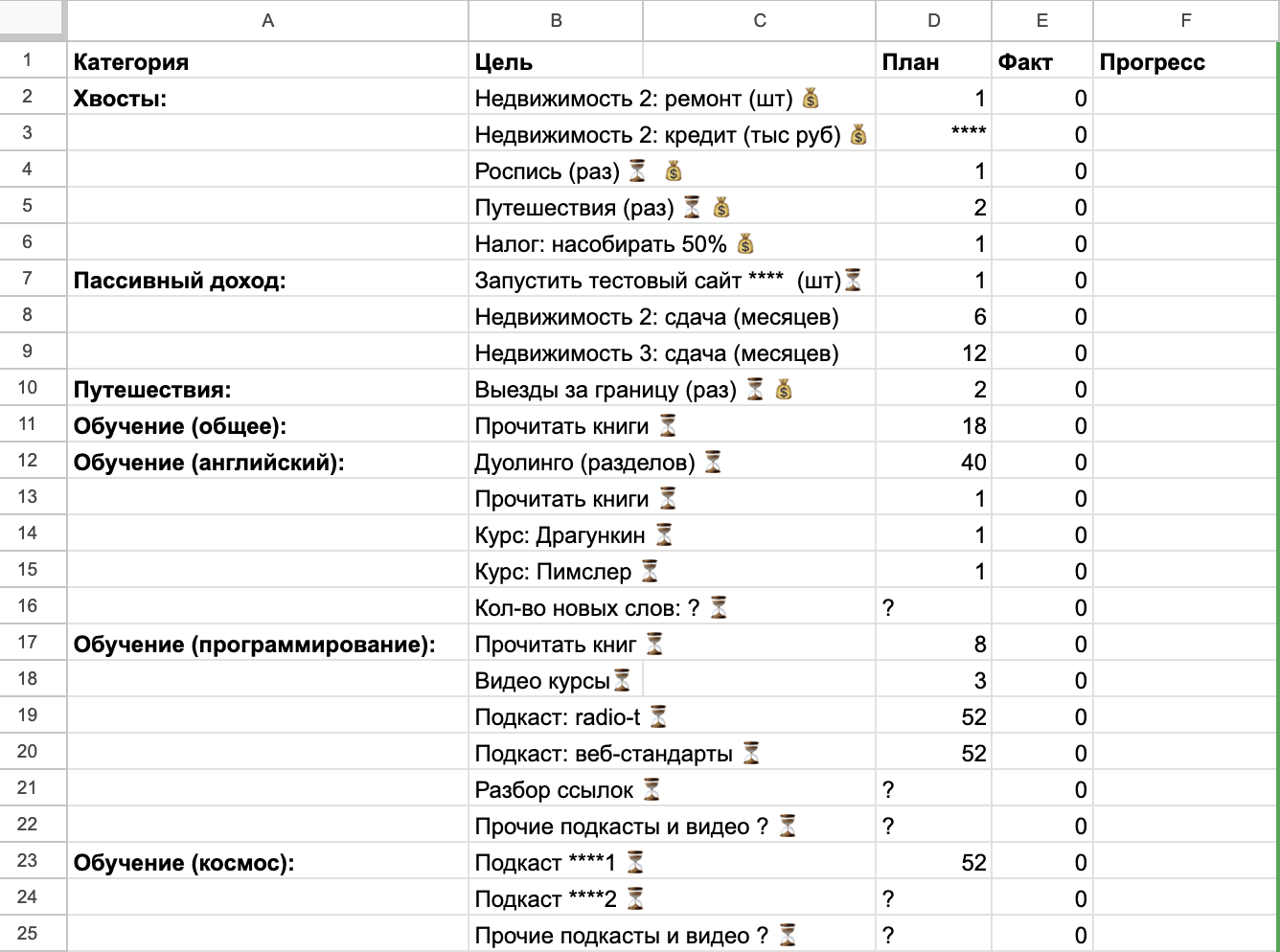
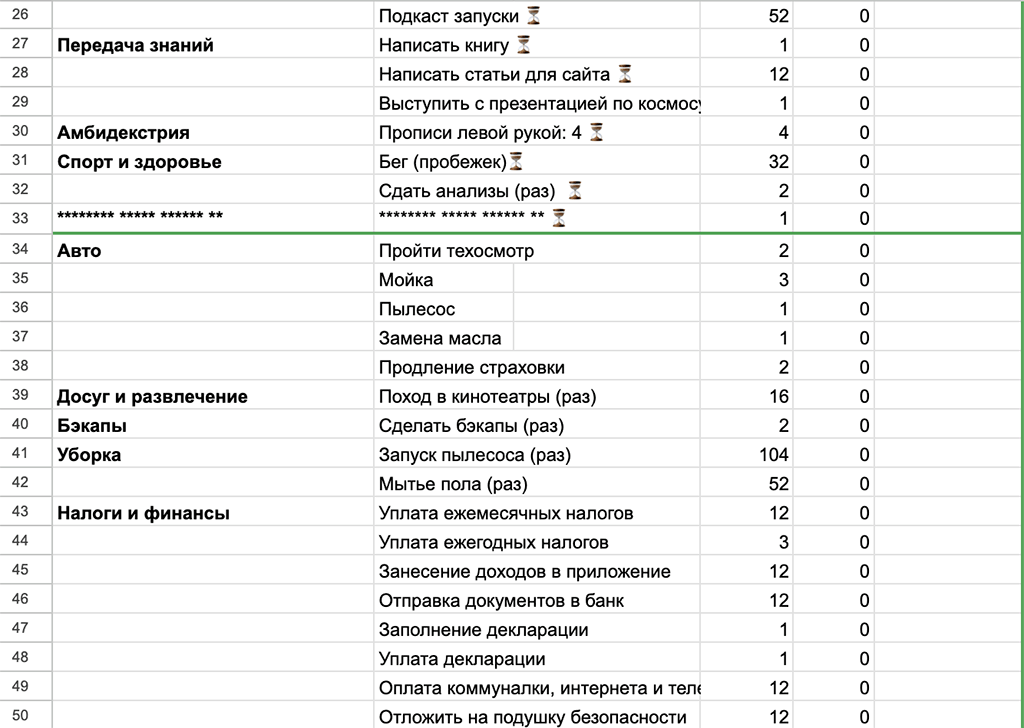

So, main goals became a little over 30, although initially there were 40. I trimmed down nicely, and already this can be worked with. In fact I moved all monetary goals for my parents to next year (which means you can already guess that 2025 for me is the "year of parents" or "year of helping parents"). As for time-based goals, here I gave up some knowledge-sharing goals, removed one goal with asterisks, and one of the podcasts. Moreover, it is worth remembering that the travel goal is duplicating — exactly like the book-reading goal. So in fact I now have about 30 monetary and time-based goals, and knowing my throughput from past years, this is just the quantity I can handle.
Generally speaking, one of the goals — namely Duolingo — I already started with 4 sections completed in advance. 40 sections is the necessary norm for moving to the next level (talking about levels A1/A2/B1 and the like), so I had 36 left (which I would divide evenly across all quarters). However, looking ahead, I will say that I greatly overachieved this goal by quantity, because roughly in the first half of the year this app had a major update, and they split those 40 large sections into about 50–60 smaller ones. This is exactly the case when you tie goal completion to someone else — which is not really worth doing (I wrote about this in my first book "How to Master Productivity and Planning?"). But nevertheless, throughout all planning of the Duolingo study volume goal I never adjusted it, and for me it was rather important to simply study steadily every day. And I already guessed I would pass the total of 40 sections quickly, but I did not set a new specific goal either.
Note that I did not adjust or remove routine goals at all, because in fact these are not goals but obligations you cannot get away from no matter what. Treat these goals as reminders, not as target load for the year. After all, both paying taxes and washing the car are fairly quick tasks that do not require much time. Therefore from now on throughout the coming year I keep in mind the top 30 goals plus routine reminders that are always in front of my eyes.
So, a certain intermediate step is done. If this were a computer game, I would say it is now time to save, because ahead — we proceed to detailing this list. But before doing that, let me remind you of the approximate action algorithm:
1) Break goals into quarters.
2) Plan the first quarter and break goals into the first 3 months.
3) Plan the first month and break into 4 weeks.
4) Plan the first week, scheduling by days.
5) After a week ends, take the next week into work; after a month — the next month; after a quarter — the next quarter.
6) Throughout all planning conduct reflection, reconciliation, and assessment of remaining tasks. Do not forget to mark progress in the general spreadsheet as tasks are completed. Here is what an example of real progress looks like at the start of summer, or rather — the first month of summer (I included a screenshot for clarity, so it is clear how you can visually record and track the entire process):
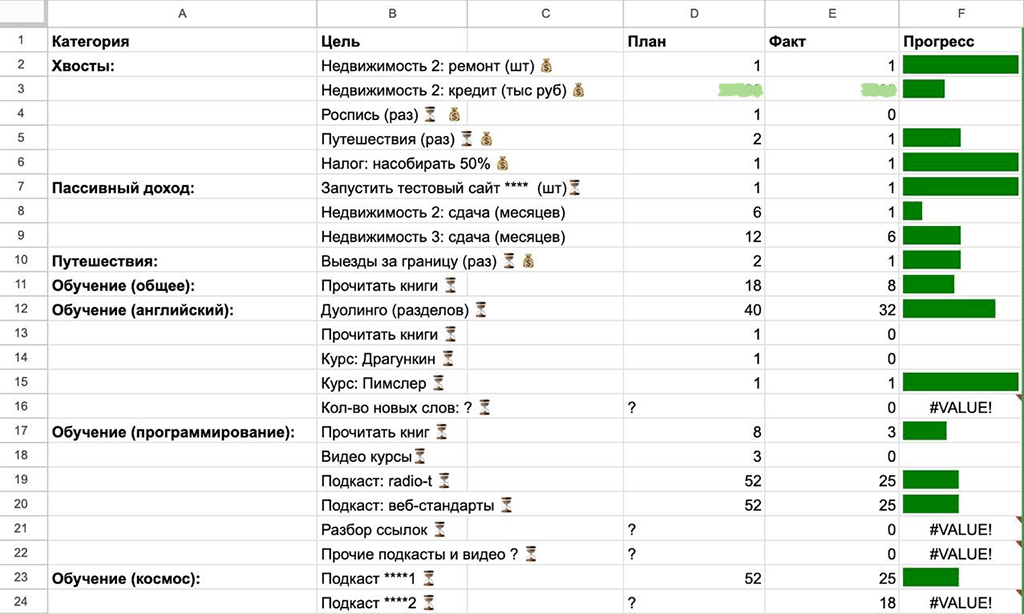
I think any comments would be superfluous. Everything is clear, everything is understandable, roughly half the goals are completed.
So, we move on to planning the first quarter. Generally speaking, besides this program in the form of Excel or Google Sheets, I will use one more. In the first spreadsheet program I will store only planned goals for the year, quarters, months, and weeks, while the actual day-by-day planning, as well as executing these tasks, I will do in another program — a simpler list. But you, by the way, can calmly use a calendar for the second program and plan your tasks right in the calendar. A bit later, I think, you will understand why global goals (or "top-down" goals) are better kept in one place, and specific tasks — in another.
Well, I begin planning my first quarter. For this I use the same spreadsheet program (Excel / Google Sheet) and right after the table I use 4 columns for quarters. It will look as follows:
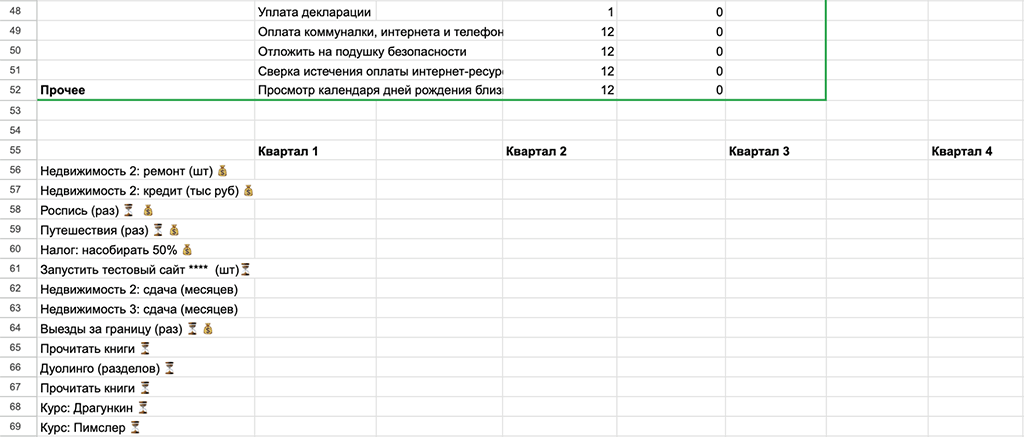
On the left, in the first column, we duplicate all our goals — both main and routine. Now I begin the most fun part: dragging my goals across quarters. This should happen evenly for both financial and time-based goals, meaning the time and money load should not differ much from month to month (unless, of course, in one of the months you go on vacation or receive double salary at work and want to close more goals that month).
I will make a few clarifications. First, a trip abroad is a responsible event, which means preparation is needed. Second, in essence I combined books (the general goal, in English and about programming) into one item, which means I will have to regulate book selection, their topics, and language myself so that by the end of the year all book-related goals are completed. Here is what I got:
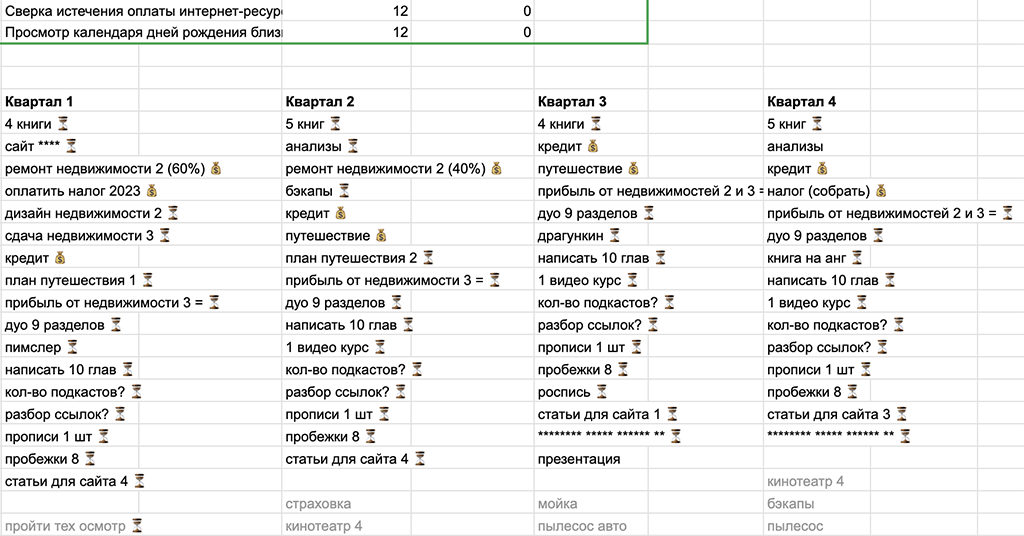
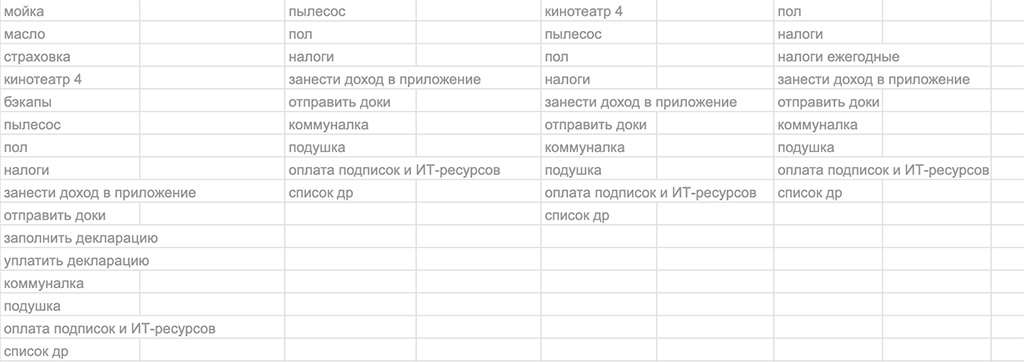
One more small comment before moving on: routine goals I placed below the main ones and marked in gray so they do not stand out much against the main goals, since these are goals that do not especially bring me closer to achieving key tasks. I also shortened names for compactness (however, in 2025 I use goals without compressed names), but in both 2024 and 2025 when planning in detail I already try to write all goals in lowercase (it is easier for me to perceive and read that way). Shortening names and choosing which letter case to use — that is up to each person.
Next I plan the first quarter in more detail. The principle is very similar. First I will list (copy, not cut) everything I planned for the first quarter as a separate column, and then enter across three columns. When copying it is important to copy not only main goals but routine ones too.
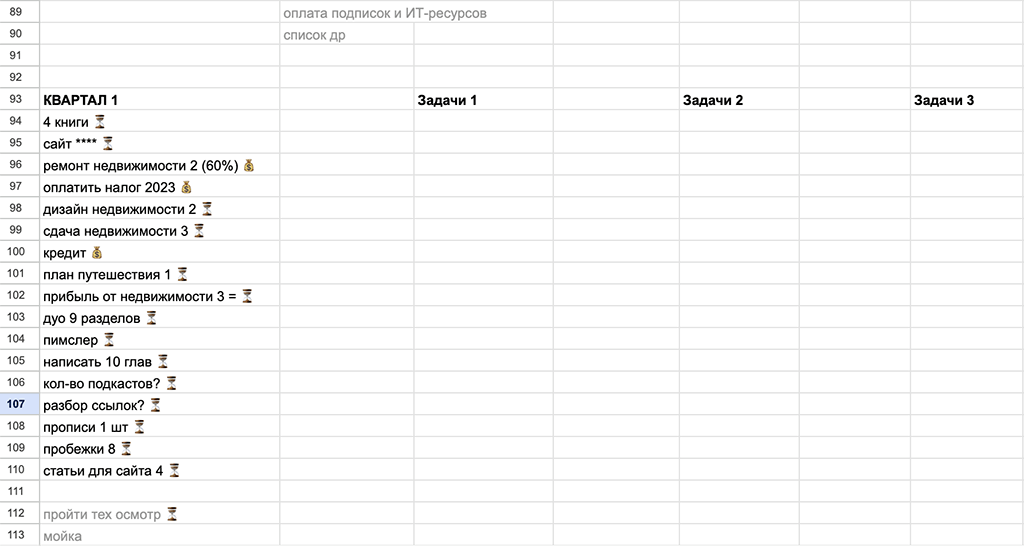
This should look as in the figure above: on the left — the list of goals from the first quarter, on the right — the first three months of the year (still empty and unfilled for now). I do all this work in the same file, on the same sheet, just a bit lower.
Next we begin spreading the quarter task list in roughly equal parts across the first three months in the corresponding columns.
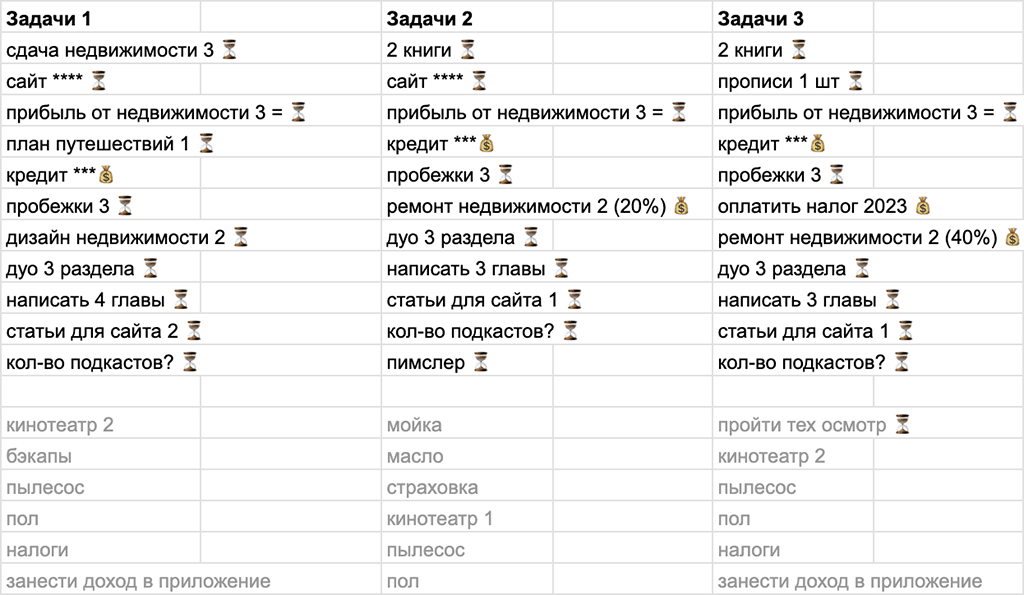
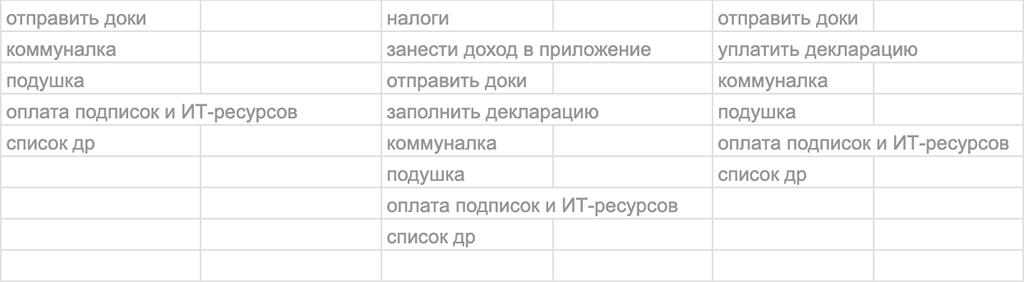
As a result, after placement by months I got what is shown in the image above. Runs totaled one more than planned. Generally speaking, I try to run every week, but stick to the principle — at least 3 runs per month. With this approach the total number of runs for the year is always above the minimum set for the year. Also at this stage you can notice a small duplicate goal in the "Tasks 3" list: "pay tax for 2023" and "file declaration" — in this case it is completely the same thing. This happened because the tasks came from different lists: from the main one (as spending a sizable part of money) and from the secondary one (as an important task that cannot be missed). Therefore further you can simply leave one task. This happens — after all, we are not doing ideal planning and not creating a task schedule for perfectionism. These are rather real and practical tasks, which means they may wander across different months and somewhere be duplicated in wording more than once. So this is absolutely normal — I think you will have this too when planning a large number of goals.
Note that I have not yet planned tasks for the second quarter and subsequent ones by month, as there is no need for that yet. And, as I already said, planned goals for the second quarter may when it arrives be moved and redistributed within the quarter — due to some new circumstances. Therefore now we focus on executing first-quarter tasks. It is unlikely that in the first three months our plans will change very much, which means this plan can and should be followed.
So, I have goals for January. It remains to spread them across 4 weeks in equal parts. Next, below, following the usual scheme, I will copy the first month's goals and create 4 columns, as shown in the figure below:
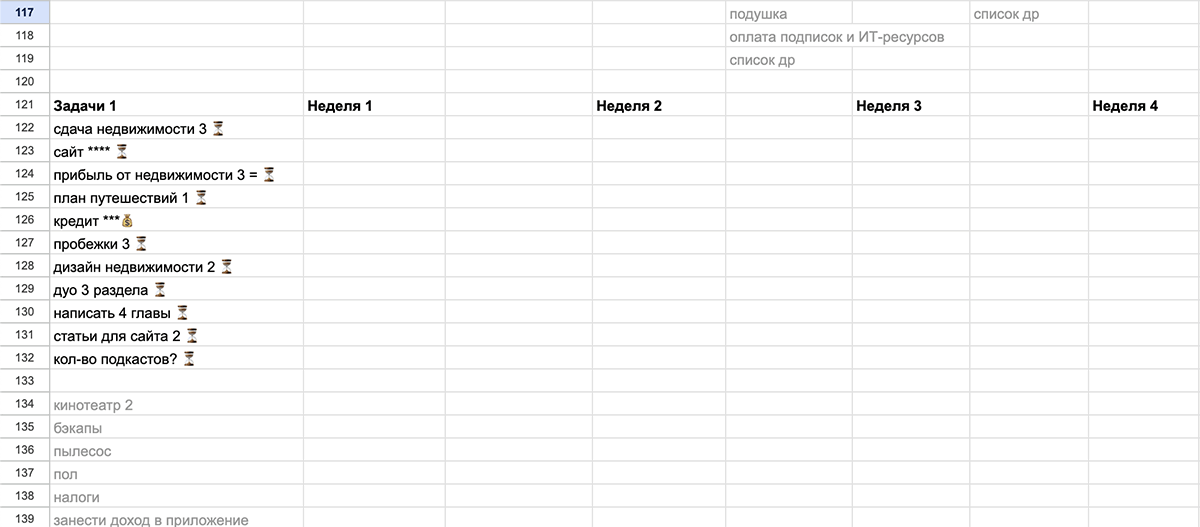
Now I begin spreading them from the general list across weeks. In the end I got the following:
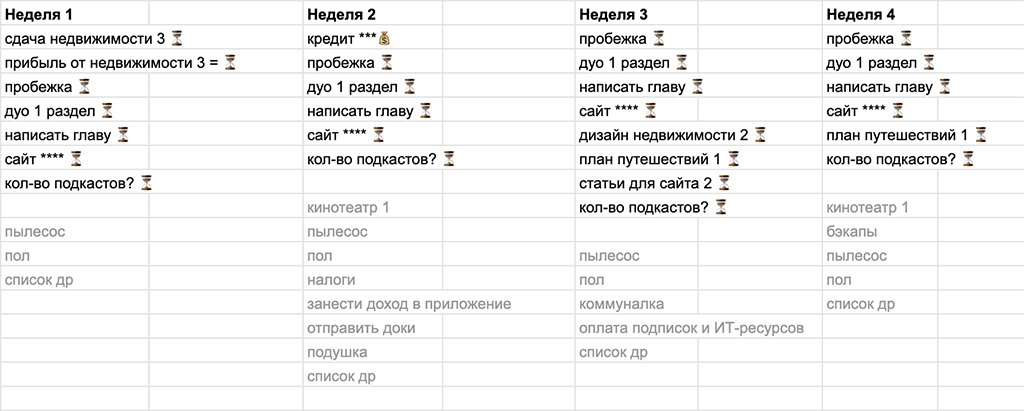
So, I have tasks for all of January that can be taken into work and executed. Ideally, I could do this similarly a bit lower, but I will act slightly differently. I will copy all goals for the week into a separate program that I open at least 3–5 times every day. Moreover, before starting to plan my week, I will also copy the month's tasks a bit higher in this program so I always remember that tasks I do within the current week are not context-free tasks but goals of the current sprint (month). As I complete a given month goal and it closes, I will cross it out from the local list (second program) and mark it as done in the first program (not delete, but mark) in the progress status at the very beginning of the spreadsheet. I will show this in more detail below. And now it is time to plan my first week of the month by days.
Here is what copied first-week tasks look like in the other program, but not yet distributed by days:
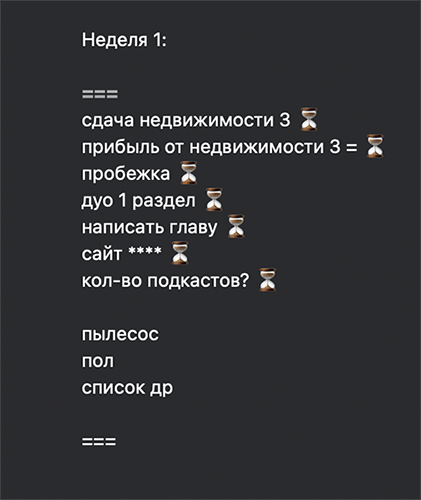
Before moving on, I will make a couple of comments. First, if someone noticed: if you add up 4 weeks of Duolingo with a goal of 1 section (exactly the volume I planned) each week, the total in the month is 4 — which is 1 more than I planned for the first month (3 sections). There is nothing wrong with this — consider it getting ahead (by analogy with runs). Besides, whole numbers (as full sections) are much easier to work with than, say, calculating 0.75 of a section each week. Second, for podcasts in 2025 I described more concretely which ones I watch and listen to, so the weekly list in 2025 is usually longer for me — but more specific.
So, I will show how I schedule a week (although I have done this repeatedly in this book). Usually I start scheduling with tasks that happen every day, and thus form the days of the week. Studying English with Duolingo fits well here, because little by little I go through it absolutely every day, which means you can start with this task:
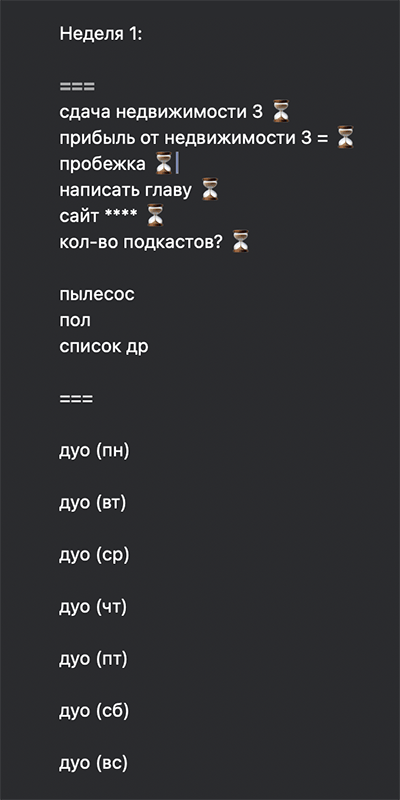
So, Duolingo is no longer in the general list, but now this task is on absolutely every day. So now I can schedule my other tasks below it. It will look like this:
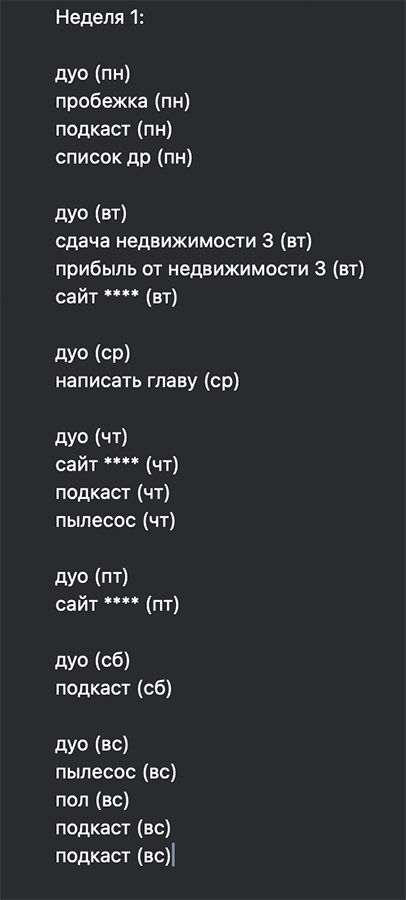
In principle, the week is formed. As very small local tasks appear that I would not want to forget, I will add them here to the list. So tasks like shaving or washing dishes will regularly appear in this list on different days as needed. Also, as you may have noticed, I removed emojis and started using text without them. And also, as I wrote earlier, goals within a week can often be moved or shifted. If I do not finish something in one day, I automatically move it to another, or conversely — if some tasks are done and time remains, you can take something from tomorrow. Also do not cherish the illusion that absolutely all set tasks will be closed within the week. This may be true for tasks that depend on no one, but the more external factors, the more likely a task moves not only to the next day but even to the next week. I no longer remember on which day and week we handed over property 3, but it was definitely not the first day of the first week — it seems this task was moved to the next week or even later.
A bit above I wrote that into the second program I transfer not only week goals for subsequent daily control but also month goals so they are always visible. So in fact my list always looks roughly like this:
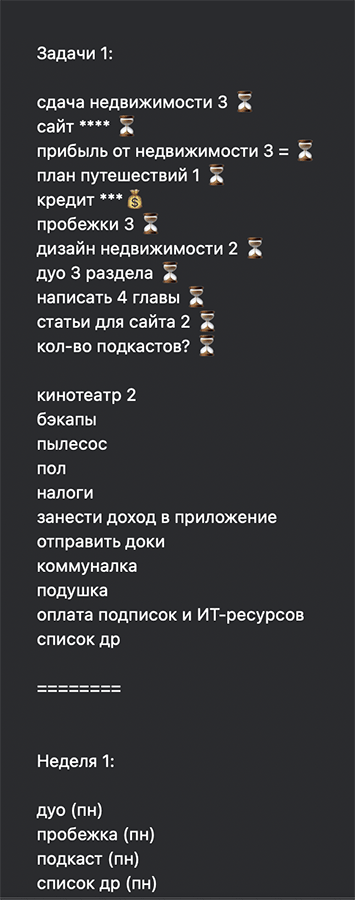
And as I said, as I complete week tasks I cross out what is done in the month list of the second program and enter it as progress in the first program. Suppose that by the end of the first week I completed 1 run, passed 1 Duolingo section, wrote 1 book chapter, and also handed over a property and received money for it. Thus the local list will look like this:

I cross out what is already done, plus reduce the count in items that are measurable (runs, chapter writing, Duolingo). As for podcasts, from 2025 I also started tracking them more strictly and made them measurable, because in 2024 I treated this more casually and did not record them systematically.
Together with crossing out from the local list we mark progress in the global list too:
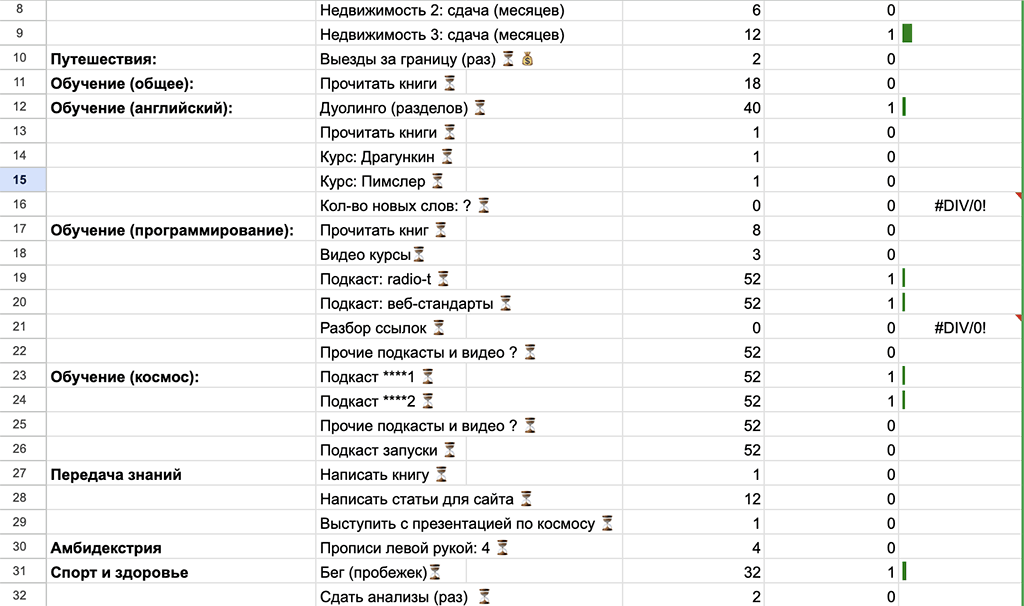
After completing the first week the result does not look very convincing, does it? Barely crawling bars on the general chart, and only for a few items. But nobody said this was a fast path — big wins always consist of small steps.
So, the first week is done. We take the second week into work — for this we go to our big spreadsheet and copy all second-week tasks of the first month into the local program.
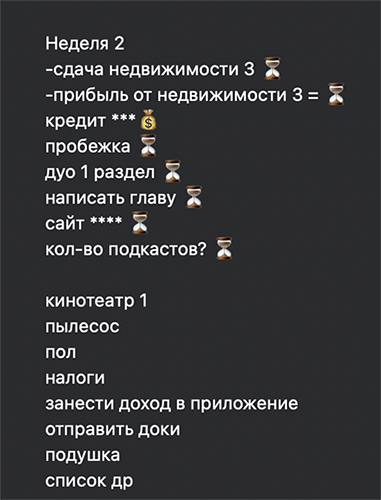
As I said above, I do not remember us handing over property in the very first week of the very first month (since local task lists and day-by-day planning are not saved for me), and most likely I had moves of this task to another week. How do I move tasks to another week that were not completed on the planned week? First, I place them at the very beginning of the list. Second, I put a minus sign before their names as a mark that this is an overdue task. If on this week too some task is not completed, I move it further, and that task gets one more minus. I have had tasks marked with three or even four minuses. For example, reviewing IT articles and public pages is often such a task — a good task in a way, but at the same time not important and not urgent (if you recall my first book "How to Master Productivity and Planning?" about task types).
Moreover, there are tasks that for some reason were not fully closed in the current month — this automatically means the task moves to the next month with a minus sign and is placed at the beginning of the list, exactly as I just described with a local week task. Repair of something, as a rule, goes beyond the plan — say, you planned it for 4 months and it stretched to 5. Then in the fifth month the "repair" task for me will go at the very beginning of the list with a minus as a mark that this is a backlog item dragging from the previous month that you would like to close sooner.
Returning to the second week of the first month. Copied second-week tasks we schedule by days. There is no point copying month goals into the second program, as they are already copied and even something crossed out. If I did not finish some task today, I move it to tomorrow or another later free day. If you feel you have too many uncompleted goals for a day, that says you took on too much and planned too much — worth revisiting your plans, moving bottom to top, up to year goals. Usually for me 90–95 percent goal closure per day is the norm, and some backlog items are constantly being moved. This is rather the norm, and perfect daily task closure you are unlikely to achieve, especially if you planned a lot. What to do with backlog items and how to plan more accurately, I will tell at the end of this book.
Goals scheduled for the second week look as follows:
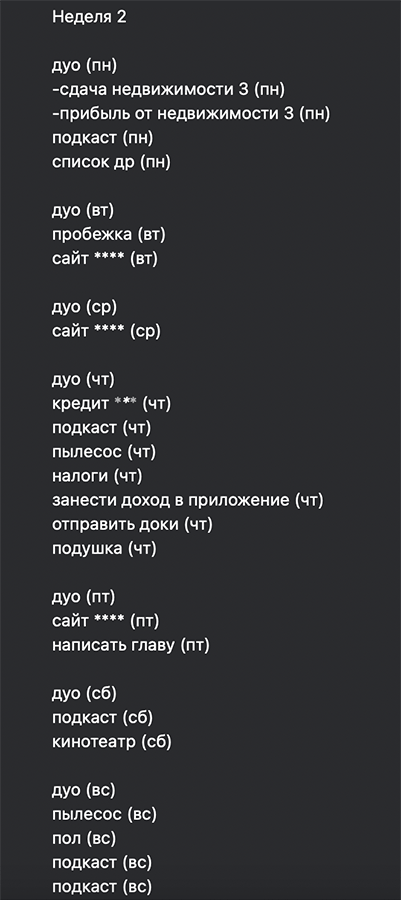
A couple more comments, some obvious, some not. I start scheduling a week with tasks I do every day (in my case — Duolingo), try to put the most important tasks higher in the list (although in that case I should have placed Duolingo a bit lower, but did not bother). As I said above, this week includes tasks that were not completed last week. This list may and will be supplemented with routine and local tasks like going to the barber, or after on Monday I look at the list of birthdays of close ones and friends, I also spread specific birthday people across days so as not to forget to write them on that day. And the last thing worth mentioning — on some days for me (and most likely for you too) a certain systematicity of the same tasks emerges. All my Saturdays and Sundays consist practically of the same tasks — for example Sunday is podcasts and cleaning — so to avoid manually scheduling the same tasks anew each time, I can copy whole groups of tasks to the next week from the current one. As a rule, I start scheduling my next week around Friday, Saturday, which means I can easily copy to the next week still-uncrossed tasks from those days.
So, after completing second-week tasks of the first month I cross out tasks from the local task list, month tasks — everything already completed — and enter them as progress in the general spreadsheet. After already two weeks of the first sprint the local task list is considerably crossed out, so after four weeks there should be no tasks left in it or, at minimum, a couple of tasks will remain. For example, the "website ****" task will remain in any case, as it will also be executed in the second month, so there is no point moving it to February with a backlog mark, that is "-website ****", since there will already be its own same-named task there.
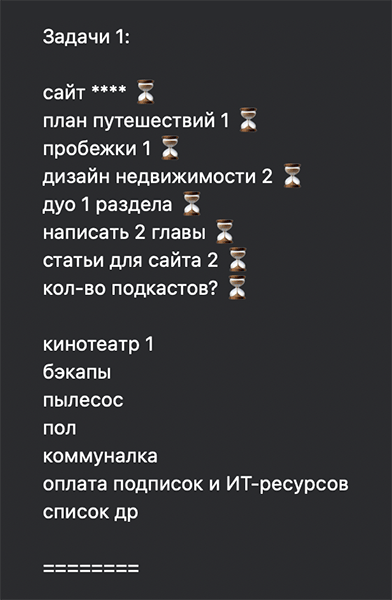
So, next I take the third and fourth weeks of the first month into work. To save time and book space I will no longer schedule them, so I go straight to month completion and analysis of what I did not complete this month and what carries over.
If you followed the month, tasks, and what and how I crossed out carefully, you most likely assumed I had this list left:

However in fact my list looks like this:

The "website ****" goal was indeed not achieved, but at the same time I allocated the second month for its completion too, so as I said above there is no point duplicating it in another month with a "backlog" mark. But what I should do with this goal is assess whether I really did about 50 percent on it? The "number of podcasts" goal, as I already said, in 2024 for me was rather abstract and weakly measurable, besides it goes in absolutely every quarter, will go in every month and every week, so if I diligently listened to fresh episodes (which as a rule I gladly do), I have no backlog here and can calmly close this task in the current month. Exactly the same I can do with routine goals that did not get crossed out, although as a rule I cross them out on the last planning week. All these goals are also monthly, even if I did not complete them in the needed volume last month — that is not critical at all.
But of all current tasks I did not fully complete travel preparation 1 — make a detailed plan, buy tickets, develop a route, book hotels, and the like. And since this task is not in the second month task list, it is quite a candidate for a backlog item role.
Do I adjust the already prepared "Tasks 2" list in such a case? As a rule, yes. I may not always do this in the global list, but in the local one backlog items (if any) are always marked and accounted for. In roughly half the months of the year there is always some task that carries over as a backlog item to the next month, and the more tasks and goals, the higher the probability of not finishing something in the allotted time. Therefore for those starting to plan fully for a year, I would recommend starting with a small number of goals — if I have about 30 (main ones), you had better cut them in half to start.
We move on to planning the second month. We return to our Excel spreadsheet, before copying February and starting to schedule it, we quickly review achievement statuses of all goals and check we did not forget to mark anything. Now we take second-month tasks and schedule them across 4 weeks of the second sprint (or February, whichever is more convenient). Here is what the list looks like before spreading.
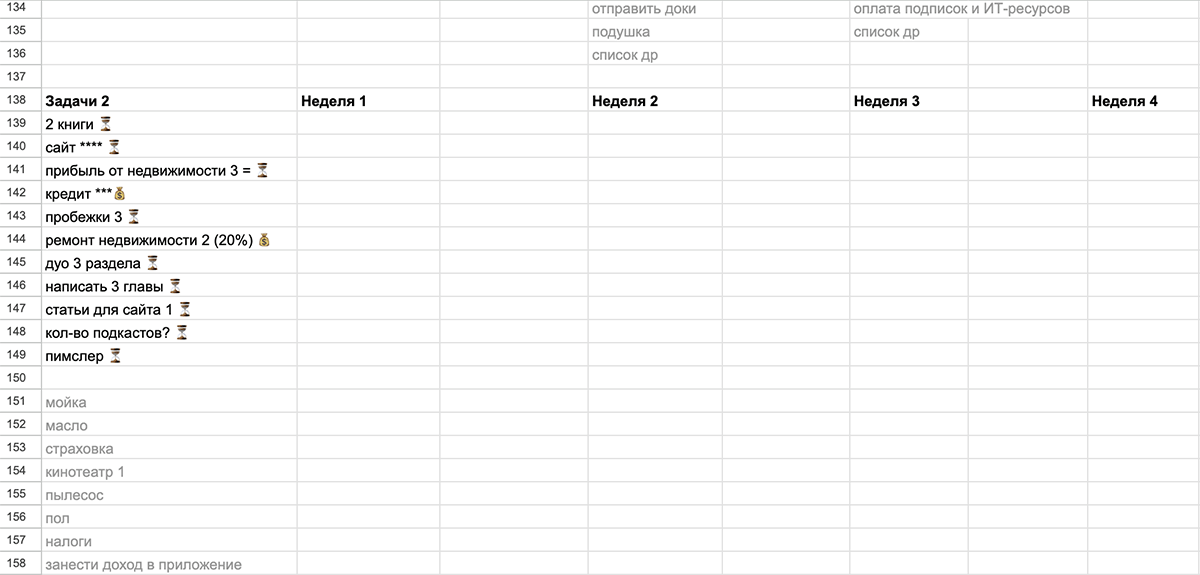

Reminder that it goes right under the list split into weeks of first-sprint tasks. And here is what the second-sprint task list looked like after filling four weeks.
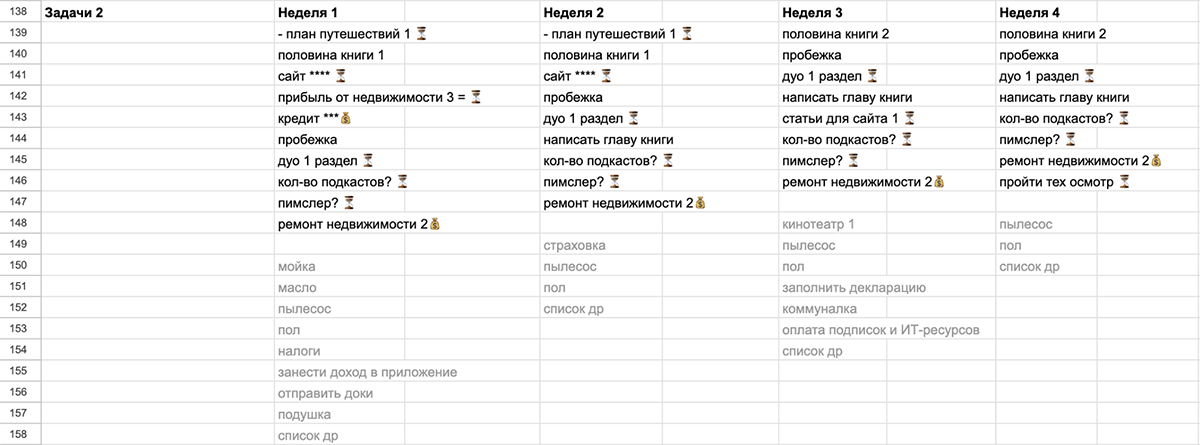
Next I copy the entire February task list (it can be copied again from first-quarter goals) into a separate program so February goals are always at hand. And together with this I copy week 1 tasks into a separate program. That is, I do the same as before.
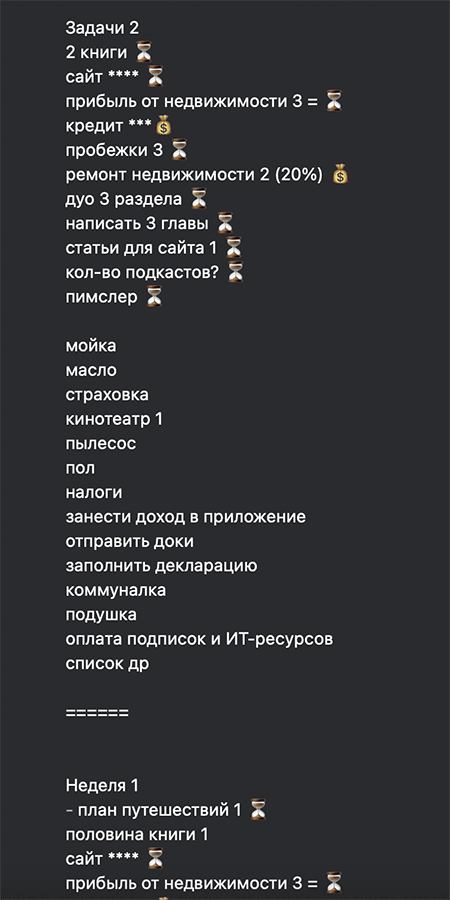

And I begin spreading goals by days. As in all other weeks, I start with what always repeats for me — Duolingo, plus podcast, plus cleaning.
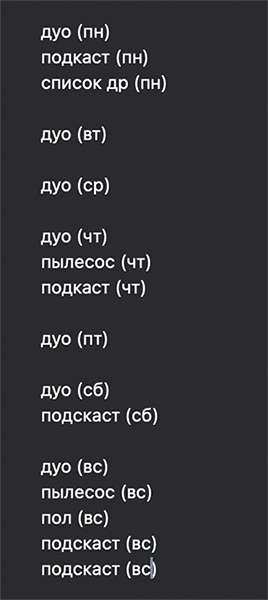
After that I fill all remaining week tasks, roughly distributing load evenly. If needed I sort tasks by importance within a day (however, I do not always do this). Here is the final plan for the week:
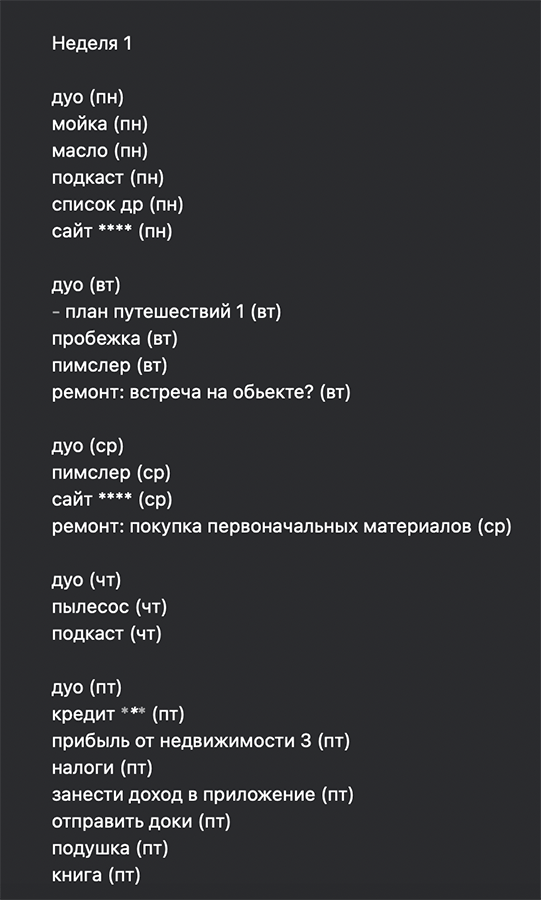
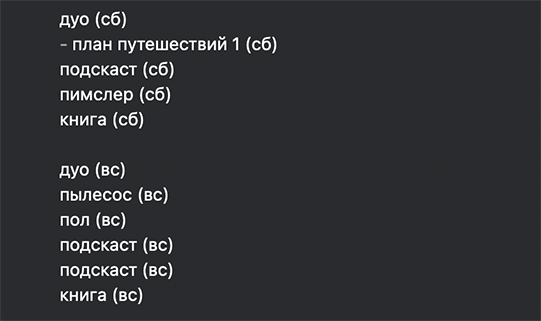
It turned out to be a quite loaded week, however, like almost all weeks. I decided not to pack Thursday too much, as I surely knew some tasks from the first three days would carry over, so Thursday is when they can be closed.
Well, the principle, I think, is more than clear. By the same logic I do the remaining three weeks of February and onward. At the end of February I look at what remained uncompleted. Among not fully completed were English study video lessons by the Dr. Pimsleur method. I analyze why this happened: there turned out to be too many videos, I distributed them poorly, or rather, poorly followed the planned viewing schedule due to heavy load in the month with other, more important tasks. I move about 20 percent of this task to March. I mark it with minuses at the beginning, so now to plan March I need not only March tasks but this small backlog item too. In total it looks like this:
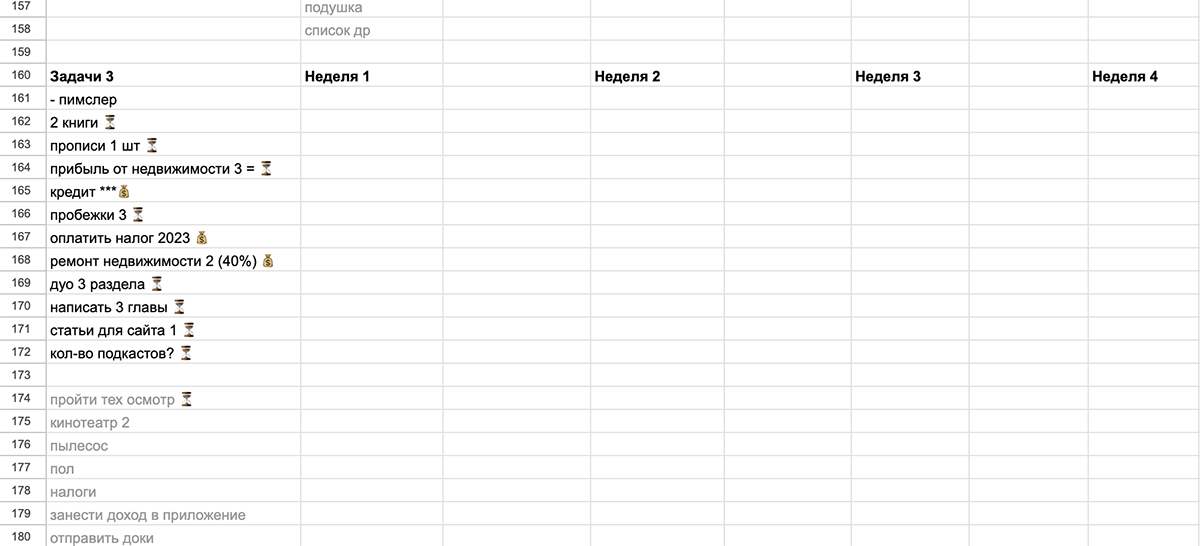

Next the principle is the same. I spread March tasks (including the single backlog item) across 4 weeks.
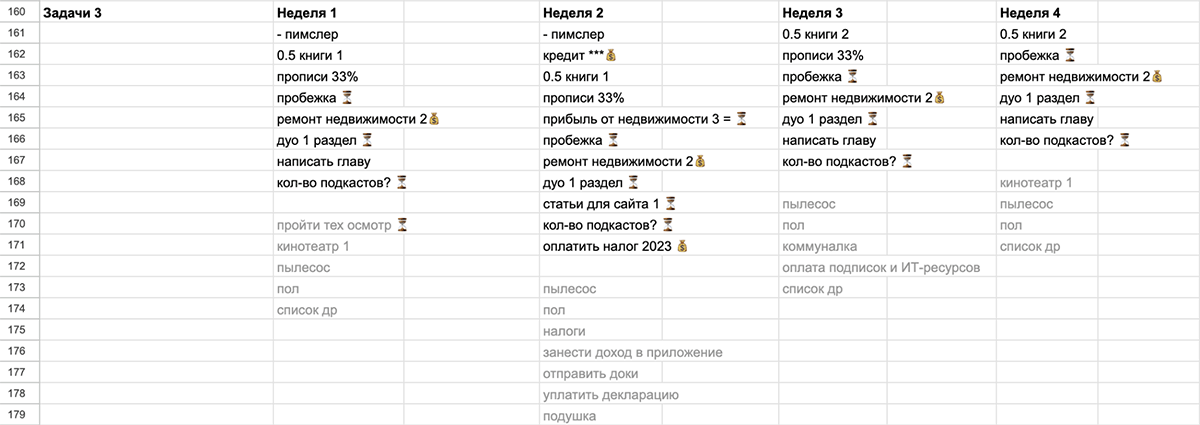
So, showing scheduled March, I think, makes no sense, just as there is no point saying that at the end of March you need to look carefully at what is done and what is not.
Next I will show how I planned my second quarter by months, since the first has already ended. Perhaps I do not even see the point of showing detailed planning of April or some other month of the second quarter, since I already showed this both in previous sections and in the example of the first quarter of my personal year. However it is definitely worth showing that goals over the course of a year can change, and that is perfectly normal. So, closer to summer, or rather, some even during the second quarter, new goals began appearing, while some others stopped being relevant. Roughly mid-year three goals became irrelevant for me, or rather, part became irrelevant, and regarding another part I understood I would not manage to do them this year. Here is the list of goals I had to temporarily say goodbye to:
Learning (English): Read books
Knowledge sharing: Give a presentation on space
******** ***** ****** **: ******** ***** ****** **
For example, I decided to give up reading a book in English, because I realized I have grammar problems, and in fact I replaced one goal with another without changing direction globally. Also my sister is finishing her studies and needs consultation and mentoring on her thesis project, plus there were several personal goals I will denote with asterisks. Here is the list of added goals:
Learning (English): New Round Up
Diploma
******* *********
******* *********
In any case global directions did not change at all, their substance changed, and the number of canceled goals is practically the same as new goals.
After updating, nothing at all changes in the planning mechanism. Take a quarter, plan by months, those in turn — by weeks, weeks — by days. Use two programs. As tasks are completed mark on the progress bar. Second-quarter plans are as follows:
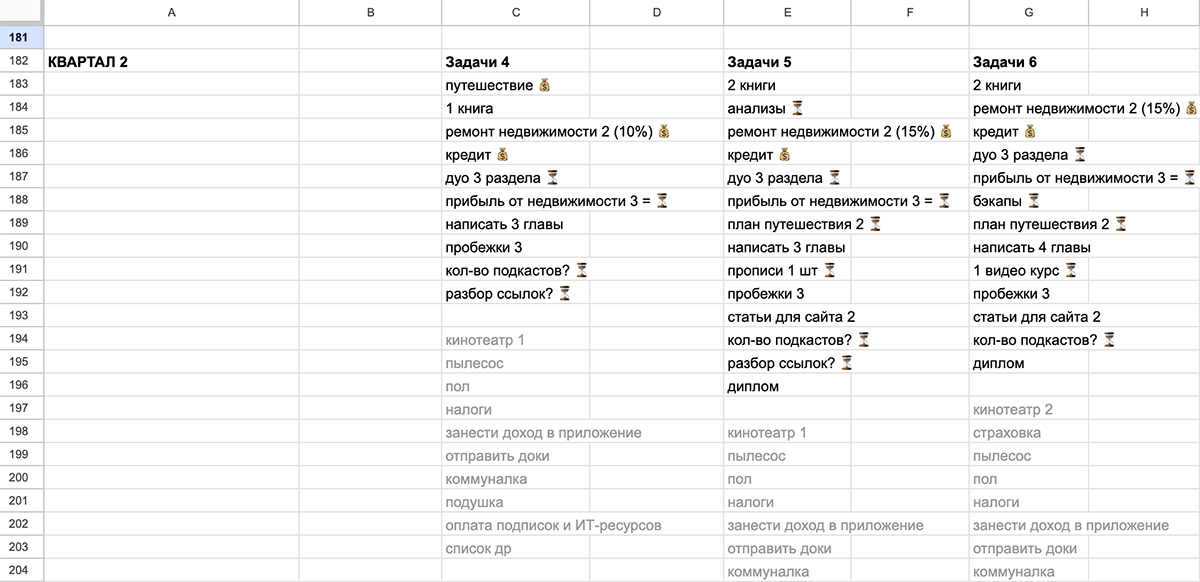

Of new goals here only thesis consultation and supervision. The remaining 3 new goals, as I already said, were added roughly mid-year, which means they go to the 3rd or 4th quarter. I also note that for convenient spreading of second-quarter goals first I copied them all into column "A" under the words "QUARTER 2" and then began moving by months (similar to what I already did above).
I will also show plans for the 3rd quarter.
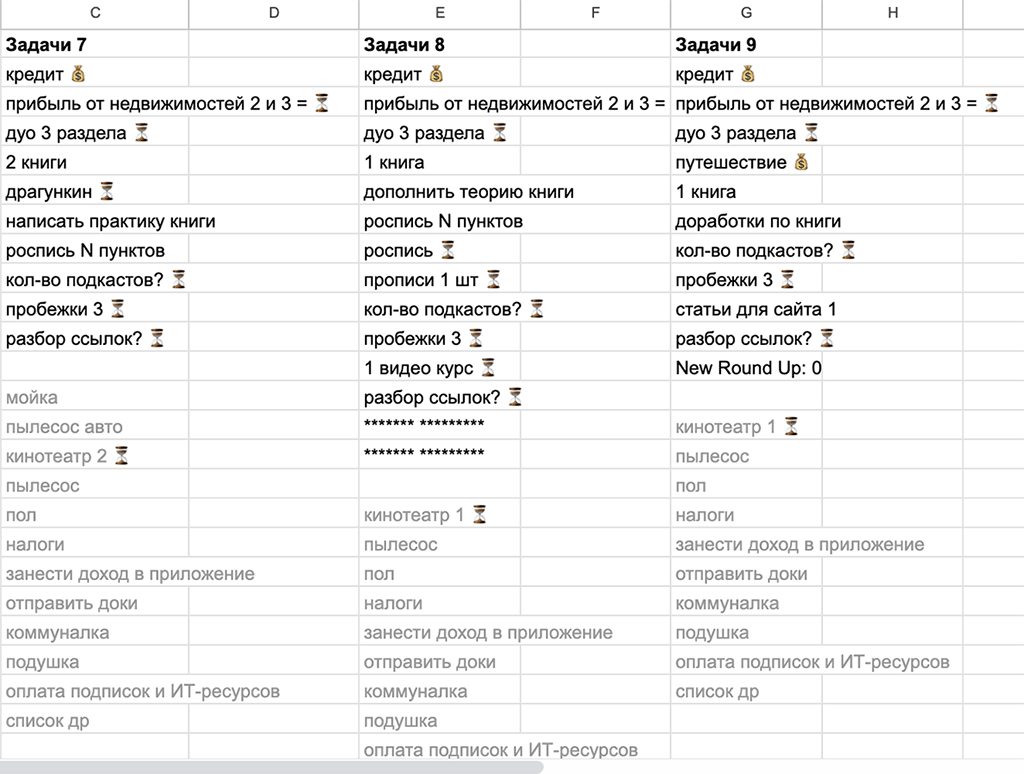
A few comments on the third quarter:
1) Instead of "write 10 chapters" (exactly that was the goal name for writing this book) in the end, closer to finishing the book, I decided to write more specific items for each month. Determine in which month I work on practice and in which on theory. As a result there turned out to be a lot of theory, and I decided to move practice into this separate book. Besides, plans shifted considerably on publication, because editorial work and image processing for the first book took a lot of time. So in fact in 2024 I wrote only theoretical material.
2) Travel was actually in a different quarter. Planned for September, but in fact took place in October, which is another month and even another quarter. In general there is nothing bad about this, because it is a complex organizational process. At the moment the last month of the 3rd quarter arrived (September), when I understood the move was inevitable, I tried to unload the next month (that is, October) and take some October tasks and complete them in September, that is, effectively swap the trip and part of some other tasks.
3) The registry office ceremony (or wedding) turned into the item "registry N items," because it also turned out to be an event requiring preparation. Therefore as the goal formed and, of course, the list, instead of "N" my wife and I substituted a specific number and began completing these items a month before the ceremony itself. Besides, for the ceremony I decided to duplicate the item itself — or rather it was there from the start, unlike all preparatory stages in the "registry N items" goal.
4) The "link review?" task — it too turned out rather abstract and I practically never found time to execute it, though I will write more about this.
5) About runs I already wrote above, but I will duplicate. 8 runs per quarter in fact turn into 9 for months, or rather even 12 for weeks. The thing is 8 is the minimum number of runs I plan per quarter, but also for a specific month I try to be stricter with myself regarding sport and write not 8 but 9 (equally 3 runs per month across 3 months). Next, when I plan weeks (I have 4 full weeks in a month) I raise requirements on myself even more and plan a run for absolutely every week (except, for example, weeks when I am abroad). Thus the number of runs in a quarter can increase from the initially planned 8 to 12 and more (if you proceed from the fact that weeks in a month are not exactly 4 but slightly more). That is why the final running goal is reached roughly by the end of summer.
6) You should not bind too strongly and strictly to the hourglass and money emojis used everywhere by me. Their main value for me is assessing financial-time goals at the start of planning the whole year, at most quarters. Further there is no particular point to them — they rather just auto-copy from higher-level goals to lower-level tasks. In week planning I generally try to give up emojis.
7) Some tasks go with strong ahead-of-schedule progress: movie outings, Duolingo, running, which I already wrote about above. Why this happens — generally different answers for different goals. In the case of running it is heightened demand for health and unwillingness to lose tone; in the case of movies it is periodic monitoring of good movie listings and unwillingness to miss good films, plus going to the movies does not take much time and does not require recovery or preparation, as with a run. As for Duolingo — it is the kind of language study method and task type that does not require deep concentration for a long time, which means people (including me) take on such tasks more often, start with them more often, and complete and overachieve them more often. In any case for all these goals even with ahead-of-schedule progress throughout the year I did not plan them in smaller volume.
So, upon completing the third quarter (as upon completing the second quarter or in principle any month) I do not forget to catch up on backlog items at the top, if any. In this case it is the trip that shifted by a month.
Next I move to the fourth quarter. Generally speaking, it differs slightly from the others. First, there may be vacations here (what that is I will write further), second, by this time a general picture emerges of which year goals are already closed and which need extra effort. Third, there are goals going ahead of schedule — in my case Duolingo and running, and perhaps it is worth doing these a bit less in favor of other tasks. On the other hand running is an investment in health, and I do not want to risk it. Fourth, there are several tasks that are no longer relevant, since I gave them up in summer, though others came in their place. But still the planning mechanics of the fourth quarter remain exactly the same as the others. Before I show how I planned my 4th quarter, I will also show goal lists for this quarter that I set at the very beginning of the year, as well as before the start of the 4th quarter:
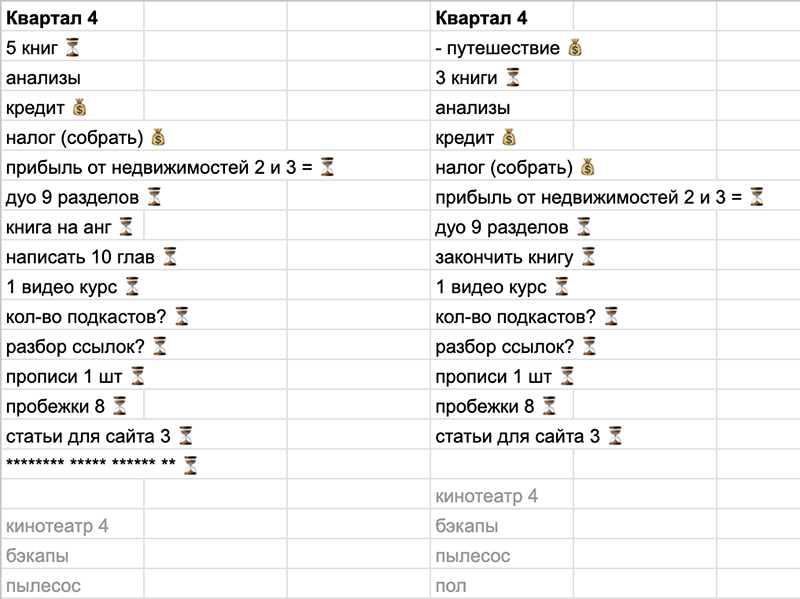
Secondary goals there is no particular point showing, so I omitted them in this demonstration and brought mainly main goals. Main differences: on the left — those set for the 4th quarter at the moment of planning goals for this year (that is, practically a year ago), on the right — fresher updated goals:
1) Instead of 5 books it became 3. This is because I still managed to find time for extra book reading throughout the year, and for the planned annual plan 3 books are enough, not 5, especially since there are other unclosed goals and no point reading more for now.
2) Of course, a carried-over "backlog item" appeared in the form of travel. By the way I read one of the books in the last month of the 3rd quarter instead of traveling.
3) I considered reading a book in English not yet worthwhile for now, and instead completed another goal in the 3rd quarter. I already wrote about this above.
4) Instead of the goal to write 10 chapters I set a more specific "finish the book," because the material was in fact being edited and formatted rather than new content being recorded.
5) I also gave up (still in summer) one more goal recorded with asterisks.
Otherwise there are no changes. Here is how I planned my 4th quarter.
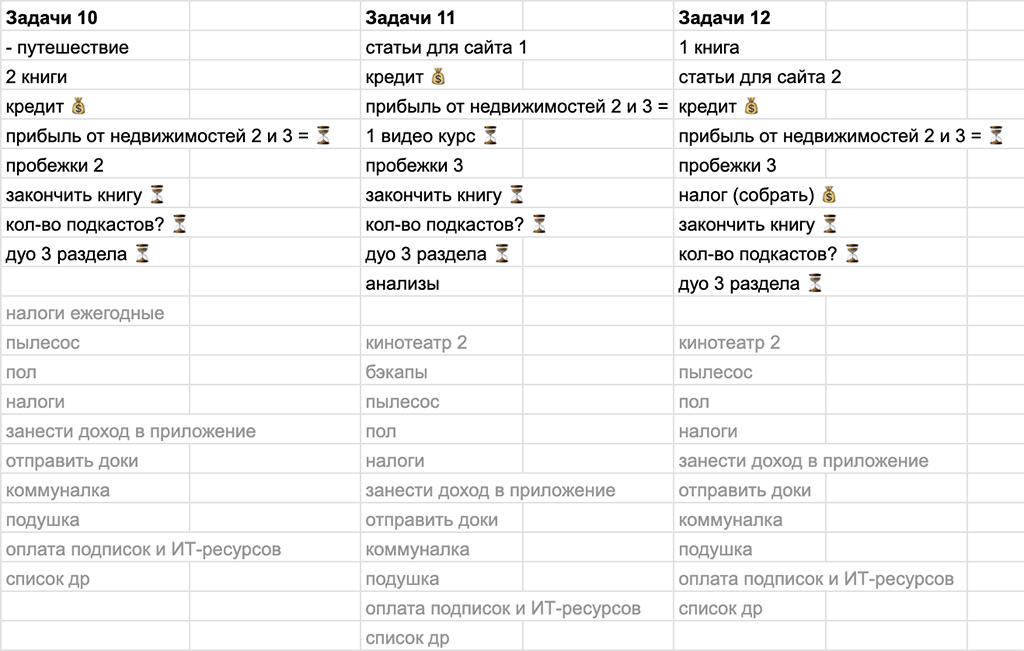
Since I said the 4th quarter is always the most, possibly, chaotic of all quarters — because you need to analyze even more what is done and what remains, there are both ahead-of-schedule tasks and backlog items — well, the most chaotic among all months of the year is December. This is the very last month, which requires even more analysis and effort. On the other hand, this month is most pleasant in that it is in it that the largest share of goals closes fully and is marked on the chart in the main spreadsheet. And the feeling of goals completed at 100 percent or maximally close to 100 percent is very pleasant and in some way motivating.
Scheduling the 4th quarter by months, weeks, and days I also no longer see particular point in, since I think you already know how to do this well. For interest I want to show the very final spreadsheet of my 2024.
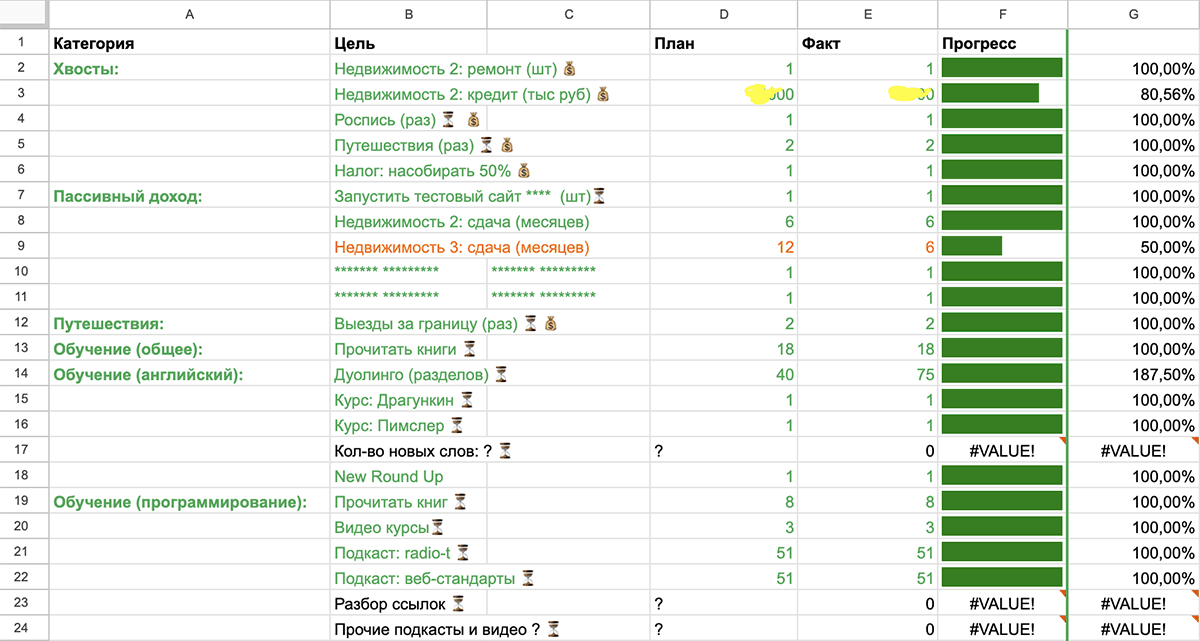
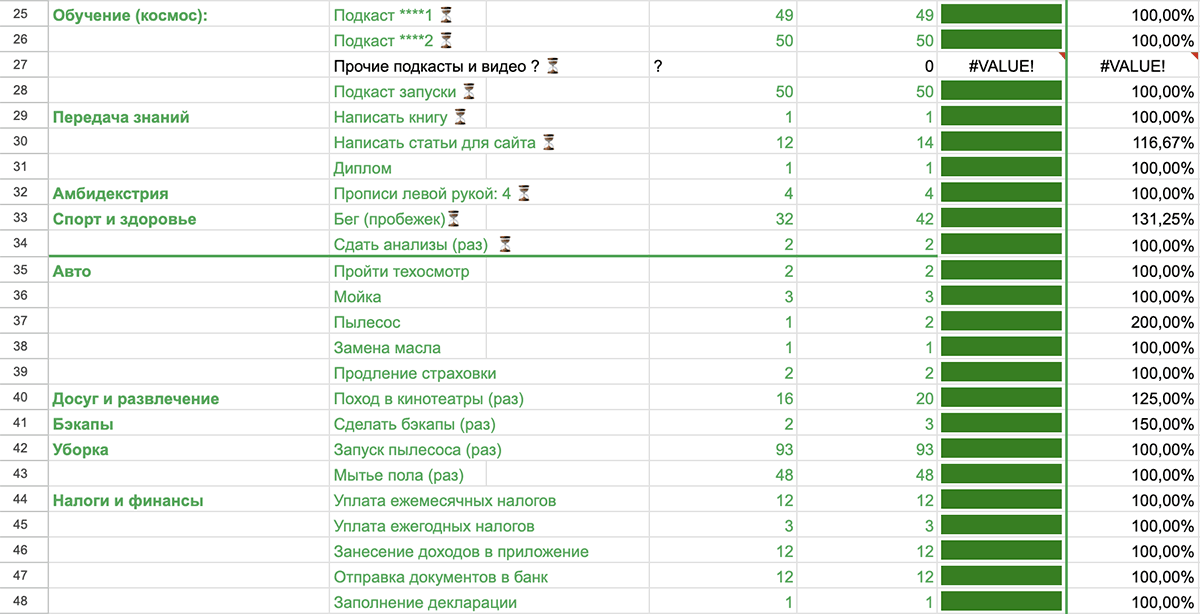

Some goals did not close, but one should be realistic — with 30–35 main goals and a whole bunch of routine ones it would be foolish to hope absolutely everything would go smoothly and that I could plan everything with ideal precision. Among unclosed or partially closed only a few goals remained, which means overall the year plan can be considered successfully completed. Several goals (primarily related to podcasts and training videos) I could not fully count, so I decided it was not so important and did not bother.
