
The last practice step you still need to absorb and apply.
Duration: for the rest of your life.
Goal: achieving personal goals.
First, a few words about the title. Annual means that we will plan a year ahead, and guru because this is a professional and master of their craft.
After you have practiced with sprints and completed about a dozen of them, and also developed the habits of planning and checking against your plan, it is now time to move on to bigger goals. In section 2, throughout the entire section, we thought about what we want from life and what we want from the coming year. At the end of the section we drew up a list of goals that are important to you. Its volume should be such that you can accomplish all the goals within a year. From now on we will approach completing tasks on schedule more strictly. However, even after completing ten sprints and possibly even several years of life according to the "Annual Guru" section, your intuition for taking on exactly as much as you will get done and no more may still not be perfect. And that is perfectly normal. Experience in accurately assessing your own "throughput" of energy comes with years. And if it is not yet accurate enough, you can either round the corners or move and shift unfinished work to the next time period. We will talk later about which approach is more correct. For now, let us focus on how exactly to approach planning according to the "Annual Guru" methodology.
So, at the input we have a list of tasks that you have decided to carry out. Ideally, it is best to start following your goals from the beginning of the year. However, I will not give such advice, as that is rather the lot of the weak and lazy. There will be no better time than now, so you need to take all new undertakings into work right now. If it is not the beginning of the year, I would advise living according to the "Monthly Sprinter" methodology until the end of the year, including the most urgent and important matters there, and then from the beginning of the year fully start using the "Annual Guru" methodology.
The essence of the "Annual Guru" practice can be described in just one paragraph. We take all our goals for the year and spread them across quarters in roughly equal parts. Next we plan the first quarter in more detail, and spread all the goals and tasks of the first quarter in more detail across three months. And for the very first month of the first quarter we plan tasks in detail down to four weeks. Thus, we will have a sprint scheduled by weeks for January. Next we take January's tasks and carry them out according to the "Monthly Sprinter" methodology. After the first month ends, we plan February's goals and tasks in detail and take them into work. After February ends, we do the same for March. After the first quarter ends, we again spread what is planned for the second quarter across the three months of the second quarter in roughly equal parts, and also plan the first month of the second quarter in detail, that is, April. Next we sequentially apply sprints to all three months of the second quarter. After the second quarter ends, we again proceed to planning the next (third) quarter and its first month. Similarly, after the third quarter ends and all three sprints of the third quarter are completed, we plan the fourth quarter. We finish the year by summarizing the entire year, analyzing what was completed and what was not, drawing up a list of goals for the next year, spreading them across quarters, planning the first quarter in more detail, and planning the first month in as much detail as possible.
Do not be frightened if nothing in the paragraph above makes sense — we will go through everything in detail with practical examples.
To begin, we again turn to chapter "2.4. Determine what you want to accomplish in a year. Connect your backlog". If you already had some plan drawn up, now is the time to update it. If you have no goals for the year, you need to identify them by moving some goals from the main backlog and the backlog of secondary matters.
The number of goals absolutely does not matter. It can be 3–4 goals in which you want to spend your entire year, or it can be all 50. Everything depends on your financial and time capabilities. If you describe and complete them in detail, the number does not matter. My list usually has about 25–30 goals for the year. Also, I hope you have not forgotten from the theoretical book that goals should be set independently as much as possible, without tying them to other people. If you did list several people in your goals, you will need to be an active initiator, executor, and controller in such goals.
Well, first we take this list and split it in roughly equal amounts across the 4 quarters of the year. All quarters have roughly the same number of days, so it is important and necessary to split evenly (unless, of course, one of your quarters is clearly more loaded, say with work, relative to the others) or you have decided to take a vacation (I will explain what that is later). For now, let us assume we will divide evenly. For better clarity I will draw up 10–15 fictional goals and spread their completion across quarters.
List of goals for … year:
1) Read 8 books
2) Carry out apartment renovation
3) Save up for a car
4) Quit smoking
5) Learn to play backgammon
6) Train the dog in three popular commands
7) Achieve a salary increase at work
8) Plan a trip abroad
9) Throw out everything I do not use
10) Spend less time on the phone
11) Get a driver's license
12) Save for a financial cushion
13) Make 2 backups.
The first thing here that contradicts what I wrote above is that all the goals are scattered across the most different categories, that is, there is no single life direction. However, this is because the goals are exclusively fictional and for an example this is more than enough. First, I do not think that by the time you read the book you have already determined in much more detail and clearly who you want to be, so that accordingly you form all goals or at least most of them in some single unified sphere; second, you can simply remain a person with diverse interests, so such a list is quite appropriate. Besides, its substance is not especially important right now — what matters is how we will plan it further.
Before moving on to detailed planning, let us describe each of the goals in detail and see what tasks and steps we need to take to achieve these goals.
1) Read 8 books. This goal actually has no complicated steps — we take it and carry it out, evenly splitting the number of books across quarters.
2) Carry out apartment renovation. This goal turned out very abstract and clearly does not fit the SMART methodology that I wrote about in my first book "How to Master Productivity and Planning?", but nevertheless it is quite a real goal. What to do in such a case? It is worth bringing it into a more detailed form, that is, breaking it down into steps, and then carrying them out with an approximate time estimate. If this is not your first renovation, it will be significantly easier, but even if you have not dealt with this before, it is quite easy to find all the steps of renovation on the internet. Let us imagine this is a new building without finishing. Then you need to take approximately the following steps:
— approve some design project (it can be done by a professional designer or by you on a sheet of paper — everything depends solely on the level of detail)
— run rough electrical wiring
— run rough plumbing
— finishing work
— tile laying
— laminate and wallpaper
— built-in furniture
— stretch ceilings
— other furniture
— outlets, switches
— faucets and taps
— interior doors, baseboards
The plan, although not described in great detail, is on the whole already better than nothing. It is also worth remembering that some items can possibly be swapped and done in parallel, and also that while one part of the work is being done, you will need to actively work through the next items: choosing certain products and placing orders so they arrive on time and do not halt the renovation as a whole.
3) Save up for a car. This goal is probably also clear. Suppose we have a certain sum and we are short $2000. Each month we will set aside equal parts of a certain amount so that, for example, we can buy a car in the fall. For convenience, let us assume we have 10 months at our disposal, so we will set aside $200 per month.
4) Quit smoking. Right away I will note that I am not a great specialist on smoking and methods that help quit smoking, but for an example I will take the most common method — gradual reduction of cigarettes per day. Suppose you currently smoke 15 cigarettes a day. Let us try to gradually transition to zero. And besides reducing cigarettes we will also study other methods that help quit. Thus, we will identify the following subtasks/steps:
— reducing the number of cigarettes
— studying alternative methods
— as we find a certain method, we will set aside time for it and apply it
5) Learn to play backgammon. A goal that is hard to imagine anyone would need, but nevertheless for an example we will also describe it. Let us break it down into the following steps:
— studying game theory
— practice and real games (for example online games)
6) Train the dog in three popular commands. Although in life I am more of a dog person than not, and we had smart dogs that understood commands, I still do not understand how we taught them. Most likely it is simply regular repetition of commands with prompts plus praise for the dog when it performs. For more proper training it would probably be worth turning to professionals, but for our example we will train on our own. In our case we will record the commands as follows:
— command 1
— command 2
— command 3
Instead of numbers you can substitute whatever you like: lie down, sit, give paw, speak, and others. By the way, this is the first goal that is relatively tied to someone else, though not a person but an animal. However, as experience shows, sometimes it is easier to come to an agreement and work together with animals than with some people.
7) Achieve a salary increase at work. This item also requires involving other people, since you can hardly assign your own salary. Moreover, this item will most likely be a poor fit for workers in government sectors. Although, however, various professional development courses might possibly save the situation. Let us still try to identify the following steps in this item:
— raise the conversation with management about a salary increase, at which:
a) agree on the amount of the increase
b) find out when this is possible
c) understand what you need to do for this.
— from item "C" the answer will most likely follow:
a) do more work than you do now
b) raise your qualifications and experience.
For raising qualifications and experience we will set aside time for self-study in professional career growth. We will also set aside time for possible automation of some processes to speed up work. In general, you need to understand that by the phrase "we will set aside time for automation…" I do not mean that I will suggest something specific to you. Everyone has their own strictly individual solution for your automation. You must find and invent it yourself. Say, if you work with Excel, instead of entering data manually it would be correct to study Excel in depth at the level of formulas or even at the level of writing scripts for it. It is especially relevant now to connect neural networks to your work, which I also wrote about in my first book "How to Master Productivity and Planning?" in one of the sections.
8) Plan a trip abroad. This goal will include the following tasks:
— decide on the country (countries)
— decide on the month and dates
— buy tickets
— book accommodation
— choose sights
My list usually includes several more items, but for an example this is quite enough.
9) Throw out everything I do not use. Let us try to break this goal down into the following tasks:
— Conduct an audit of my personal wardrobe
— Conduct an audit of things, souvenirs, and trinkets
— Conduct an audit of furniture and kitchenware
10) Spend less time on the phone. By analogy with smoking, let us try to simply reduce the "dose." Let us identify the following steps:
— Install an app to track time
— Gradual reduction of time
11) Get a driver's license. This goal includes the following steps:
— Sign up for driving school
— Pass the medical examination
— Attend 30 theory lessons
— Attend 20 practical sessions
— Pass 7 tests
— Pass the internal exam at driving school
— Pass the exam at the traffic authority.
Generally speaking, I no longer remember exactly how many tests there are, how many theory lessons, and how many practical ones. Moreover, from country to country the rules and format of training may and most likely will differ. Let us assume we signed up for April and over 4–5 months we will be "attending" driving school, so we will plan tasks for those months in the future.
12) Save for a financial cushion. A goal whose tasks will be very similar to buying a car. The only difference here is that until the moment we buy the car we will save $50 per month, and after buying the car already $100.
13) Make 2 backups. What backups are — in case you have forgotten — you can find out in my first book "How to Master Productivity and Planning?". Suppose we want to make backups of information valuable to us 2 times. As we plan other tasks and see which quarters have the fewest goals in work, we will schedule time for backups in the months of those quarters.
Now it is time to split our goals across quarters. Let us distribute the goals as follows:
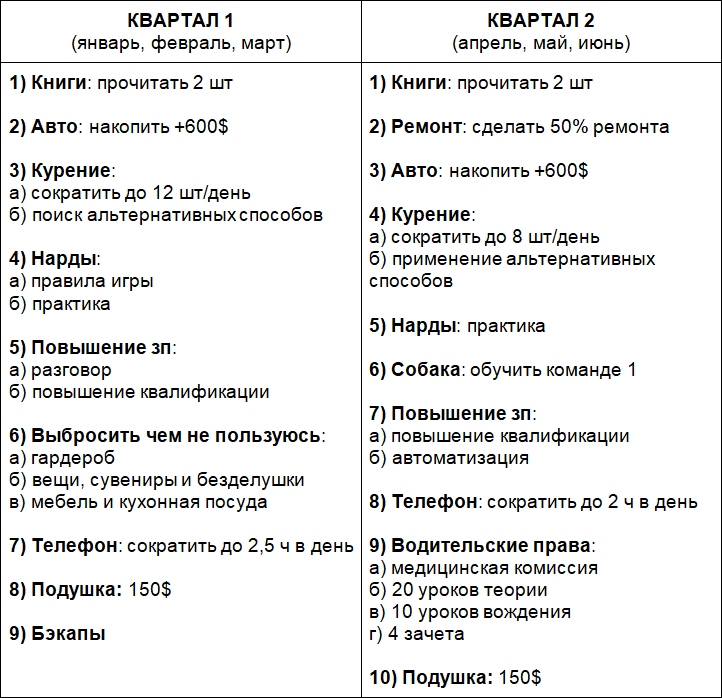
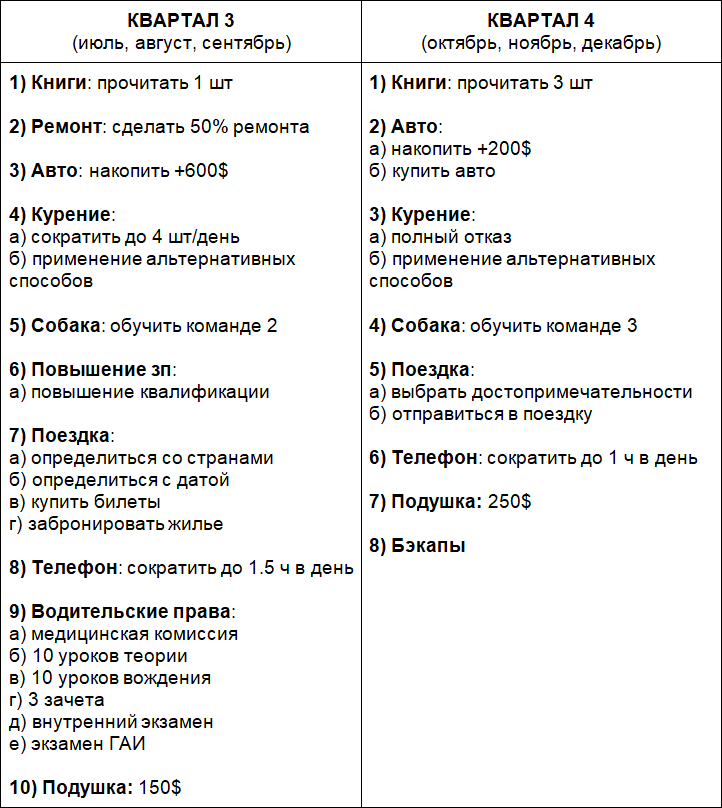
You can quite well plan all matters roughly the same way I did above. This option is quite good and correct. Not counting the fact that you can train a dog in three commands in a couple of weeks, while we will spend 3 quarters on it :). Although I myself rarely plan matters in such detail already at the stage of planning the entire year. Probably, if I were planning such a list of matters for myself, it would be compiled as follows:
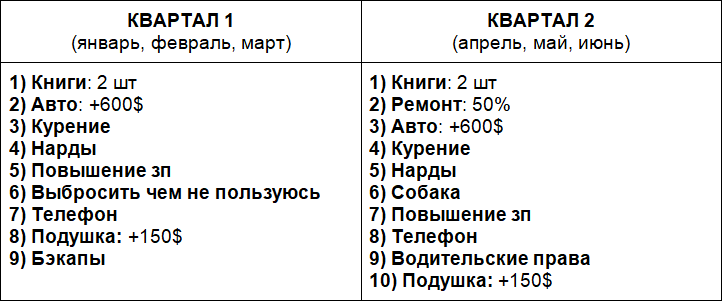
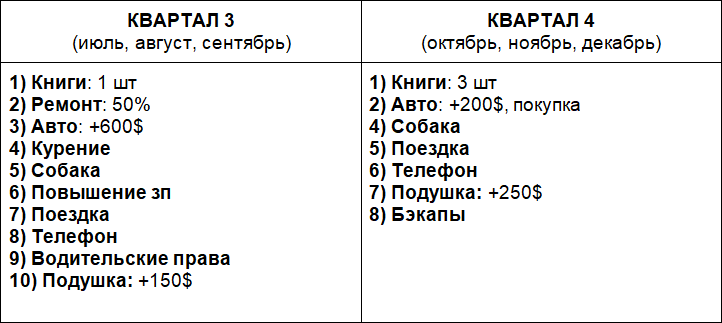
You will agree, such a list is easier to read and keep in your head. Drawing it up requires less time and effort at the current stage, and the effectiveness from it is no less than from the detailed one. Although, no matter how you spin it, we will still need detail, but for the current moment a shorter record is quite enough. Of the precise calculations I indicated in parentheses, at the current stage I noted only what is most easily subject to analysis and counting. More complex variants I would not plan out yet. However, how to proceed in this case — plan in detail now or later — you will decide yourself and choose the option most convenient for you.
Next we take the tasks of our first quarter and continue working with them:
1) Books: 2 pcs
2) Car: +$600
3) Smoking
4) Backgammon
5) Salary increase
6) Throw out what I do not use
7) Phone
8) Cushion: +$150
9) Backups
We break this list down in detail by month. This may look as follows:
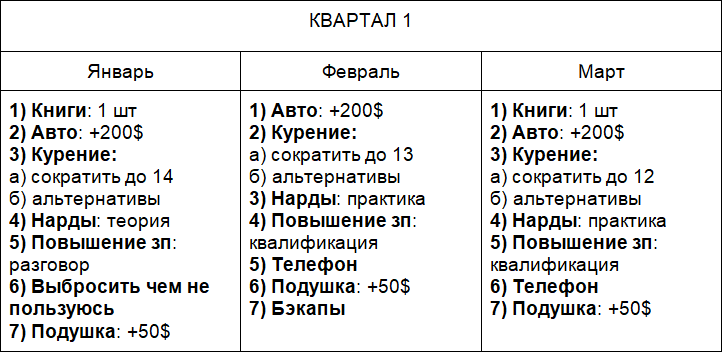
Next we take the tasks of the month closest to us (January) and break its tasks into 4 weeks. This may look as follows:
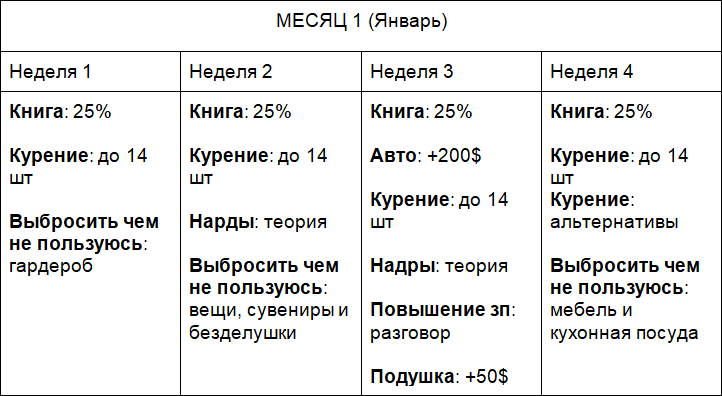
I will make a few comments about the table above. I simply split the book into equal parts of 25 percent across 4 weeks. Instead of percentages you could have indicated the number of pages. More precisely, that would actually be more correct. Plus it is not necessary to read the book absolutely every week. Say, you could read it in 2 or 3 weeks, but then of course the volume of pages read would need to be increased for each of those weeks. As for smoking, as it seems to me, this is an important task that must be done absolutely always without giving slack. Also in the fictional month let us assume our salary is deposited into the bank account around the third week, so specifically on the third week I marked setting aside money for the car and for the cushion. The other notes, I think, do not need comments.
Thus, we have already broken our detailed plans down to the level of "Weekly Beginner". What to do next, you already know quite well. You take the tasks of each week and break them down by days so it is convenient for you to carry them out — that is, you apply the "Weekly Beginner" practice.
After the month comes to an end and it is time to carry out February's tasks, in exactly the same way we take our February tasks and break them into 4 weeks. To begin, let us once again duplicate the planned tasks for February:
1) Car: +$200
2) Smoking:
a) reduce to 13
b) alternatives
3) Backgammon: practice
4) Salary increase: qualifications
5) Phone
6) Cushion: +$50
7) Backups
And finally, let us break them down by weeks. This may look as follows:
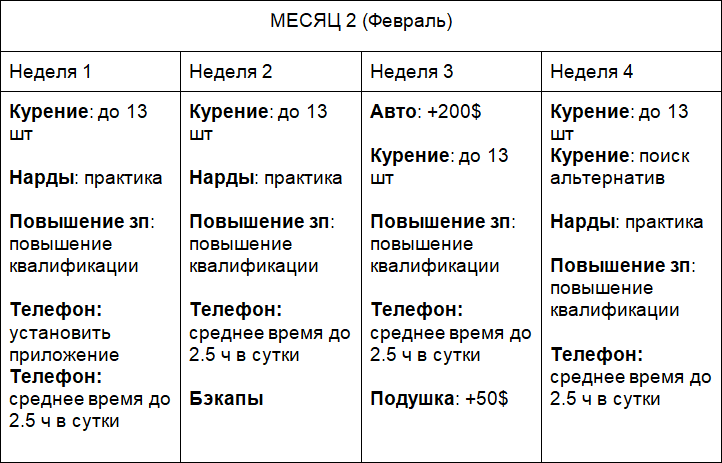
I will also leave a few comments on drawing up tasks for the month. I deliberately decided not to include backgammon in the third week. With phone time you could have started reducing time more strictly not only by months but also by weeks, but for the example I decided to leave the same value. Raising qualifications may imply both simply studying theory and directly raising qualifications in certain courses. Money for the cushion and for buying the car we will set aside in the salary week, that is, the third week of the month.
In the same way we got weekly tasks that should then be broken down by days and taken into work. I expect that the "Weekly Beginner" methodology did not cause you any particular difficulties, so to save my authorial time I decided not to break weekly tasks down by days as well.
At the very end of February it is time to break March's tasks down by weeks. To begin, let us duplicate and refresh our memory and list what exactly we planned for March:
1) Books: 1 pc
2) Car: +$200
3) Smoking:
a) reduce to 12
b) alternatives
4) Backgammon: practice
5) Salary increase: qualifications
6) Phone
7) Cushion: +$50
Let us spread these tasks across weeks:
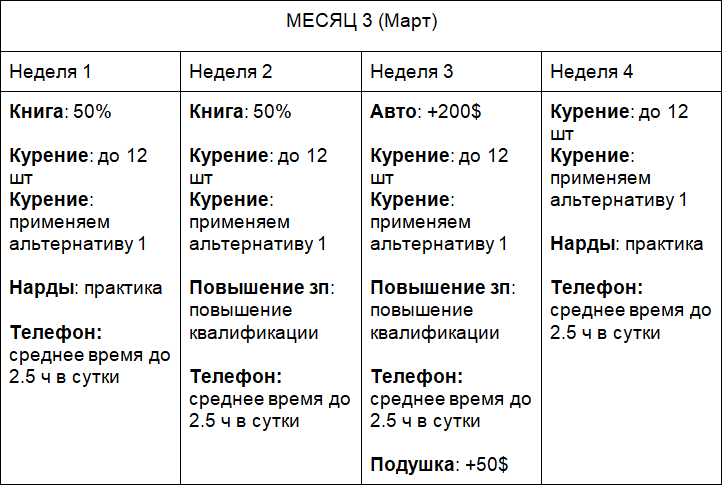
By tradition, a couple of comments on what I wrote above. Suppose the book this time is small and we will read it in 2 weeks. In smoking we will reduce the amount to 12 cigarettes per day, and also apply possible alternatives, since I hope that by this month we have already actively studied what else can help wean us from smoking, or rather, reduce the desire to smoke. Perhaps it is simply gum, candy, sunflower seeds that can distract and suppress the desire to smoke for a while. There can be other methods not related to food at all. Next, suppose we have a very busy 2nd and 3rd week due to studying theory for a salary increase, so we will only play backgammon in the first and last week of the month. It is also important to continue and not violate the planned goal of reducing interaction with the phone, and we will carry this out every week without giving slack, thereby developing a new useful habit: "not sitting on the phone for long."
Bingo. The first quarter is over. We have just successfully planned and completed it. By completed I, of course, mean conscious and purposeful completion, not just notes on paper. Otherwise everything planned has no meaning at all.
Already now you can conduct some analysis and small adjustments to goals. Whether to do this or not, each person will determine for themselves. If there were many overall goals for the year, completing the first quarter is quite an occasion to adjust something, since a quarter of the year has already passed. And if there were only a few goals, perhaps there is nothing to adjust.
So, we move on and take the tasks of the second quarter:
1) Books: 2 pcs
2) Renovation: 50%
3) Car: +$600
4) Smoking
5) Backgammon
6) Dog
7) Salary increase
8) Phone
9) Driver's license
10) Cushion: +$150
By analogy with the tasks of the first quarter, we break them down in table form by months:
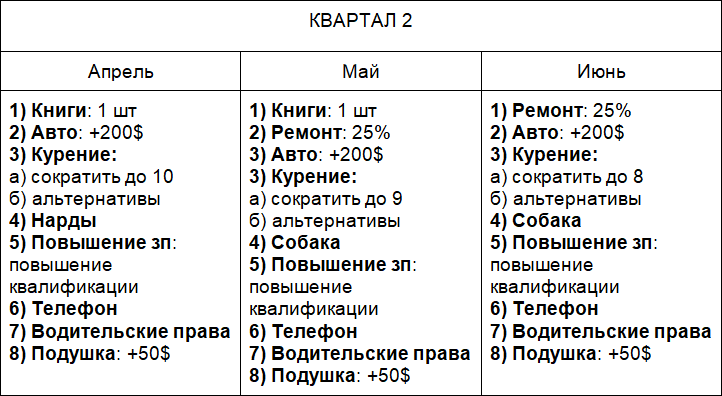
Next, according to the scheme already well known to us, we take April's tasks and plan them in detail. For an example, besides January, February, and March, let me also plan tasks for April. We get approximately the following.
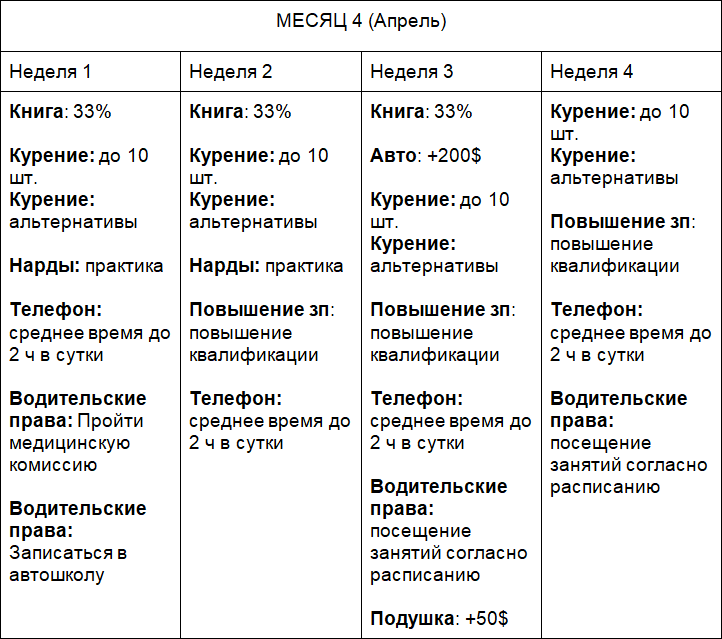
By tradition I will tell about what I planned above. We will read the book in 3 weeks in roughly equal parts. Although it is not at all necessary to stick to equal splitting, and nothing critical will happen if a small part carries over to the 4th week as well. We also continue the fight against smoking and have reduced the number of cigarettes allowed to be smoked per day a bit more, and also continue studying and applying alternative methods that can help us in the nicotine war. In backgammon we will play only the first two weeks, since driving school classes will begin after that and we will have less free time. We also continue doing everything we once agreed on at the beginning of the year with our boss, aimed at a salary increase. This can be both additional automation of work processes and raising qualifications. We continue reducing phone usage time. Well, and we begin studying at driving school, which I already mentioned in a couple of words. To begin, we signed up for driving school (most likely the signup itself should be much earlier in case there are long queues, but for our example we omitted this nuance). In the third and fourth weeks we will have several weekly theory classes that we must attend according to our driving school schedule. Then, when planning weeks with breaking tasks down by days, knowing the exact days when these classes will take place, we can explicitly mark them in the list or calendar. Also do not forget that in the third week we have our salary, which means we will need to set aside the amount for the "cushion" and for the car.
In this "Annual Guru" section I have never yet given an example of what to do with tasks that we broke down into 4 weeks. And at the beginning of the chapter I was not even going to do this, since in the "Weekly Intern" section there is enough information and examples. Nevertheless, for completeness at the end of the current section I still decided to change my mind, and as an example decided to plan at least one of the weeks. Let us take our first week of April. Here are the tasks we should have done there:
Week 1:
Book: 33%
Smoking: down to 10 pcs.
Smoking: alternatives
Backgammon: practice
Phone: average time down to 2 h per day
Driver's license: Pass the medical examination
Driver's license: Sign up for driving school
As I said earlier, when reading books it is easier to work with real pages rather than percentages, so let us assume the book consists of 300 pages, which means its third part that we planned to read in a week equals 100 pages. Each weekday we can read 20 pages. And if we do not manage something, we will finish reading on the weekend. Smoking is important to control every day, which means this is a daily task where ideally you need to keep track of cigarettes smoked and possibly even some accounting of the effectiveness of alternatives. With backgammon everything is simpler. This is a slightly abstract task and does not have very rigid SMART goals — our goal is simply to learn to play it, and by this time we already know its rules well, have played many games, and further simply continue practicing, say, in the evenings at least 3–4 times in those weeks when we can devote attention to backgammon. With the phone the situation is analogous to smoking: every day we will control our time through the installed app (which we should have installed back at the beginning of the year). Ideally, if such an app allows setting limits on phone usage and will issue messages when they are violated. For the driving medical examination we will set aside two days, if we assume that in one day we will not manage to fully pass the examination, and also on one of the days we will sign up for driving school. As a result we will get approximately the following schedule:
WEEK 1:
book: 20 pages (Mon)
smoking: down to 10 (Mon)
smoking: alternatives (Mon)
backgammon (Mon)
phone: up to 2 hours a day (Mon)
…
book: 20 pages (Tue)
smoking: down to 10 (Tue)
smoking: alternatives (Tue)
phone: up to 2 hours a day (Tue)
driver's license: pass the medical examination (Tue)
…
book: 20 pages (Wed)
smoking: down to 10 (Wed)
smoking: alternatives (Wed)
phone: up to 2 hours a day (Wed)
driver's license: pass the medical examination (Wed)
…
book: 20 pages (Thu)
smoking: down to 10 (Thu)
smoking: alternatives (Thu)
phone: up to 2 hours a day (Thu)
driver's license: sign up for driving school (Thu)
…
book: 20 pages (Fri)
smoking: down to 10 (Fri)
smoking: alternatives (Fri)
backgammon (Fri)
phone: up to 2 hours a day (Fri)
…
smoking: down to 10 (Sat)
smoking: alternatives (Sat)
backgammon (Sat)
phone: up to 2 hours a day (Sat)
…
smoking: down to 10 (Sun)
smoking: alternatives (Sun)
phone: up to 2 hours a day (Sun)
…
Also, instead of an ellipsis I recommend that you include other matters as well, such as a trip to the hairdresser, for women — booking a manicure, doctor visits, or even shopping, if you do this not every day but rather 1–2 times a week. This will allow you to keep in the list all matters you need to complete during the week — some of them lead to achieving goals, others are simply routine.
There is probably no point in planning May and June in detail anymore, since the general methodology and the process itself are more than clear — we have planned January, February, March, and April. You should have the following tables filled with your own matters:


Note that week numbering for me starts anew from each month, but month numbering does not. We will reset months only at the beginning of the year.
After the second quarter ends, it is necessary to move on to the third. Split all tasks across 3 months.

Plan July's tasks (month 7) in detail and carry out the 7th sprint (month 7):

After the 7th sprint (month) ends, we plan the 8th sprint (August) in detail and take it into work. Then the 9th sprint (September). After September ends, it is necessary to spread across months all the work we need to do in the 4th quarter, and also plan sprint number 10 (October) in detail. After completing the 10th sprint, we plan the 11th sprint by weeks and take it into work. Next we do the same with the last 12th sprint of this year (December). After December ends, we carry out reflection and conclusions for the entire year. We will talk about how to do this below in other chapters.
I did not plan the entire year in detail with goals down to the days of each week, but we planned in sufficient detail for an example:
1) initial splitting across quarters
2) more detailed splitting across the first and second quarters
3) detailed splitting of the first four months
4) thorough splitting of the first week of the fourth sprint
Thus, we have just become more familiar in detail with the planning practice on the example of a certain fictional list of goals. For even greater reinforcement of the practical material, I suggest considering one more example of the "Annual Guru" methodology. This time it will be a real example. An example of my 2024.
