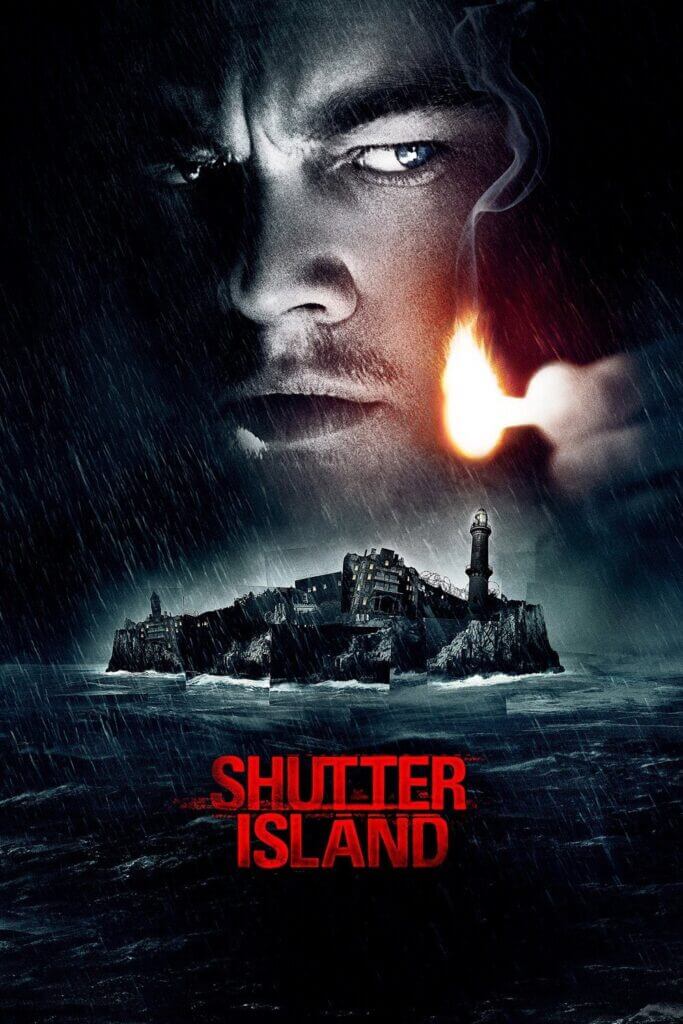
Now I will analyze Martin Scorsese's film "Shutter Island." Spoilers will follow, so if you haven't seen it yet, it's better to watch the film first.
This is one of those films where for almost the entire runtime you sympathize with the protagonist and think that everything around him is staged. But Martin Scorsese, much like Christopher Nolan in "The Prestige," scattered a bunch of small clues throughout the film that hardly anyone notices on first viewing.
As we already know from the film's ending, the protagonist Teddy Daniels, brilliantly played by DiCaprio, is not a federal marshal at all. He is a former serviceman who, upon returning home one day, saw his drowned children and then killed his wife. This is why he was committed to the hospital on the island. He invented a story for himself in which his wife died in a fire and they never had children. This was his subconscious protecting him from the real story, in which he is not a killer, but rather a victim. Moreover, in this story he has no children, meaning he no longer has to remember their deaths.
However, it wasn't only family tragedy that affected him. The film also repeatedly features flashbacks to a prisoner-of-war camp he had to liberate. In particular, the memory of the events at Dachau reveals another severe trauma he couldn't overcome.
The hospital doctors decided to stage a real performance, giving the protagonist a chance to confront himself and remember who he really was. Why did they do this? Because he posed a serious threat to other patients, possessing military skills and having already committed a murder. Therefore, if he had been harmless, they might have left him in his thoughts, dreams, and persona. But it could no longer continue this way, and something had to be done.
At that time, psychology had two approaches to such severe cases. The modern approach attempted to give patients a chance at rehabilitation, including playing along with their roles, as the hospital staff did. The more classical and older approach practiced lobotomy — surgical intervention in the brain to disrupt the functioning of certain areas.
One of the heads of this institution, also a physician, Dr. Cawley, played by Ben Kingsley, decided to give Andrew Laeddis a chance and stage a real performance before him to bring him back to reality.
Did the doctor's plan work? After all, in the end, Andrew still received a lobotomy, as we can infer from the final shots?
Actually, the very last shot deserves a closer look. "How are we doing today?" asked Dr. Sheehan, played by Mark Ruffalo. He deliberately didn't ask anything else, but posed the most abstract question to understand: who exactly was standing before him today — the wife-killer who survived the loss of his children, or Federal Marshal Teddy Daniels?
"What are we gonna do, you tell me."
"We gotta get out of here, Chuck, back to the mainland," said Teddy.
This clearly shows that he is out of his mind again, and the entire experiment has failed.
But the most important thing is Andrew's final line. As soon as Dr. Sheehan walked away, he added: "I ended up here and thought: which is better — to live as a monster or to die as a good man?"
He said this while fully aware, that is, being in the real world, not in a fabricated persona. It is too difficult for him to go on living each day, tormented by his past, and he is ready for the most radical step — lobotomy — just to forget his past and everything he's been through.
There were many scenes throughout the film that indicated the protagonist was mentally ill, starting right from the very first shots.
Two federal marshals are sailing in fairly ordinary weather. There is no storm. Yet one of them is getting seasick. Why? Either because he is struggling without the pills he had taken for years, or because the water reminds him of his trauma, since it was in water that his children died.
"You're my partner?" — a strange phrase, as if they had just met, even though they are already approaching the island.
Then Teddy can't find his cigarettes. To which Chuck replies: "People on the island like to bum smokes." But they haven't been there yet. Which island? By logic and common sense, they are only arriving at the island and haven't been there before. And then how would he know whether people there like to steal cigarettes or not?
There were many other factors pointing to the oddities of this marshal duo. The camp guards treated them rather strangely, and not just because of their own rules and regulations, but because one of them required special attention.
During the so-called interrogation of patients, they also acted strangely. First, many of them answered mechanically, as Teddy himself noted. Second, almost all of them looked at Dr. Sheehan, as if waiting for some approval from him.
Recall, for instance, the scenes where the guards search the island for the missing Rachel Solando. To put it briefly, they do absolutely nothing, and it certainly doesn't resemble a search operation to capture a patient. Additionally, Teddy found it particularly hard to listen when the feigned staff and patients spoke about heroes whose fates resembled his own story.
Also, one crucial scene for uncovering the truth took place with a patient from Block C — George Noyce. He directly hints to Teddy that there is no real investigation and that the entire island is playing by his rules. Noyce also tells him that Teddy is being used like a rat in a maze and that everything happening is actually connected to him.
When you watch this film a second or third time, you pay attention to all these little details, but on the first watch, you don't.
And this is precisely what I liked about the film. Scorsese, on one hand, scattered clues throughout the film so that the viewer could conclude that the protagonist is indeed mentally ill. On the other hand, he does almost everything to keep us sympathizing with the protagonist until the very end. All the characters, except for Teddy, are shown as absolutely repulsive, and their speeches are suspicious. They interfere with the investigation, forbid access to certain places, and don't hand over personal files, which, of course, raises certain suspicions.
And this, in my opinion, is the main focus of "Shutter Island." We are made to investigate the case together with Teddy, although in reality, we are not investigating the disappearance of Rachel Solando, but Teddy himself. All the clues are right in front of us, but like the protagonist, we prefer to believe the version of events we like more.