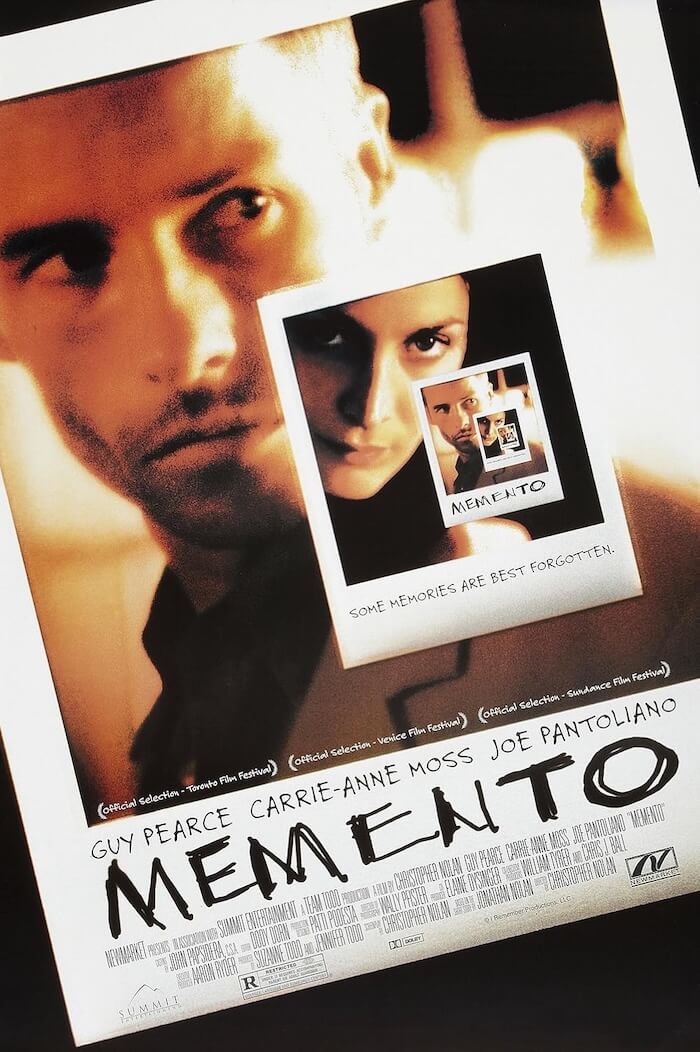
Attention! Unlike most films, where I usually try to avoid spoilers, here we're not talking about a hidden meaning or the director's message, but about untangling the plot itself, which, most likely, remains incomprehensible for many viewers after the first viewing. So spoilers are unavoidable here. If you haven't watched the film yet, it's better to pause this breakdown and watch Memento first.
The first thing that catches your eye is that black-and-white shots alternate with color ones, but they unfold completely differently. The black-and-white line develops in forward order, while the color line unfolds almost entirely in reverse. That is, the regular color scenes play out backward, while the black-and-white ones are sequential.
At the same time, the black-and-white line is more connected to memories and the past, while the color line gradually shows us what's happening in the present. The black-and-white scenes help us at least somewhat understand what the film is even about and what problems are being addressed in the color line. Each new insert adds another piece of information, until both lines finally converge in the middle of the plot — that is, effectively at the story's finale.
This creates an interesting effect: the color line is chaos, in which it's nearly impossible to make sense, while the black-and-white line is at least some kind of island of sequence and explanation.
For the first while, you really don't understand anything in the film, but that's no surprise — the plot is constructed very cleverly. Moreover, even after a second or third viewing, you can still find new details that you never even noticed before.
So what's actually going on?
The main character is indeed trying to find the man he believes killed his wife. But gradually it becomes clear that the story he's convinced himself of is far from that simple.
The first ten minutes of the film already hint that Leonard is far from killing someone for the first time and that he may have already found and killed several people he held responsible for his wife's death. Yet on a first viewing, we barely notice this, because we don't yet know the ending and don't grasp the significance of many dialogues and details.
For example:
— "Have I told you about my condition?"
— "All the time, I hear that."
Or:
— "My car!"
— "Is that really your car?"
There's another very interesting detail. When the characters first arrive at the warehouse, Leonard's car is already there. And it's the very same blue car he left there earlier. So they've been here before, and not for the first time. Later, it's said that the car has been there for about six months. This indirectly shows that Leonard has been in this city for a long time and has been carrying out his search for quite a while.
Another important moment occurs when Leonard puts a gun to Teddy's head and asks if Teddy even knows who he is. Teddy calls him by name, and Leonard corrects him: "That's who you were?" The line seems odd on first viewing, but after the finale, it takes on a completely different meaning.
Throughout the entire film, we're constantly given hints that Leonard has been living in this state for a long time and that his condition doesn't just hinder his life — it allows other people to take advantage of him.
Teddy is clearly using him for his own benefit. The motel owner also realizes he can make more money off Leonard: he constantly forgets where he lives and how much he's already paid. The bar worker also exploits his condition for personal gain. So practically every person who understands that Leonard has a memory disorder tries to use it to their advantage.
A particularly interesting moment happens closer to the middle of the film, when Teddy starts asking Leonard questions: where did he get the car, the suit, the money for the motel? And instead of engaging critical thinking and questioning the storyline Nolan has been leading us along from the very beginning, we continue to believe the main character unconditionally.
Even the basement of the abandoned warehouse becomes an important detail. At the start of the film, the characters never go down there because Jimmy's body is already lying there, and if Leonard had seen it earlier, the entire structure of the film would have fallen apart much sooner.
And here we gradually come to Sammy Jankis.
Throughout the film, Leonard tells the story of Sammy — a man with the same memory problem. His wife supposedly tried to test whether Sammy really couldn't remember new events, and as a result, he gave her several insulin injections, forgetting he'd already done so before. In the end, an overdose occurred.
But closer to the finale, Teddy tells Leonard a completely different version: Sammy did exist, but he didn't have a wife. The story about diabetes and insulin actually belongs to Leonard himself and his wife.
It's right here that the film finally begins to blur the line between reality and what Leonard forces himself to believe. We see hints that Sammy's story is actually a distorted reflection of Leonard's own story. The film even has visual moments where Sammy's image is literally replaced by Leonard's.
So it turns out that Leonard's wife survived the attack, and then he himself gave her multiple insulin injections. He didn't realize he'd already given the previous injection, and ultimately became the actual cause of her death. This version explains why Sammy's story so closely resembles his own. At the same time, the film deliberately leaves some ambiguity, forcing the viewer to decide for themselves how much of Teddy's account aligns with reality.
And here comes the most interesting part of the film.
Throughout the entire viewing, we empathize with Leonard. We know he's sick, we know he lost his wife, and we hope he'll find her killer and take revenge. Yet gradually it becomes clear that this very story is what allows him to keep living.
Whether it's just how humans are wired, or whether Christopher Nolan perfectly positions the audience to sympathize with the protagonist, we fail to notice the substitution for a long time. Most likely, it's a bit of both.
Leonard essentially doesn't want to know the truth. He needs a purpose. He needs a man to find and punish. Because if the killer is found, then what does he do next?
A very powerful idea is voiced in the film by Teddy: "A man's life doesn't depend on his notes." Yet Leonard has effectively built his entire life around these notes, photographs, and tattoos.
And here another interesting thought emerges, this time from Leonard: "How can you forget a loss if you're not in time?" For a normal person, time helps them cope with loss. Months pass, years pass, the pain gradually fades. But for someone with impaired short-term memory, this process practically doesn't exist. For Leonard, every new awakening is almost like returning to the very same day.
Teddy, meanwhile, knows that Leonard himself caused his wife's death, but to some extent he tries to help him find a purpose. Perhaps he does this for his own gain, perhaps he's curious to see what happens to Leonard after the next killing. Or perhaps he just enjoys controlling a man who remembers nothing.
But the most interesting thing happens right at the end.
Leonard realizes that everything Teddy told him is most likely true. He understands that he's already found the real John G. (if such a person ever even existed) and that the revenge he's been living for all this time is essentially over.
But instead of accepting this truth, he consciously decides to get rid of it.
He photographs Teddy and writes on the photo: "Don't believe his lies." Then he writes down his license plate number, burns the old photos, and effectively creates his own evidence that Teddy is the next John G. Leonard isn't just being deceived. At some point, he consciously chooses self-deception.
Throughout the entire film, Nolan makes us empathize with the protagonist and believe his story. At the same time, the plot itself is so brilliantly constructed that the black-and-white and color lines gradually converge at a single point.
Moreover, the color line is a kind of reverse detective story. Usually we're given a question and gradually learn the answer. Here, Nolan first shows us the answer, and then in the next scene explains where it came from. The black eye, the unfamiliar car, the clothes, the money, the events at the motel — almost every detail in the color line is explained in the following scene.
In the end, Memento for me isn't just a film about a man with short-term memory loss. It's a film about a man who so desperately doesn't want to live with the truth that he creates his own reality. And perhaps the film's most frightening thought is precisely this: if a person cannot remember the past, then to what extent can you really trust their present?