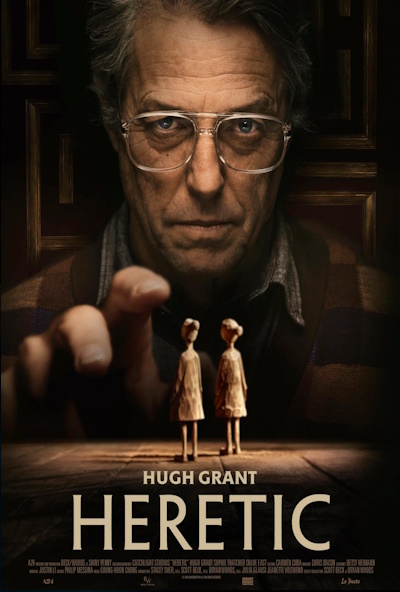
Why do I like the movie "Heretic"? Well, firstly, I appreciate Hugh Grant's acting — whether it's Guy Ritchie's "Operation Fortune" or the family adventure film about a bear named Paddington. But I wouldn't be making a review of this film if there weren't a "secondly." And secondly, it's the very theme of the film, which resonates with me. Because for me, as a person who has been passionate about science for several decades now, it's quite strange to see how in the 21st century, a huge number of people still remain religious. Thirdly, this film is also good because there's no explicit humiliation of religion here. Rather, it raises a global philosophical question, and far more than one. Actually, all these questions are what I will analyze in this review. A review with spoilers, so if you haven't seen the film, watch it first.
Mr. Reed
Let's first examine the main character, played by Hugh Grant — Mr. Reed. A man who has studied religions all his life (starting with the study of religion in college), he asked himself: where is that one true religion? By the age of 50, he was oversaturated with various religious delusions that he had been filling his head with for decades. And every cult and sect claimed to be the one true faith, but none turned out to be true upon closer examination. These are actually verbatim quotes from the film. Despite being an atheist, Mr. Reed was a very frightening man. He is an intellectual sadist: for Reed, physical killing without mental breakdown holds no interest. His main pride and perversion is to first kill a person's faith, force them to become completely disillusioned with their beliefs, feel the meaninglessness of existence, and acknowledge Reed's superiority. He is well-versed both intellectually and psychologically: from the very beginning, he takes the initiative and controls the entire process unfolding in the film. Almost everything happens according to his plan and script. At the same time, perhaps he even sincerely believes that he is not a banal maniac, but a "scientist" and "enlightener." The lectures about music, Monopoly, and doors are needed by him to justify his own cruel madness and feel like a higher intelligence controlling "rats in a maze." Of course, Hugh Grant plays a despicable person, but if you set this image aside, the problems are real and the themes are important.
What is True Faith?
The first and most important question I will answer, based on the film. So what is this one true religion that Reed found? He does not speak of Christianity or any specific religion. By "true religion," Hugh Grant's character means control over faith as a system. According to his logic, all religions repeat the same ideas and borrow myths, symbols, and rituals from each other. As good examples and analogies, he cites music and the game Monopoly. But the essence of all religions is control. That is, "religion" in his understanding is:
- a system of beliefs;
- fear;
- the promise of meaning;
- authority.
Faith is a virus that spreads if it is useful to the system, and a person is not seeking truth, but seeking support. Overall, the film shows how religious institutions use faith to establish control over a person. And missionaries, like marketers, sell ideas and promote their own religions. Thus, in the process of his harsh experiment, Reed comes to the conclusion that all world religions have only one common and unchanging element. It is not love, not mercy, and not the salvation of the soul, but control.
Why the Happy Ending?
If Mr. Reed is right, then why did the director make an ending where one girl still escapes and Mr. Reed himself dies? There are several reasons for this. Firstly, such a plot scenario would be predictable, and this film would hardly have become so widely discussed with such a plot. Secondly, such an ending is needed not to negate the criticism of religion, but to draw a crucial line that Mr. Reed himself overlooked. And this line is between religion and personal faith. Throughout the film, Mr. Reed criticizes religion as an institution — a system of manipulation, historical borrowings, and control. And in this criticism, he is absolutely right: his arguments about Monopoly, musical remakes, and scented candles remain unrefuted. But the finale shows Reed's own flaw. He confused religion as a tool of control with faith as a person's internal experience. Sister Paxton's survival is not a victory of the Mormon church or a specific religious faith, but of the human spirit and hope that live within a person regardless of whether they are a believer or not.
What Associations Do the Doors Carry?
In the film, there were two doors. One meant Faith, the other — Disbelief. The girls had to choose one of the doors, although both led to the same basement. Why was this done? By leading both girls through different doors into the same basement, Reed proves with a cynical grin: both naive faith and proud skepticism are equally helpless before real physical force and a well-thought-out system of control. If you blindly believe, it is easy to manipulate you through promises, beliefs, and fear. However, if you doubt and consider yourself smarter than others, you can just as easily be manipulated by giving you the false feeling that your skepticism makes you free. Thus, with this detail, Reed clearly illustrated his idea: whether you believe or not, whether you choose religious faith or complete skepticism — in his constructed system, the outcome and finale are the same for everyone. At the same time, this message from Mr. Reed can be viewed even more broadly: no matter where a person's conceptual path leads — through blind Faith or through intellectual Knowledge — the physical and life outcome for everyone is the same — physical death. It's scary if God exists and helps only when we pray to him. But if he doesn't exist and we are just insects hoping for eternal life, that is also scary. This is practically a verbatim quote from the film.
Why Did He Talk to Them for So Long?
If the finale is still the same — the basement and death — the question arises, why did Reed put on this whole performance with tea and arguments? There could be several reasons for this as well — from the most banal (the film's runtime) to more philosophical ones. He wanted to first destroy the faith inside a person and psychologically break them. Moreover, the physical death of the missionaries themselves was not very interesting to him. He wanted their complete submission, just as happened with his slave women who ate the poisoned pie.
What is the Trick with the Resurrection and Why is it Needed?
Now let's smoothly move on to the question of resurrection. The trick with "resurrection" — the substitution of the body — and the scene where the girls realize the deception are also among the important moments of the film. In it, Mr. Reed tries to finally destroy the faith of Sisters Barnes and Paxton. With this trick, Mr. Reed wanted to show the girls that all "miracles" in human history are cheap tricks. He wanted to clearly demonstrate how religious myths are created. If you show people a "resurrection" — the death of one girl and the appearance of another "healed" one — they will easily believe in the authenticity of the miracle, especially if you create the right atmosphere and emotional context. According to Reed's plan, this was supposed to serve as a harsh illustration: there is no passage to another world, there is only the body, physical death, and manipulation of the audience. At the same time, he deliberately showed it clumsily so that the girls could guess for themselves and doubt. So the fact that the girls guessed about the substitution was fully anticipated and part of his plan.
What Was His Original Plan?
So what was Mr. Reed's real plan regarding the girls? He pursued only two goals. Firstly, he wanted to break their faith. Mr. Reed wanted them, having lost their faith, to submit to him. After all, it is easier to keep under control someone who has lost everything in this life. And this is indeed true. Remember how your acquaintances become more religious after the death of loved ones. In the same way, the church draws into its nets people who have suffered serious losses in life. In the same way, Mr. Reed wanted to take possession of the girls who, after communicating with him and his "resurrection," were supposed to become disillusioned with faith — since it is the meaning of life for them. Secondly, Mr. Reed pursued another goal: these girls, whom he was supposed to completely subjugate, were needed for his subsequent performances. After all, one of them must eat the poisoned pie to become the victim of the trick, and someone must come out and show the "resurrection."
Why Do Former Victim-Missionaries Play His Game and Lure New Victims?
Actually, the answer to this question lies in the previous answer. If we omit primitive things, like the fact that he starved them, the main message is that he began to manipulate them, and they, in turn, became completely his. The victims in the cages are the missionaries of his religion who, like the girls with booklets telling about the advantages of their religion over others, tried the poisoned pie. Because that is exactly what Mr. Reed demanded instead of walking around the streets with booklets.
Why Is He So Straightforward?
Mr. Reed was quite straightforward and was not shy about saying unpleasant things to the girls. There may be several reasons for this, as I see it. For example, it could be a firm stance by the film's directors, Scott Beck and Bryan Woods, who wanted to convey their atheistic views to the viewer. And they did it quite boldly and directly, because few viewers would pick up on hidden meanings and subtexts. If we return to the main character, his straightforwardness is due to his control over the girls and his manipulation of them. He allowed them to look at the names of the candles and realize that there was no pie, intentionally changed the key, intentionally drags out the introduction to the wife who turned out not to exist. Mr. Reed watches and observes how far the girls will go and when they will start asking questions. And the problem is that the girls continue to politely support the lie, although they know the truth. This is again another reference to religion, in which the same missionaries or other church officials do not want to ask unnecessary questions, but do exactly as they are told. I cannot help but recall another quote from the film: "Why do people continue to believe in God? Because at a tender age, someone told you that he exists, despite the doubts that came with age, despite the evidence to the contrary throughout the rest of your life. People continue to believe, knowing it's a lie, because they are afraid: what does it mean if it's all a lie? I put a candle on the table so that you would think about the things you believe in only because someone told you to believe."
For me, the film "Heretic" is one of the best films I have ever seen. A film in which the central part is occupied by dialogues and thoughts of the characters. Perhaps there are some horror movie shots here and there, but it is still not a classic horror film, but rather a philosophical film. It poses one single question: if faith is just a system, then how is your faith different from any other?