
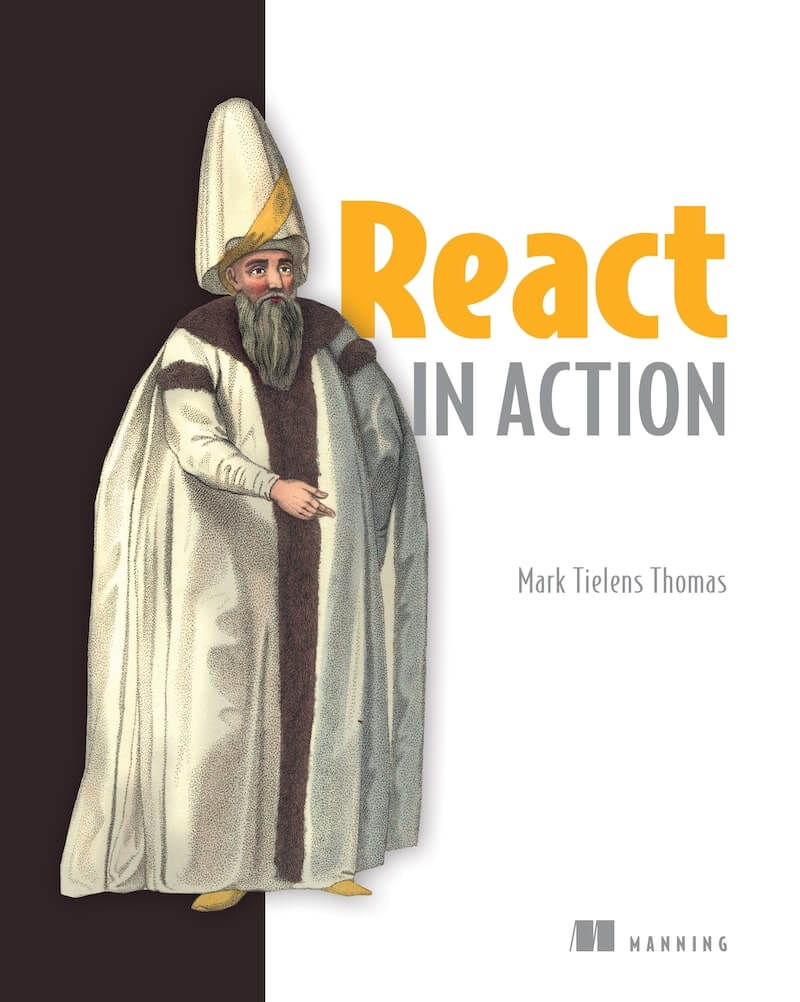
General Description
The book is just over 350 pages long. It contains 13 chapters. The content is not only text but also graphic material, and there are plenty of code snippets. At the start of each chapter there’s a list of topics that will be covered, and at the end, of course, the chapter’s conclusions. The book reads fairly easily.
Short Description
So, the book is divided into three parts and has a total of 13 chapters. These are the topics covered in those chapters:
Part I. React Overview
Chapter 1. What is React
- Getting acquainted with React.
- Some React concepts and paradigms.
- The virtual object model of the document.
- Components in React. React in team work.
- Trade‑offs of using React.
Chapter 2. <Hello world! />: our first component
- Thoughts on component‑based user interfaces.
- Components in React.
- How React renders components.
- Various ways to create components in React.
- Using JSX in React.
Part II. Components and Data in React
Chapter 3. Data and data flows in React
- Mutable and immutable state.
- Stateful and stateless components.
- Relationship between components.
- Unidirectional data flow.
Chapter 4. Rendering and lifecycle methods in React
- Configuration via application repositories.
- The rendering process.
- Lifecycle methods.
- Updating React components.
- Creating a news feed with React.
Chapter 5. Working with forms in React
- Using forms in React.
- Controlled and uncontrolled form components in React.
- Validation and cleaning data in React.
Chapter 6. Integrating third‑party libraries with React
- Sending form data as JSON to a remote API.
- Building some new component types, including location selectors, input handlers, and map displays.
- Integrating a React app with Mapbox for location search and maps.
Chapter 7. Routing in React
- More advanced design and component usage.
- Creating multi‑page React apps with routing.
- Building a router from scratch with React.
Chapter 8. Routing and Firebase integration
- Using the router developed in Chapter 7.
- Creating routing‑related components such as Router, Route, and Link.
- Working with the HTML5 History API to enable routing with state updates.
- Reusing components multiple times.
- Integrating user authentication with Firebase.
Chapter 9. Testing React components
- Testing client‑side applications.
- Setting up tests for React.
- Testing React components.
- Configuring test coverage.
Part III. React Application Architecture
Chapter 10. Redux application architecture
- Redux actions, stores, reducers, and middleware.
- Testing Redux actions, stores, reducers, and middleware.
Chapter 11. Integrating Redux with React
- Reducers—how Redux determines the change in state.
- Using Redux with React.
- Transforming Letters Social to use the Redux application architecture.
- Adding like and comment functionality to the app.
Chapter 12. Server‑side React and React Router integration
- Server‑side handling with React.
- When server‑side rendering of the app is necessary.
- Transitioning to configuring routing with React Router.
- Handling authenticated routes with React Router.
- Fetching data during server‑side rendering.
- Using Redux in the server‑side rendering process.
Chapter 13. Introduction to React Native
- Overview of React Native.
- Differences between React and React Native.
- Sources of information on React Native.
Opinion
Not a bad book about React. First, from one chapter to the next the author builds a small real‑world app. Second, this is a fairly well‑structured book touching on core React concepts—from validation and the comparison of functional and class components to routing and using Redux for state storage. Given that the edition I got was from 2019, it may be worth looking for a newer version if it exists.
