
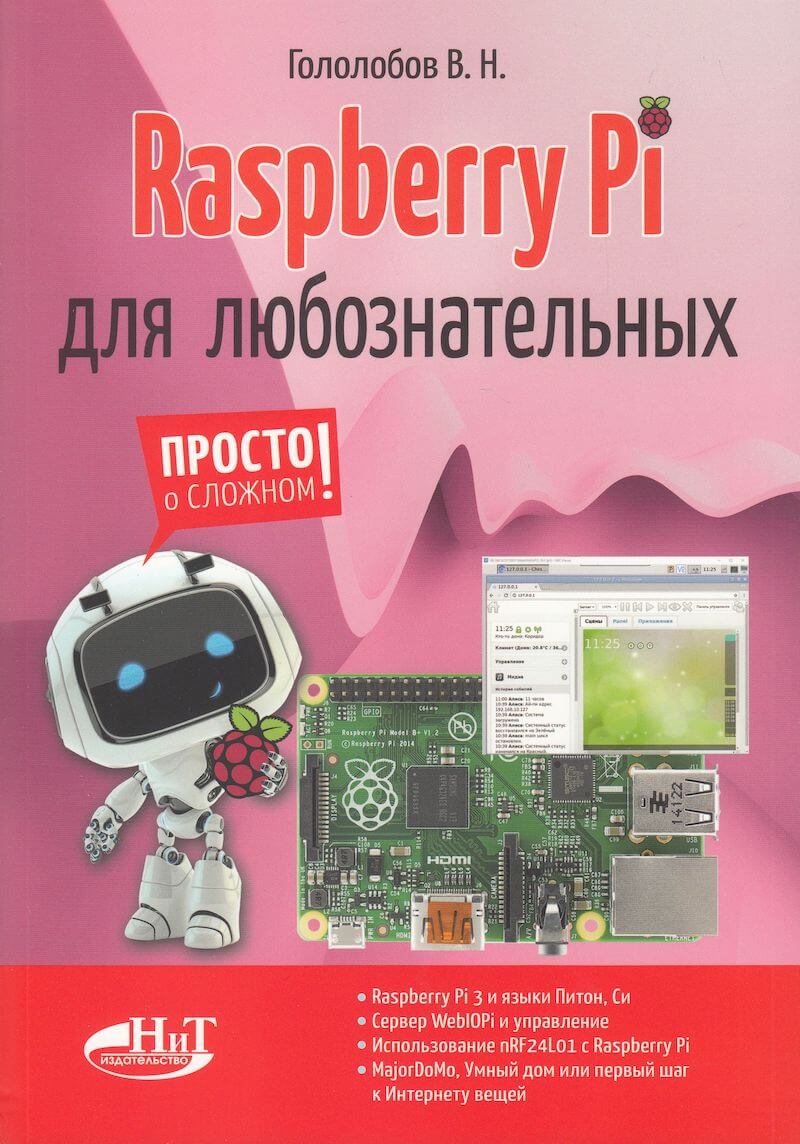
General Description
The book consists of 240 pages and includes 12 chapters. Apart from textual material it contains many graphic illustrations and code snippets. The difficulty level is easy.
Brief Description
Chapter 1. Until the Raspberry Pi Arrives
The author prepares the reader theoretically: familiarises them with development tools (IDE, code navigation, debugging) and gives an overview of the Python language and interfaces.
Chapter 2. When Raspberry Pi 3 Arrives
This section explains how to properly connect a Raspberry Pi: display, power, cables, the operating‑system installation and other nuances. The first boot is performed, the OS (Raspbian) is installed, and the environment is prepared for further work.
Chapter 3. For Those Who Can’t Wait to Do Something
Finally it is time for the first practical task: blinking an LED via Scratch2, using Python 3, and working with the Thonny IDE.
Chapter 4. What Happened
A logical continuation of the previous chapter. Possible problems are discussed – why it doesn’t work, debugging, and explanation of errors.
Chapter 5. Raspberry Pi and lirc
An introduction to lirc—a library and system for controlling IR devices (infrared communication). The author explains why lirc is needed, how to install and configure it for the Raspberry Pi, and what possibilities it opens up (controlling household appliances via IR). The chapter introduces the topic of interacting with real external devices via IR.
Chapter 6. Lirc and WebIOPi
This section covers the joint use of lirc and WebIOPi: how to control IR devices through a web interface. The author shows Python examples along with error analysis and ways to diagnose interaction problems.
Chapter 7. WebIOPi, nRF24L01, SPI Interface and Other Devices
The author moves on to wireless modules (for example, the nRF24L01 radio module) and communication via the SPI interface.
Chapter 8. Project “Controlling the TV via Radio Channel”
The author sets and solves the task: controlling a TV via a radio channel (IR commands) with the Raspberry Pi. The entire solution path is examined: how to generate commands and transmit them via the radio module and IR.
Chapter 9. MajorDoMo – the Smart‑Home System or the First Step to the Internet of Things
Introduction to MajorDoMo, a home‑automation system (“smart house”). The author shows how the Raspberry Pi can be integrated into the smart‑home infrastructure via MajorDoMo.
Chapter 10. Teaching the House to Think
The logical continuation of the previous chapter with increased complexity in device management, for example, adding automatic reactions.
Chapter 11. How to Blink an LED in MajorDoMo
A practical module example: running Python code from a MajorDoMo scene so that the LED blinks in response to events.
Chapter 12. Hello, Internet of Things
The author generalises the Internet‑of‑Things topic, discusses prospects and principles, and reflects on the future of the smart home and the role of the Raspberry Pi in its ecosystem.
Opinion
If there were 48 hours in a day I would definitely take a more serious interest in electronics, but I have to settle for what I have. The book is quite well‑structured with clear material and examples, so every reader will understand it.
