
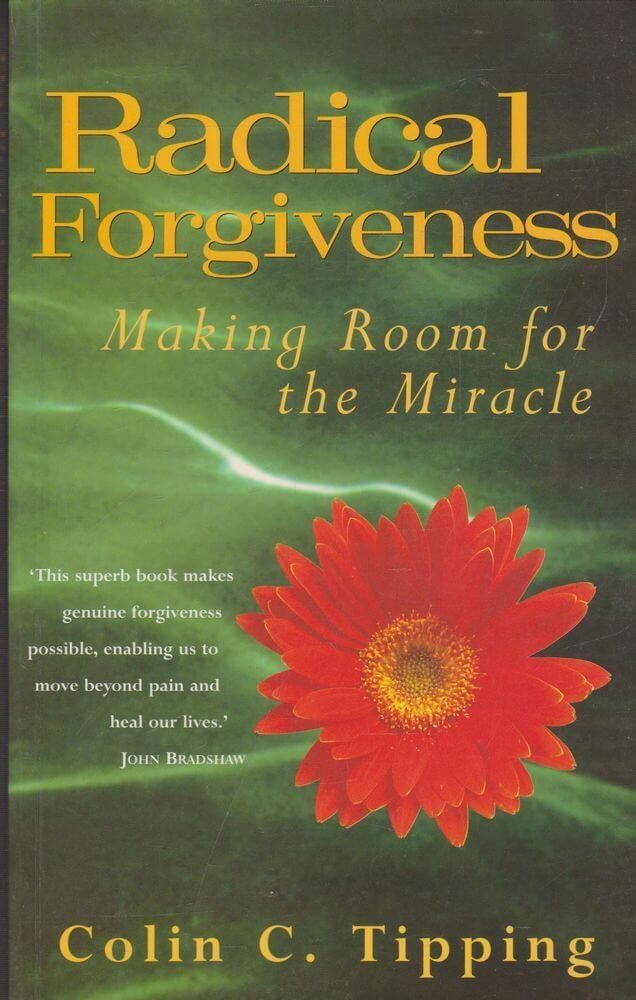
General Description
The book is 215 pages long. It consists of 30 chapters. In different editions, the number of pages and chapters may differ slightly. The material is presented purely as text. It's easy and quick to read. There is an audiobook version of the book.
Brief Description
The book begins with the story of the author's sister (Jill), whose marriage was on the verge of divorce, and after talking with the author, her life changed dramatically, and the marriage was saved. Then the author outlines the basic spiritual assumptions on which the method of radical forgiveness is built. Next, the author describes that we live simultaneously in two "worlds": the world of spirit/consciousness and the world of human experience, where ego, fear, and the illusion of separation operate. Considerable attention is paid to the ego and how it interferes in life. The author then emphasizes that forgiveness does not mean avoiding responsibility, as well as the fact that much of our pain comes not directly from events, but from the story we have "made up," not from real memories. At the end of the book, the author encourages readers to express all their grievances in so-called letters to the offender.
The book calls for changing our basic attitude toward grievances, pain, deception, and fear: to stop seeing ourselves as victims, separate individuals, and to begin perceiving life's "misfortunes" as part of the soul's path, as challenges that provide an opportunity for healing and growth.
Opinion
I honestly tried to give this book a chance until about its middle. There are indeed some decent ideas in this book that you can grasp and adopt. For example, that one must find the strength to forgive and move on, that old memories are often distorted and embellished by our brains rather than being real memories, and that writing down thoughts, including grievances, on paper can help get rid of them.
But, perhaps, that's all. Now I'll try to write what's wrong with this book. To be more precise—everything is wrong with it. Right from the start, you can encounter all sorts of pseudoscientific terms such as "spirit," "energy frequency," "spirituality," "energy level," "energy structures," "energy blocks." According to the author, consciousness has an impact on the Universe. He endorses homeopathic remedies, relying on the fact that their energy and waves are capable of healing. Even the practical exercise he proposes—breathing practice "Satori," about which I had to specifically google and figure out—turned out to be not just useless, but dangerous for people with heart problems. The author very cleverly repeatedly brings in science without any evidence or references, misleading readers. And, of course, the entire book is built on religion. According to the author, radical forgiveness cannot exist and is impossible without religion.
If you want to create "torture" for a tech-savvy person, just play them this audiobook through headphones. There is so much absurdity in the book that you're amazed that there are people who give it positive ratings, vote for it, and recommend it to others. According to the author, people who harbor resentment toward others and are "radically unforgiven" get cancer, and not a word about ecology or poor nutrition. Moreover, he suggests treating cancer with meditation and prayers (not a word about medicine).
The examples in the book are a separate kind of absurdity. I mentioned cancer above, another example is his friend who was cured of the flu through forgiveness. At the same time, he had already been in bed for at least 10 days by the time he started to "get into" radical forgiveness. And of course, here I want to recall the famous phrase by physician William Osler: "If you treat a cold, it will last seven days, and if you don't treat it, it will last a week." So for me, it's a great mystery how one could not understand this logically, how one could write about it, and how this book came to be, if not a bestseller, then well-known and popular.
I won't even mention the fact that the book essentially kills any desire to fight for justice where necessary. If you were cheated on like a sucker, then it's not that you're like that—it was meant to be that way, and just let go and forget those who tricked you: the Universe will punish them.
This is a bad book that I don't recommend anyone read. If the above opinion is not enough for you, below I will provide examples of some of the most vivid quotes from the book, which I started collecting around the middle.
"However, it should be especially noted that TRP will not work in combination with traditional psychotherapy and psychology. The questions and assumptions underlying these approaches are too far apart."
"Shame settles in the body at the cellular level and blocks energy flows in the body."
"However, thoughts more strongly charged with energy—especially emotional or creative energy—affect the world to a much greater extent."
"Now I am convinced that the inability to forgive is the main cause of most cancer cases."
"We are used to thinking that the best way to prevent diseases is regular preventive medical examinations. Now we know that it is much more effective to visit someone who can read auras—that is, someone who can tune into the energy structures of subtle bodies—in particular, the etheric body."
"Forgive yourself for mistreating the planet. Unite in a worldwide prayer for peace. Accept Radical Forgiveness as a way of life. That's exactly how."
"Interestingly, science and mysticism have recently reached a new level of mutual understanding regarding the nature of reality and other spiritual questions that, as it seemed until now, are outside the scope of science. For many centuries, Hindu mystics have claimed the ability to directly know certain universal truths that come after forty years of meditation in the Himalayan caves."—what does this have to do with science?
"Now we can confidently say that quantum physics confirms the principles that mystics knew about many centuries ago."—but which ones exactly?
"Although the chakra system occupies a central place in the medical traditions of the East, Western science pays no attention to it. Western medicine hardly recognizes that chakras have a crucial impact on our health, spiritual well-being, and level of vibrations. In reality, chakras have a decisive influence on our lives. If these energy centers become unbalanced—for example, in cases where a person experiences emotional shock or trauma—they begin to rotate in the opposite direction, become unstable, and in some cases close almost completely."
"2. Number clues. Sometimes the same situations not only repeat but follow a certain numerical pattern."—they even brought in numerology.
