
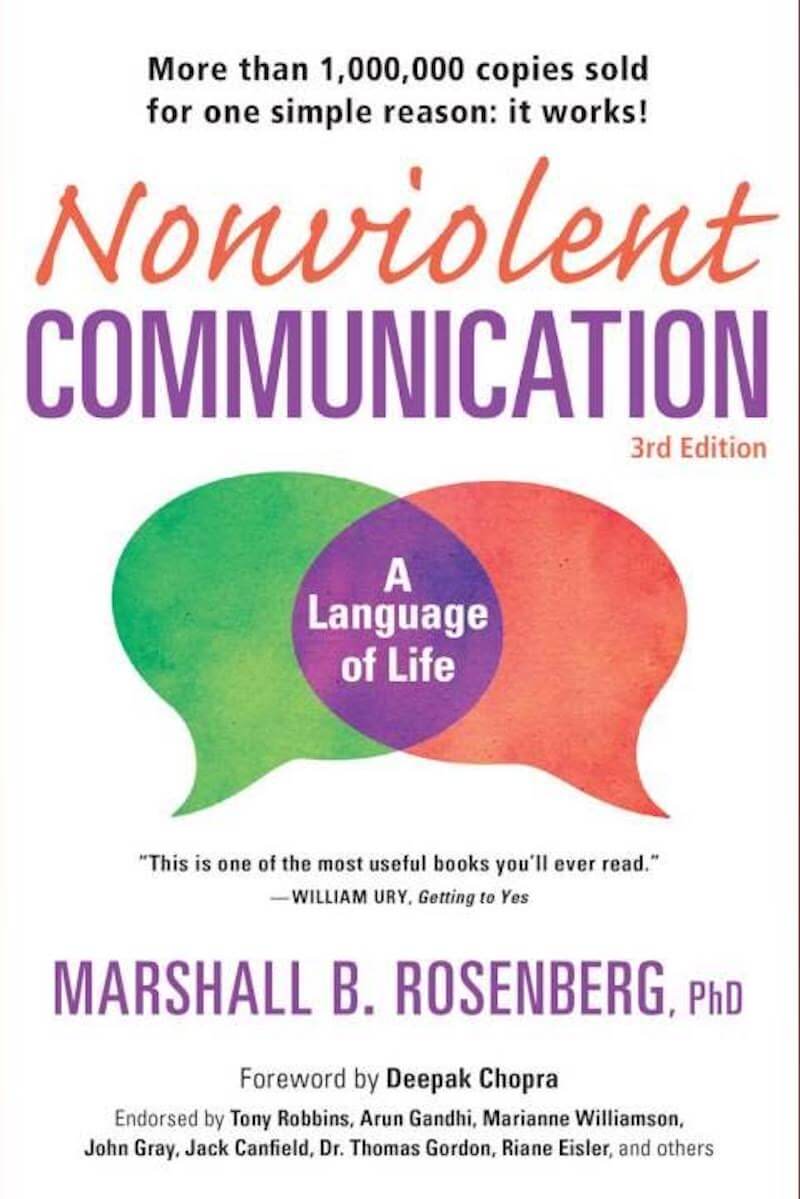
Overall Description
The book is about 270 pages long (the page count may differ across editions and formats). It is made up of many chapters that smoothly guide the reader from theory to practice. The main focus is on explaining the concepts of Nonviolent Communication (NVC) and their practical application in everyday life. The text is easy to read, incorporates dialogue examples and exercises, allowing the reader to apply the author’s ideas immediately. The material is primarily presented in text format.
Brief Description
Part I. Foundations of Nonviolent Communication
- Chapter 1. “Giving from the Heart” – an introduction to the essence of NVC and the process of applying it in life. It explores ways to focus, using NVC in the world and in personal practice.
- Chapter 2. “Communication that Blocks Empathy” – the author analyzes typical obstacles to mutual understanding: moral judgments, comparisons, denial of responsibility, and other forms of alienating communication.
- Chapter 3. “Observation Without Evaluation” – teaches how to separate facts from interpretations, increasing clarity of perception and the ability to empathize.
- Chapter 4. “Recognizing and Expressing Your Feelings” – discusses the importance of identifying emotions and building a vocabulary of feelings for honest expression of one’s experience.
- Chapter 5. “Taking Responsibility for Your Feelings” – explains the connection between feelings and needs and shows ways to free oneself from emotional slavery.
- Chapter 6. “Requests that Improve Our Lives” – distinguishes between requests and demands, and teaches how to formulate requests consciously and effectively.
Part II. Empathy and the Application of NVC
- Chapters 7–8. “Empathetic Acceptance and the Power of Empathy” – develop listening skills, paraphrasing, and maintaining emotional connection to reduce conflict.
- Chapter 9. “Empathizing With Yourself” – work with internal judgments, self‑forgiveness, and developing mindfulness.
- Chapters 10–12. “Expressing Anger, Resolving Conflict, and Using Strength” – a practical guide to constructive handling of negative emotions and conflict situations, including the role of mediation.
- Chapters 13–14. “Freeing Yourself and Helping Others” and “Expressing Gratitude” – focus on inner development, overcoming old patterns, and shaping grateful, harmonious communication.
- The epilogue sums up, highlighting basic feelings, needs, and key components of the NVC process.
Opinion
The book is reasonably good, though it probably won’t be a fit for everyone. Psychopaths and egotists are unlikely to change after reading it, but they will still benefit from learning that alternative ways of communicating exist. The book outlines an entire system built on clear, sequential steps. The author regularly uses this system and, as he claims, has resolved numerous conflicts with its help.
