
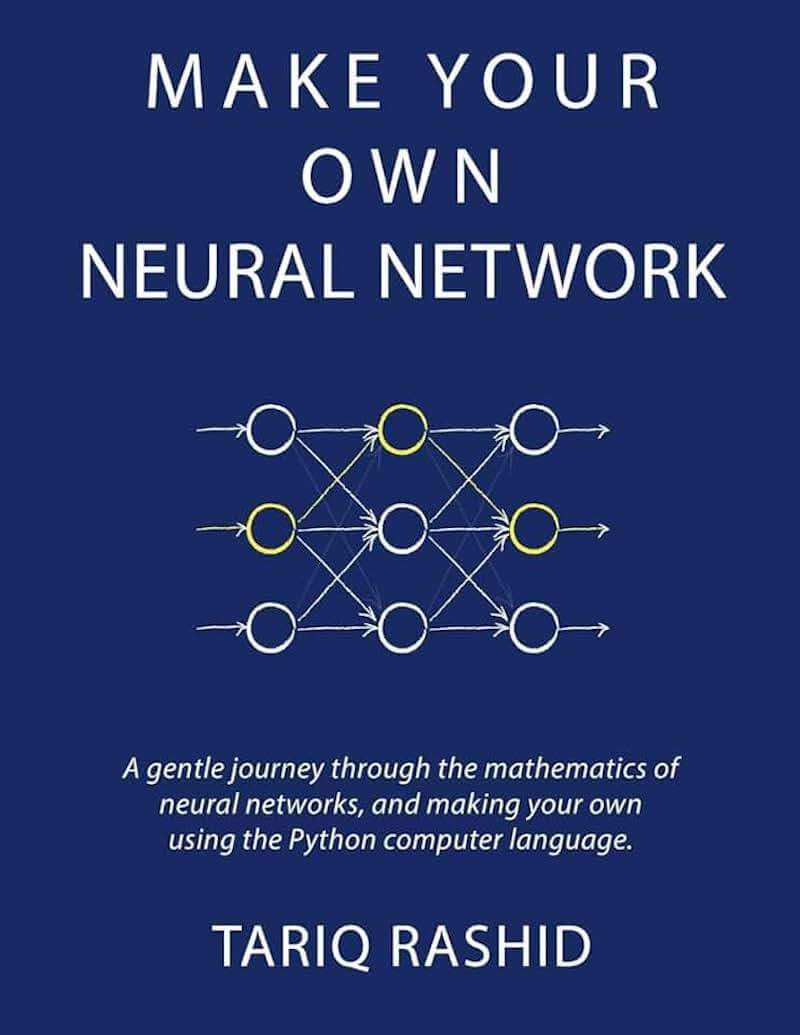
General Description
The book is about 270 pages long. It contains a sufficient amount of graphical material. The difficulty level is medium.
Brief Overview
Chapter 1. How Neural Networks Work
The chapter explains the basic principles of how neural networks work: what neurons, weights, signal summation, and activation functions are. The author intuitively introduces the concepts of learning, error, and backpropagation, avoiding complex mathematics. The main goal of the chapter is to form a correct mental model of why a neural network can learn anything at all.
Chapter 2. Creating a Neural Network in Python
This chapter step by step implements a simple neural network in Python from scratch, without using frameworks. The author shows how to initialize weights, implement forward propagation, training, and backpropagation. In the end, the network learns to recognize handwritten digits (MNIST), and the reader gets working and understandable code.
Chapter 3. Several Interesting Projects
The chapter is devoted to the practical application of the already created neural network and experiments with it. It covers improving recognition quality, working with custom images, and the influence of training parameters. The main emphasis is on how to modify and extend the model, not just blindly use a ready-made example.
Appendix A. A Brief Introduction to Differential Calculus
The appendix explains the minimally necessary mathematics for understanding the neural network training process. Derivatives and gradients are introduced at an intuitive level — exactly to the extent required for understanding the backpropagation algorithm. This is not a calculus textbook, but rather a kind of "mathematical bridge" to the main text.
Appendix B. A Neural Network on Raspberry Pi
This part shows how to run and use the neural network on a Raspberry Pi. The author demonstrates that neural networks can work even on weak hardware if the model is simple enough. The appendix well illustrates the practical side of the embedded approach and standalone devices.
Opinion
This is the first book I started with to understand how neural networks work internally and how they are implemented in practice. Using Python as an example, the author develops a primitive neural network and gradually improves it from chapter to chapter. As a result, the material is presented clearly, sequentially, and accessibly.
