
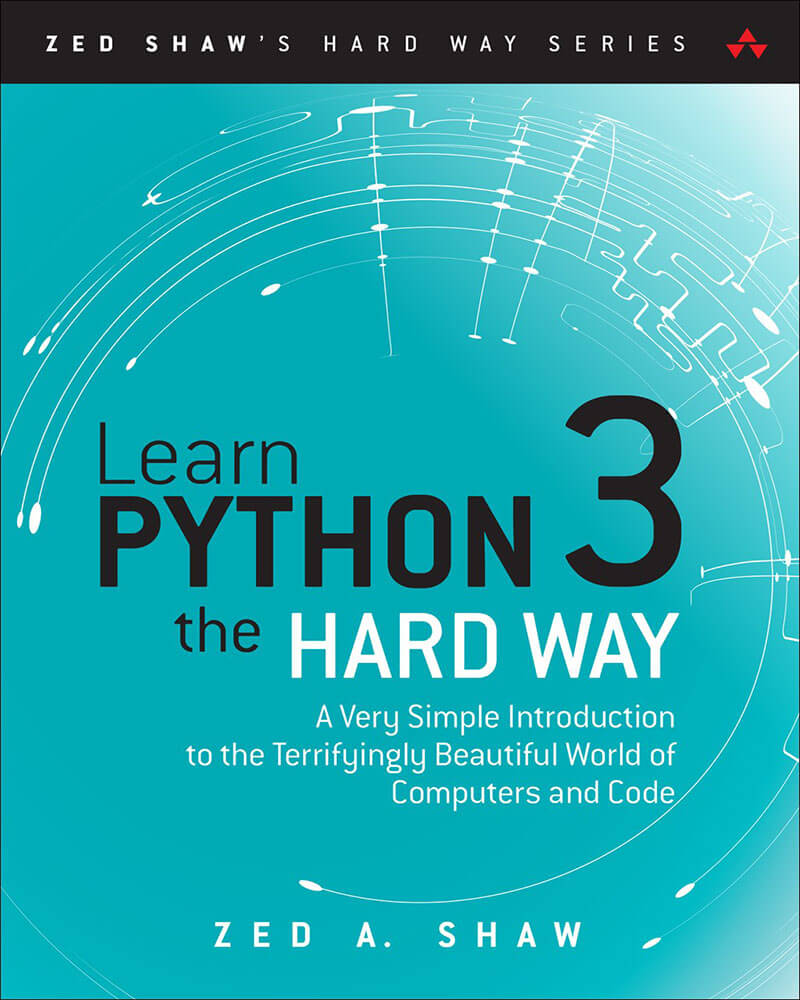
General Description
A book consisting of 370 pages and including 52 step-by-step exercises in Python. Each exercise represents a certain topic: working with strings, input-output, and others. There is no graphical material as such, except for a few tables. But there are quite a few code inserts. The reading difficulty level of the book is something between easy and medium.
Brief Overview
As a brief overview, I'll provide the names of all exercises.
- Setup
- First Program
- Comments and Symbols
- Numbers and Math
- Variables and Names
- More about Variables and Output
- Strings and Text
- More about Output
- Output, Output
- Output, Output, Output
- Control Sequences
- Getting Answers to Questions
- Requesting Input
- Parameters, Unpacking, Variables
- Requests and Confirmations
- Reading Files
- Reading and Writing Files
- More about Files
- Names, Variables, Code, Functions
- Functions and Variables
- Functions and Files
- What Functions Return
- What You Know Now
- Strings, Bytes, and Character Encoding
- Extra Practice
- And More Practice
- Attention, Test!
- Learning Logic
- Logical Expressions
- What If
- What If Not
- Making Decisions
- Loops and Lists
- While Loops
- Accessing List Elements
- Branches and Functions
- Development and Debugging
- Introducing Symbols
- Working with Lists
- Dictionaries
- Modules, Classes, and Objects
- Let's Talk about OOP
- Composition, Inheritance, Objects, and Classes
- Basics of Object-Oriented Analysis and Design
- Inheritance and Composition
- Game Development
- Project Skeleton
- Automated Testing
- Advanced User Input
- Sentence Formation
- Your First Website
- Getting Input from the Browser
- Game for the World Wide Web
Opinion
If you want to quickly get acquainted with Python syntax, this book is well suited for this. Despite the rather large summary, almost all of it consists of simple code examples. In addition, the author of the book moves from theory (studying syntax) to practice and creates a very primitive game. For advanced Python programmers, the book is not informative, I recommend it to beginners.
