
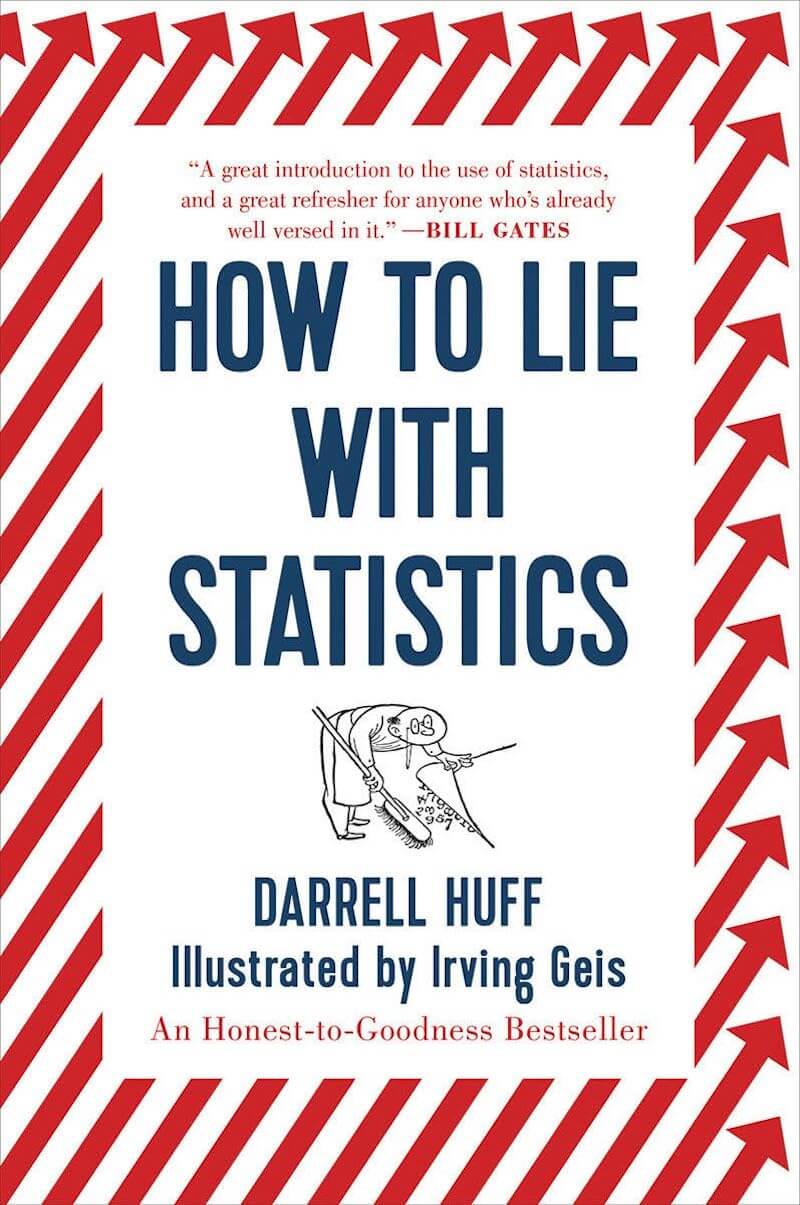
The title of the book reflects its main idea. The book shows how people who compile statistics can deceive others, often quite legally, in a way that is difficult to challenge. However, if you know the basic tricks of statistics (which, by the way, are extensively discussed in this book), your attitude towards statistics may change slightly.
Drawbacks of the Book
Perhaps I'll start with the drawbacks — there are at least two. First, it seemed to me that all the ideas presented in the book could have been fit into one large article. Second, I can't say that I learned anything fundamentally new from the book, although, of course, there were some interesting moments.
Strengths of the Book
On the plus side, the book provides a detailed description of the ways statistics can be manipulated. For example, it explains how the average value can be calculated differently. To be precise, there are three methods: the commonly used arithmetic mean, the median, and the mode.
It also thoroughly describes the main tricks statisticians use when working with graphs:
- cutting off the bottom of a graph;
- stretching the graph widthwise;
- doubling the height, which visually increases the object not just twice, but at least four times, creating the illusion of more significant growth.
Distorting Statistics
The book also discusses data substitution or distortion, where statistics were collected based on one set of parameters, but the graphs present different indicators, or the same data but in different conditions. Another significant issue related to statistical distortion is small sample sizes, which are often found in psychology and scientific research.
Reliability of Polls
The book explains why public polls are the most useless and inaccurate type of statistics. There are several reasons:
- It is impossible to survey all groups of people, no matter how much we want to.
- Respondents often tend to distort their answers.
- Results depend heavily on who is asking the questions.
Additionally, the author provides other reasons why polls are unreliable.
Conclusion
Throughout the book, interesting examples and real-life cases are examined, including mistakes made by people or professionals working with statistics. All of this leads the reader to one key idea — the importance of critical thinking. It is through critical thinking that one can identify, if not all, then most inconsistencies in statistics.
In conclusion, the author offers a basic checklist of questions that help "verify" the presented statistics. For example:
- "Where did this information come from?"
- "Does this make sense?"
- "Has the subject of the study been substituted?"
- and others.
Overall, the book is quite easy to read. There is an audiobook version available. It may not be the best book I've ever read, but I would rather recommend it than not.
