
About the Book
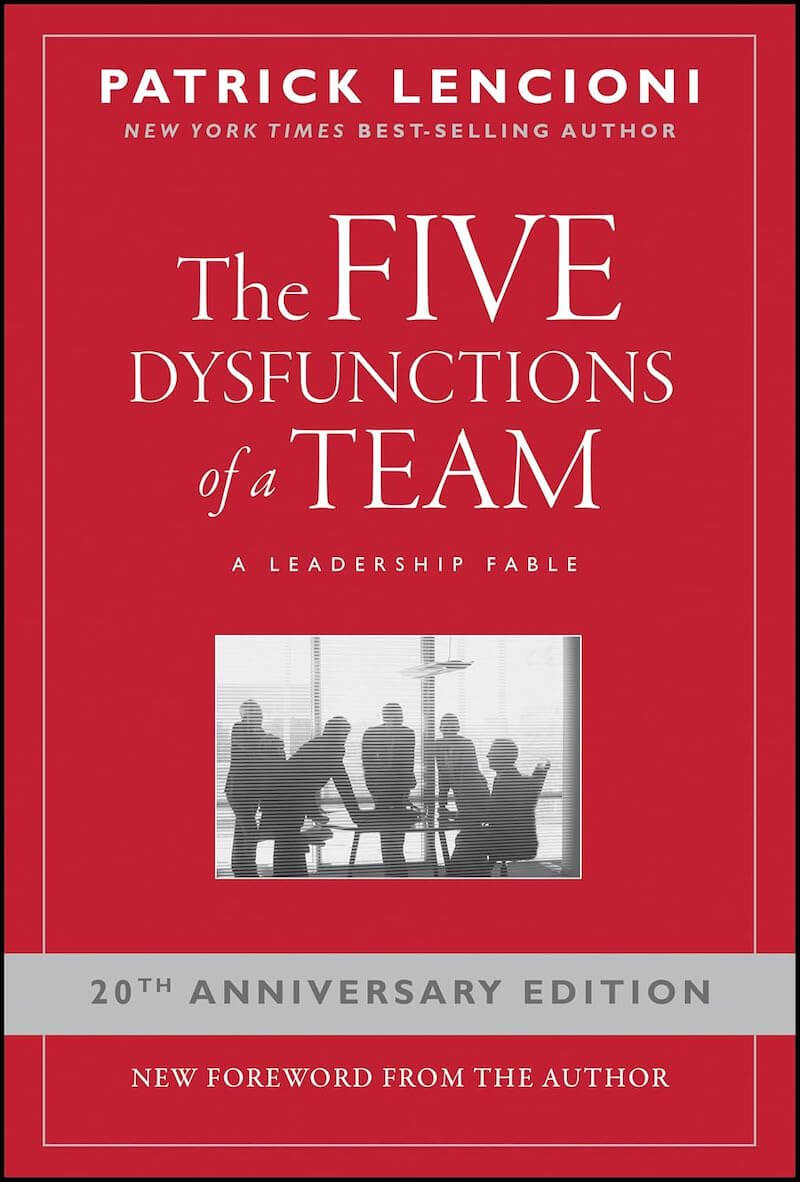
What is this book about? Generally speaking, it's a regular story — that is, a fictional and abstract narrative, company, and characters. However, it presents quite imaginable cases of interactions between project managers. Technically, the book consists of five parts, but it could easily be divided into two logical sections. The first is the actual story, which takes up around 180 out of 250 pages, and slowly but steadily the author, through a fictional company and its internal relationships, delivers to the reader those very 5 dysfunctions. The last 70 pages are purely theoretical material, unrelated to the company or characters. It's a sort of recap with clearer and more structured explanation.
Pros
- The book is easy to read. There's an audiobook — that’s the version I listened to, and overall it’s well perceived.
- It’s fairly short and can be read quickly.
- There aren’t too many characters (although at first, I did confuse who’s who, their personalities, and roles), but I got used to it quickly and navigated easily.
- Each character comes with an explanation — their personality and position.
- As I mentioned above, all 5 "dysfunctions" are first delivered through the story and then through a more structured explanation (meaning that at least the material considered important by the author is repeated twice — in different styles, which helps with reinforcement).
- Now about the essence: the book touches on quite sensitive and delicate topics, most of which can hinder team development, and many company owners and managers might not even be aware of such problems.
- It offers not just the problems themselves, but also their solutions, and specifies the role and position leaders should take to solve and correct these issues.
- The problems themselves, by the way, are well visualized — which is, of course, a big plus.
Cons
- Not a word about distributed and remote teams (and we know remote teams can perform just as well as office ones).
- The example in the book says that meetings (including off-sites) help unite people, but in the story it's also stated that the team consists of professionals and top employees. In reality — no matter how many meetings you hold, if the team consists of non-professionals offering obviously odd solutions without understanding that there are far better and more efficient ones, those meetings will still lead nowhere.
- The book is theoretical and based on an abstract example. However, there are many businesses and fields that are entirely dependent on other factors. Even without natural disasters, we can at least look at examples where entire businesses rely on marketplaces, social networks, messengers, or search engines (the latter — for example, Google — due to their extreme sluggishness and inability to react quickly to large-scale and radical decisions, can take from one quarter to half a year to act, which is a disastrously long time for many companies).
- As for the dysfunctions themselves: the first point about mistrust doesn’t always manifest as fear of showing vulnerability. It often involves financial and commercial secrets, intrigue around layoffs, or replacing employees with others (in the company’s interest), and so on. Avoidance of conflict doesn’t necessarily happen just because you don’t know your colleagues’ hobbies. In my experience, I’ve repeatedly argued with the design department to defend my solutions and talk them out of implementing heavy or unnecessary things in the code. I wasn’t very familiar with their childhoods or hobbies, and had only been on one off-site with them. Still, it didn’t prevent us from arguing productively. The topic of conflict is quite strange — we never got personal or questioned each other’s professional skills, but the emotional residue from such conflicts lingered for quite a while.
Overall, I would still classify this book as a positive literary experience rather than a neutral or, even less so, a negative one. It’s short, fast to read, and some of the dysfunctions mentioned by the author are indeed harmful factors for companies.
