
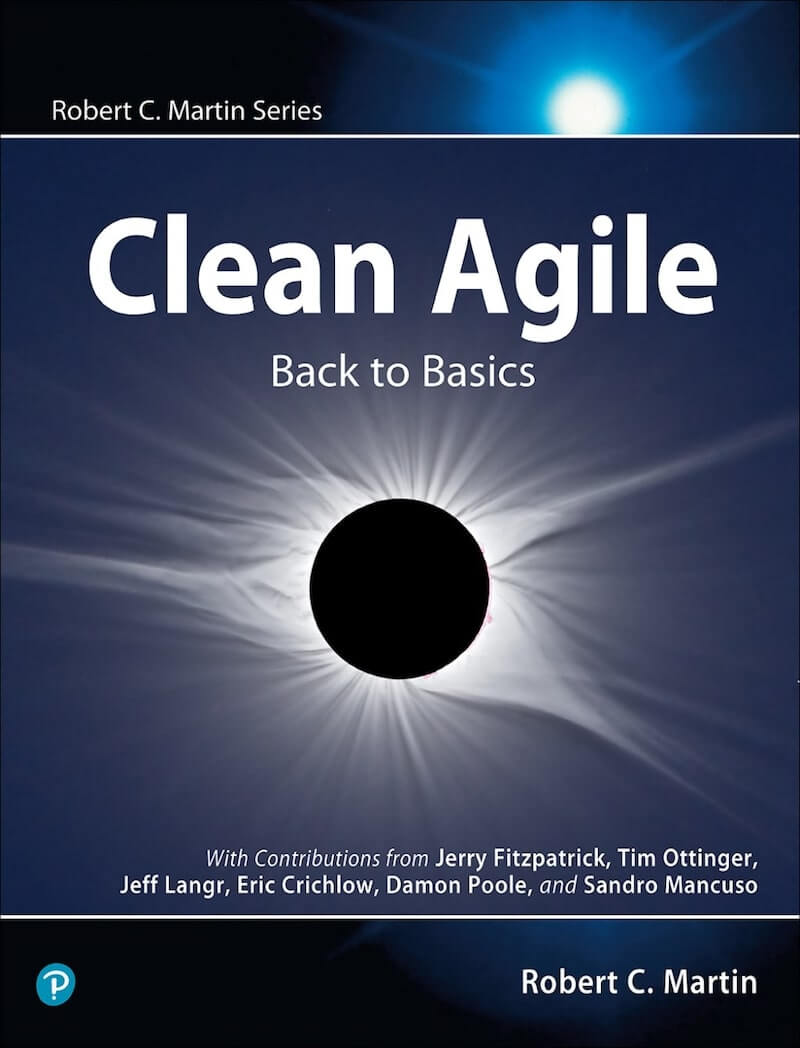
General Description
This book covers agile development in eight chapters. At the end of each chapter you can find conclusions drawn from the material. Besides the text, graphic material appears periodically. The book reads easily and quickly.
Short Description
Chapter 1. Introduction to Agile
The author explains the origins of Agile as a response to the problems of heavyweight waterfall methods. He describes the meeting on Snowboard where the Agile Manifesto and the core values of flexibility were formed. Agile is presented not as a set of practices, but as a philosophy placing people and adaptability at the center.
Chapter 2. Why Agile?
Martin shows that Agile is not just a process, but a professional approach to the developer’s work. He speaks about the need for honest and reasonable expectations between business and the team. He introduces the “Bill of Rights” for developers and customers, which records mutual responsibility.
Chapter 3. Methods of Client Interaction
The author explains that Agile is built on close, ongoing communication with the client. Planning is iterative, taking into account continuously changing requirements. Short, frequent releases enable quick feedback and risk reduction.
Chapter 4. Methods of Team Interaction
The chapter emphasizes the importance of a sustainable pace: the team must work without over‑time. Collective ownership of code enhances flexibility and reduces dependence on individual specialists. Continuous integration helps avoid technical debt and damage to the codebase.
Chapter 5. Technical Methods
Martin argues that without technical discipline Agile is impossible. Development through testing (TDD) helps produce high‑quality code and lowers the cost of changes. Simple design prevents unnecessary complexity and speeds up progress. Pair programming promotes learning, improves code quality, and raises collective responsibility.
Chapter 6. Implementing Agile
This chapter shows that implementing Agile requires shifts in culture, values, and team behaviour. Martin examines various methodologies and stresses that Agile tools must be used consciously, not just formally. Mentoring and coaching play an important role, but they should not become dogmatic.
Chapter 7. Mastery at the Highest Level
The author dissects the disappointment that often follows a faulty Agile implementation and explains why expectations diverge from reality. High‑level mastery in development is linked to professional responsibility, skills, and values, not to specific methods. Martin emphasises that the focus must remain on Agile principles, not rituals.
Chapter 8. Conclusion
At the book’s end, Martin reminds that Agile is primarily culture and values, not procedures. The power of Agile lies in continuous improvement, feedback, and respect for people.
Opinion
Another book on development approaches. Much of what’s described I already knew when I started reading, but I still learned something new and interesting. Part of the material formed the basis of my workplace presentation on agile development methodologies.
