
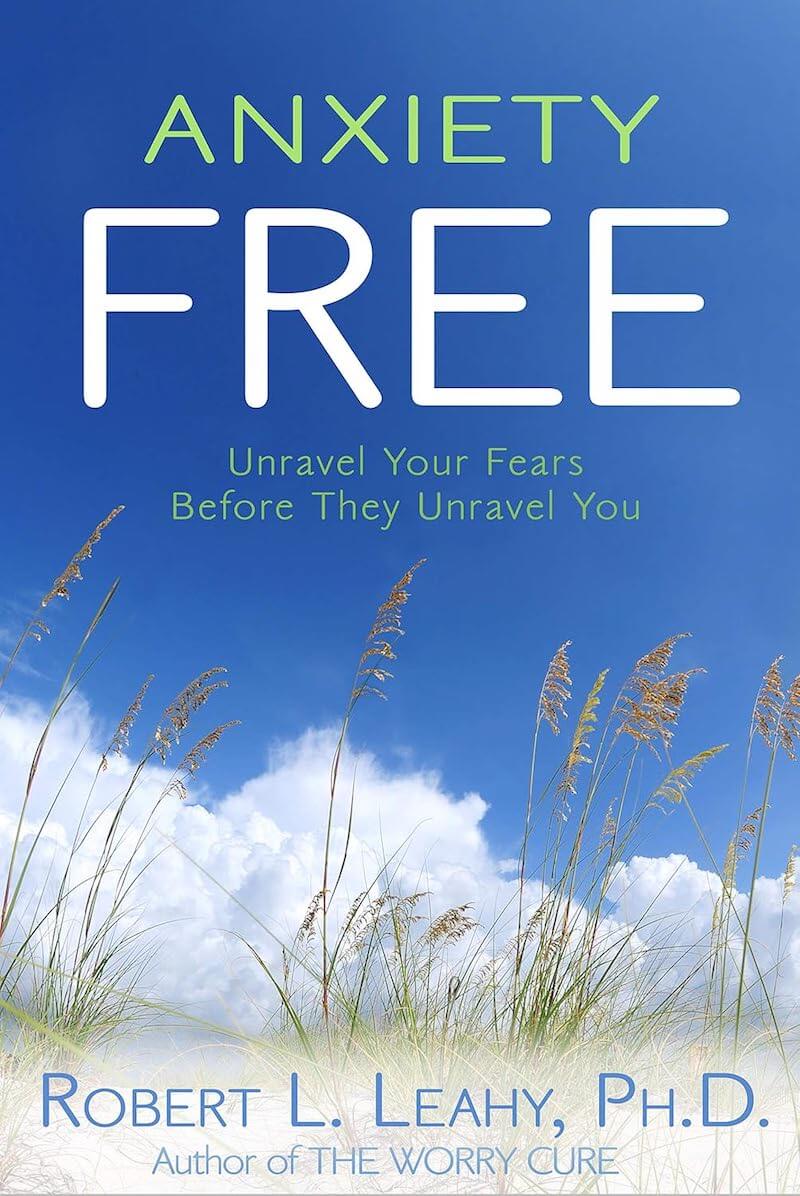
General Description
A 400-page book consisting of 10 chapters and lots of appendices. The material is presented purely as text information, with tables appearing from time to time. Reading difficulty level is easy. The book can be read quite quickly, and there's an audio version available.
Brief Overview
Let's briefly look at the book's content:
- First two chapters tell about the causes of anxiety and their historical and genetic features.
- Chapter 3 is dedicated to the beliefs that a person forms with anxiety disorders. In many chapters, these rules are quite similar. At this stage of the book, 6 types of anxiety disorders are already highlighted, which are covered in chapters 4-9.
- Chapter 4 is dedicated to isolated phobias: fear of heights, elevators, airplanes, insects, and the like.
- Chapter 5 is dedicated to panic disorders and agoraphobia. The first ones occur as a misperception of body signals and often lead to agoraphobia - this is the fear of being in a place where it is difficult to leave or get help, for example: in the subway, shopping center, elevator, airplane, at a concert.
- Chapter 6 is dedicated to obsessive-compulsive disorder (OCD). With OCD, obsessive thoughts and rituals appear, which a person performs to reduce anxiety - for example, they often wash their hands so as not to get sick, or check locks a hundred times to make sure the door is closed.
- Chapter 7 is dedicated to generalized anxiety disorders. GTR is characteristic of people who want to control life and all possible situations and outcomes of events. When aggravated and combined with other factors, this is often able to cause general anxiety.
- Chapter 8 is dedicated to social phobias - fear of public places, as well as public speaking. However, unlike normal nervousness before a speech, social phobia is the fear of being judged or looking foolish.
- Chapter 9 is dedicated to post-traumatic stress disorders (PTSD). This is characteristic of people who have experienced violence (for example, sexual) or have witnessed cruel life scenes. For example, many Jews after World War II concentration camps experienced PTSD.
- Chapter 10 is a generalized conclusion to all of the above.
As I already noted, the book has many appendices. I'll just list them below:
- Appendix A - Progressive Muscle Relaxation
- Appendix B - Insomnia
- Appendix C - Diet and Physical Activity
- Appendix D - Medications
- Appendix E - Mindfulness
- Appendix F - Depression and Suicide
- Appendix G - Diagnostic Tests
- Appendix H - How to Identify Anxious Thoughts
- Appendix I - Use Your Emotional Intelligence
- Appendix J - How to Deal with Anxious Thoughts
Opinion
I decided to read this book carefully and take some notes, as in the most problematic periods of my life, I sometimes feel anxious in the morning and have elevated cortisol, although all other hormones and tests are normal. By the way, this is why I had to look into hormones in more detail a few months ago and write an article about "good and bad" hormones. So, while reading this book, I at least understood that I have an isolated fear of not falling asleep (because I often stay up late over intellectual work before bed, and my brain buzzing with thoughts sometimes doesn't let me sleep for hours), as well as I have signs of GTR, since I tend to control everything and often think through all options and extremes.
As for the quality of this book, in my opinion, with the right approach and for people with the most common phobias (for example, isolated fear of flying or elevators), they will quite be able to overcome them. Practical recommendations are given in each chapter, but they are even more expanded and summarized in the book's appendices, which also represent considerable value. Don't harbor illusions that the book will instantly cure you from panic attacks or post-traumatic stress disorders. Most likely, for this you will need the help of a specialist. The book will only help to structure your thoughts and look at them from a different angle. Personally, I already knew a lot from what is written in the book, but that doesn't mean I know everything. So I think that people with anxiety disorders should read it.
