
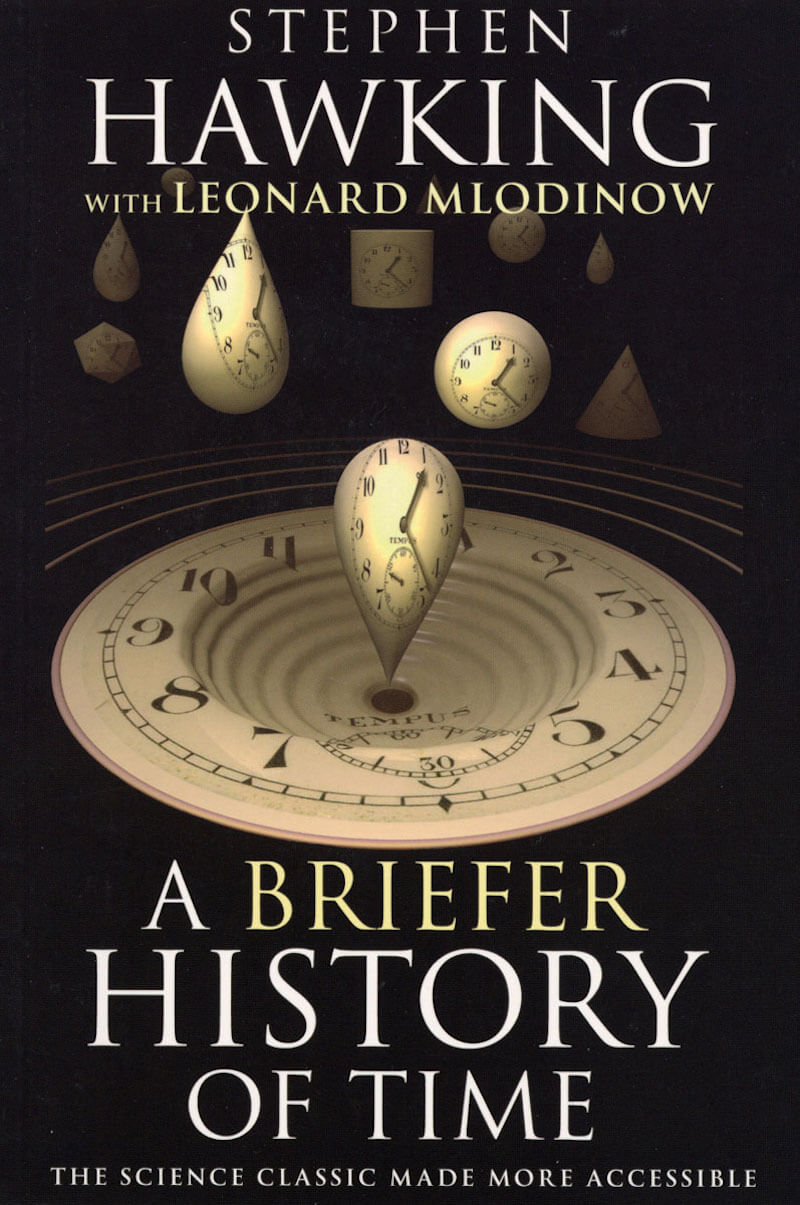
General Description
The book is 213 pages long (the number of pages may vary in different versions and editions) and consists of 11 chapters. Besides textual information, the book contains illustrations—there aren't many of them, but they nicely complement and explain the text. Although the book contains cosmological terms, there aren't too many of them, and they're quite understandable; there are no formulas in the book at all. And even though the book was easy for me to read, I think for most people, the difficulty level is somewhere between easy and moderate.
Brief Overview
Chapter 1. Our Picture of the Universe. Hawking briefly tells about the evolution of views on the universe—from Ptolemy's geocentric model and Copernicus's heliocentric model to Newton.
Chapter 2. Space and Time. This introduces the concept of relativity of time and space, based on the theories of Newton and Einstein. Time becomes the fourth dimension.
Chapter 3. The Expanding Universe. Hawking explains how we came to understand that the universe is expanding and how the Big Bang theory came about. Universe models are also considered: closed, open, and flat.
Chapter 4. The Uncertainty Principle. Introduces quantum mechanics and the uncertainty principle. Hawking explains how this destroys the ideas of absolute predictability and affects our understanding of the microworld.
Chapter 5. Elementary Particles and Forces of Nature. Covers fundamental particles (quarks, leptons) and four interactions: gravitational, electromagnetic, weak, and strong. The author describes attempts to unify all forces into a single theory.
Chapter 6. Black Holes. As a specialist in black holes, Hawking explains what black holes are, how they form, disappear, and behave.
Chapter 7. Black Holes Ain't So Black. The theme of black holes is developed in more detail. The idea of Hawking radiation is clarified, and it is explained that black holes can lose mass and eventually disappear.
Chapter 8. The Origin and Fate of the Universe. Discusses models of the beginning of the universe, including singularity and quantum fluctuations, as well as options for its death.
Chapter 9. The Arrow of Time. Hawking considers three "arrows of time": thermodynamic, psychological, and cosmological.
Chapter 10. The Theory of Everything. Like most other physicists, Hawking tries to find a solution to unify quantum mechanics and general relativity into a Grand Unified Theory (Theory of Everything).
Chapter 11. Conclusion. Conclusions of the book in the form of Hawking's reflections.
My Opinion
Stephen Hawking is one of my role models. I've already read this book for the second time and will probably reread it someday. It's amazing how a disabled person, who had only a few fingers working for almost his entire conscious life and who lost the ability to speak, still became a great scientist and wrote more than a dozen books. By the way, in this book, he doesn't use any formulas and explains everything in accessible language.
To be honest, when I first read the book, I didn't quite connect with the chapters in the sense that I couldn't fully understand why the author raised and highlighted exactly these problems in his chapters. Over time, as I learned much more about astrophysics, the answer to my question came by itself. Perhaps this is not a complete picture that would give an understanding of the structure of the universe, however, let's keep in mind that this book is for ordinary readers, and some topics will be very difficult to understand. And those that Hawking touched upon are quite accessible and clear explained. So I definitely recommend reading it.
