
Casino is one of the most popular types of entertainment: some want to win there and get rich, while others just want to pass the time and have fun. If the latter roughly understand what they are dealing with (since in most cases they are rich and successful, and often intelligent people), then the former sometimes have big problems understanding how a casino is structured from the inside. Such people are driven by the desire to get rich, and they often invent real formulas and tactics that they follow during the game. I will talk about them below.
In the title of the article I mentioned online casinos, and I did it for a reason. Perhaps few people know that casino machines must undergo so-called verification, or, more simply, meet certain standards. What do I mean by standards? It means that the algorithm of a gaming machine must be programmed in such a way that the payout (return of money back to the user) constitutes a specific, clear percentage. This parameter is called RTP (Return to Player) — the return percentage to the player.

A couple of words about how it is calculated (perhaps the formula is more complex, but for simplicity my example will suffice). For example, if a slot machine's RTP is 92%, this means that on average for every 100 dollars wagered by players, 92 dollars will be returned in the form of winnings, and 8 dollars will make up the casino's income.
An important condition that will still be useful to us in this article: RTP must not depend on the bet amount or any other parameters. Everything must be fair and transparent.
Now let's talk about what the RTP value should be. In fact, there is no clear value, and everything depends purely on local or state legislation that regulates this gambling business, as well as on the type of machine. This means that a casino does not have the right to set RTP below a certain percentage. For example, in some US states it is legislated that RTP must not fall below a certain level — for example, 80% or 85%.
I was primarily talking about physical casinos that you can go to and play in, not virtual ones located on the Internet. If the state permits casinos and at the same time neither the state itself nor especially local authorities are corrupt, then in theory one can count on the casino not “rigging” its slot machines. That is, if the state, after conducting an audit, tests the machines and issues permission for their use, then these casinos can be trusted, although one should still play cautiously.
This is perhaps a kind of ideal example, which even with physical machines does not always and everywhere work. But what about online casinos? Here several new nuances appear. An online casino located on some website on the Internet, properly speaking, should also be checked by the relevant bodies in the jurisdiction of the state in which this casino is registered. Nevertheless, there are online casinos that really operate under the supervision of regulators and have the corresponding permits and licenses for this. But it is far from certain that the casino you come across in advertising (which we will still talk about) meets all the requirements. So for a considerable portion of online casinos, the words “registered” and “certified” cannot be applied, since they operate illegally. Therefore, such sites can easily be blocked — precisely because of failed certification or because of mass complaints. The problem is that, firstly, it is very difficult to control the Internet, and secondly, even after one casino is blocked, creating a second one can take just minutes, at most hours, while finding and blocking it may take weeks. I will describe both problems in more detail.
I will try very briefly, omitting all technical nuances, to write about who owns the Internet and who can block a casino. Most often, players, when referring to a particular casino, operate with domain names, that is, website names. Accordingly, the simplest solution to get rid of a casino is to block its address, that is, its domain name. But who can do this? To do this, we first need to stipulate that there are domain names (or, more correctly, zones) that are general-purpose, that is, universal (not tied to any country), as well as specialized zones for each country. Examples of general-purpose domain zones:
.com — initially intended for commercial organizations, but in essence can be used for any purpose
.org — similarly, but intended for non-profit organizations
.edu — intended for educational content
Today there are several dozen universal domain zones. As a rule, when choosing them, no one looks at the original idea and purpose, but rather chooses the most beautiful and memorable website address.
The second group is domain names that were explicitly allocated for countries. Here are examples:
.by — domain zone for Belarus
.ru — domain zone for Russia
.it — domain zone for Italy
Returning now to the main question: who will control sites in these different domain zones? For universal domains there are special companies (the main ones are located in the USA), and for state zones the country to which this domain zone belongs has the right to regulate domain names. That is, all sites that end, say, in .by can, upon request, be blocked by Belarusian authorities in case of violation of the country's legislation.
The problem of blocking website domain names is very complex. A site must be quite well-known for it to be immediately noticed and blocked (if it violates something). In principle, there are systems that automatically analyze what is located on certain sites and are capable of reporting violations, but this is a very complex process that should not be fully relied upon. Someone will say that you can easily get a list of domain names and use it to understand whether it is a casino or not. Partly yes, but this only works for cases where the name contains the word “casino” or something similar and clearly revealing. Most often the malefactor chooses something neutral. Moreover, some quite respectable site belonging, say, to a small shoe company or a shawarma stall can be hacked: its content will be deleted and casino code uploaded. So, as I already said, identifying casinos is a very difficult matter. Now imagine that a casino is located not on a state domain, but on a universal one, for example in the .info or .biz zone. There are many such zones, and websites are almost infinitely numerous, and all of this must somehow be tracked. So it is hard and slow.
Now I will describe the second difficulty of blocking casinos. The thing is that an online casino is essentially a program in a browser. If we delve into the nuances, it is a set consisting of a server, a database, a frontend (what the user sees) and, of course, gaming software. But all of this can be “packaged” into a single automated deployment (installation) system. So for simplicity we will just call it a program. This program can easily be mass-installed and template-installed on any server that meets the minimum requirements of a casino template. This automatically means that even if the state blocked 10 casinos in 1 hour (which already looks unrealistic), in the same hour 100 other casinos with the same design or minimally customizable interfaces can be automatically deployed.
By the way, you are unlikely to find licensed fly-by-night casinos through search engines. Well, firstly, search engines themselves are configured against online casinos, at least against fly-by-night casinos. Secondly, the SEO promotion process itself is lengthy, and sometimes a casino site will not have time to be fully added to a search engine before the state blocks it, and the site itself (template/engine) moves to another domain name. That is precisely why promoting a casino is advertising, not SEO optimization through search engines. Advertising on sports sites and broadcasts, advertising on legal platforms with movies and similar sites — everywhere you can find links to casinos. And the most interesting thing is that the same casino (which I think belongs to the same person) may be blocked on one domain, say casino1.org, but this does not bother the owner in the slightest, and he can easily change the address to casino2.org and so on.
Well okay, let's say a casino did not pass certification. But what is bad about that? Here I play online and either win or lose. My chances are 50/50, whether it is a physical casino or an online casino (if we consider the game using roulette as an example). Isn't that so?
This is exactly where the whole mistake of players who lose money lies. Fly-by-night online casinos do not always work according to the logic of “won or lost, 50/50”. If programmers have already invented neural networks that can think and reason like a human, do you really think they are unable to create a more cunning game algorithm, one that you won't even notice? I think they quite can!
I am not any kind of expert in casinos and all their types of machines, but using the example of classic roulette I can break down one very popular game scheme. I think it is often used by people who lose. Its essence is that you need to constantly bet on the same color (either black or red), all the time until the moment of winning, increasing the bet after each unsuccessful step.
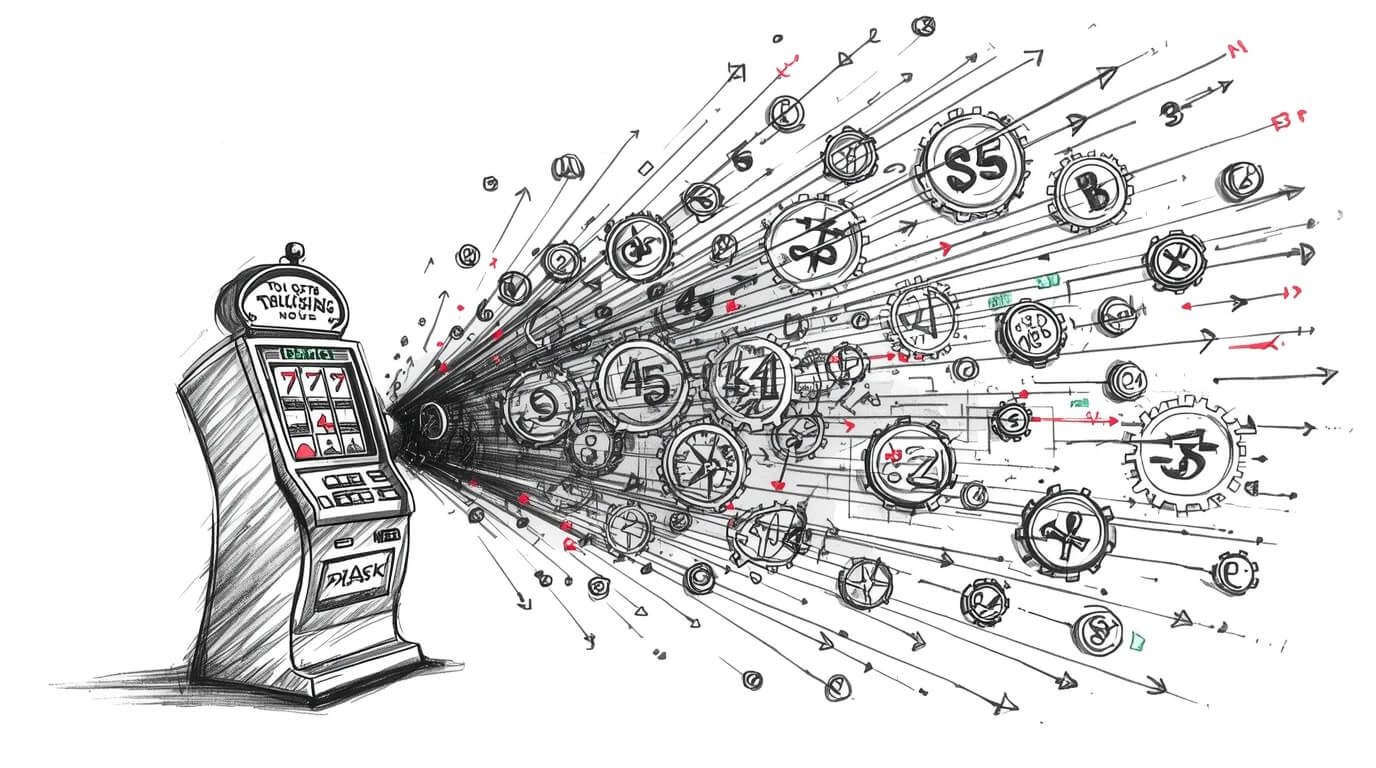
Suppose a player starts with a bet of 1 dollar on red.
1) In the first round black comes up → loss, the player loses 1 dollar.
2) In the second round he doubles the bet and places 2 dollars on red. He has already placed a total of 3 dollars, but if he wins, his winnings will be 4, and he will recoup all costs and be slightly in profit.
3) In the third round (suppose he lost again earlier) he places 4 dollars. If he wins, he will receive 8 and recoup 7 (1 + 2 + 4), and will also remain in profit.
4) In the fourth round (suppose he lost again earlier) he places 8 dollars. If he wins, he will receive 16 and recoup 15 (1 + 2 + 4 + 8).
Obviously, according to such a scheme the player is always in profit. Yes, with a very small one, but imagine: if you run such a scheme in one minute and win one dollar each time, then in 8 “working” hours you could bankrupt a casino. Isn't that so? In fact — it is not so!
Firstly, the creators of casinos are not fools at all, and they have set maximum limits in many places. For example, 1000 dollars. This means that after just 10 unsuccessful attempts in a row, the bet grows to 1024 dollars, and the total losses will be 1023 dollars — all for the sake of a potential win of only 1 dollar. At the same time, you can no longer double, since that is the ceiling. You have just quickly lost 1000 dollars and did not recoup it.
By the way, perhaps many do not double the bet after a loss, but immediately place 4 times more. So that the winnings in the end are not 1 dollar, but significantly more. That is:
1) Stage 1: 1 dollar
2) Stage 2: 4 dollars (total losses 5, in case of winning 8)
and so on.
Such people will hit that very “ceiling” of bets even faster and lose their money.
By the way, one can even suppose that there is no ceiling and no restrictions on bets. Then another problem arises: the money in your account will run out faster than you receive a win after another doubling, because the average player is not a billionaire at all.
Secondly, let's recall the RTP indicator. In normal legal and certified casinos it is strictly regulated. There, in the same roulette, the program must use a random number generator that passes an audit. But this does not mean that illegal and uncertified casinos adhere to this algorithm. An online casino is an algorithm written by programmers, which means they could have built in all sorts of logic. Suppose that while you are playing in a casino with small bets and have not reached step 4–5, your chances of winning are indeed 50/50, because these are the most frequent game variants, and they do not want to reveal rigged algorithms over small amounts. But as soon as the bets increase, the chances of winning can easily be reprogrammed: say, make it not 50% wins, but 25%. At the moment of your bet, the algorithm, of course, knows whether you bet on red or black, and it will not be difficult for it to deceive you. At the same time, since you mostly play small and rarely reach near-ceiling bets, it may seem to you that everything was fair. The system “just randomly” threw red 6 times in a row out of spite, and I lost. But in fact it might not have been a random algorithm that failed you 6 times in a row, but the malicious intent of the site owners. So this is at least one of the reasons why rich people play in offline casinos and trusted places, while those who like to lose money play in online casinos, on sites where they do not even remember the site's domain zone, and whose domain names can hardly be tracked and blocked. I am already silent about the fact that such players do not know the RTP of a given casino and its machines, and will also never learn from independent sources whether a given site has a license and permission for gambling activity.
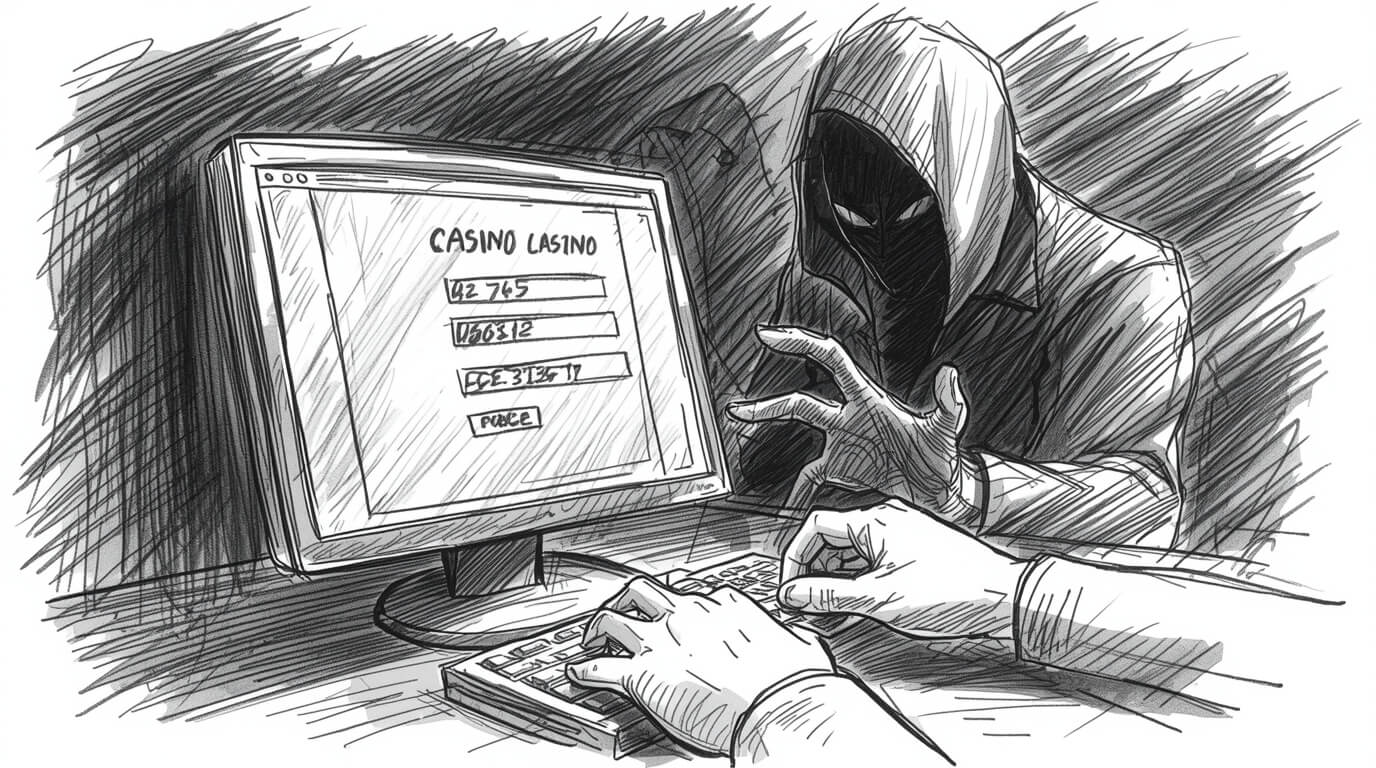
Losing in a casino is not the only problem. When topping up a balance on such sites, people do it from their payment cards and often expose their secret information there, including the 3-digit code that is needed for debiting and transferring money. If you do not have an additional system for confirming transfers via SMS messages installed, then, having run into such scammers, you risk losing not only the money you lose, but also everything that was on the card.
So, we can draw a conclusion about why online players often end up with nothing:
- Bet limits prevent endlessly doubling the bet.
- The player's limited budget also does not allow doing this endlessly.
- Players do not know what RTP is and what RTP a particular casino and the machine they are playing on have.
- Players do not check the casino's “history” and license in independent sources and run into unscrupulous sites.
- Players provide their personal data and payment system data to suspicious sites and web services.
