Introduction
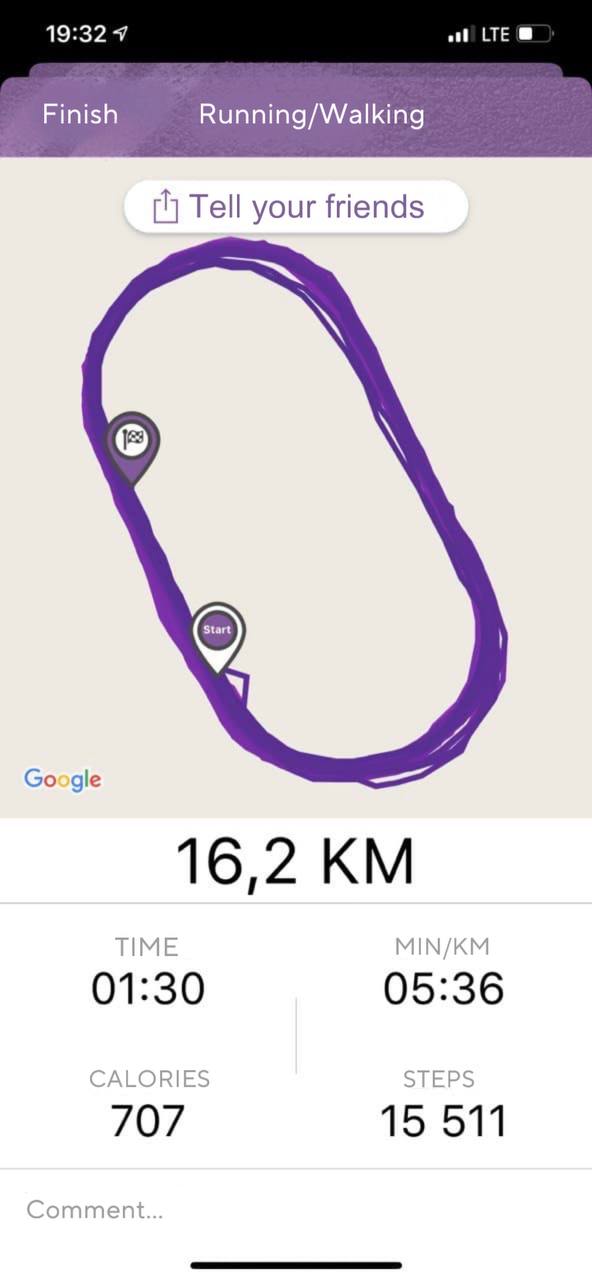
Today I set a personal running record: 16 kilometers and 200 meters without a single stop. I completed the entire distance in exactly one and a half hours. This was one of my goals for this year, and surprisingly, I achieved it by the end of April.
Why Did I Need This?
My job is primarily associated with a sedentary lifestyle. In the summer of 2018, I started to feel significantly worse overall. I experienced symptoms that were unusual for my age, such as shortness of breath, increased sweating, and heightened fatigue. When I underwent a medical examination, the doctors diagnosed me with tachycardia (rapid heartbeat). Considering I had never had heart problems before, and I had spent my entire childhood and teenage years being active, playing football, I felt like an old man since then. At 25, I realized that I needed to make a change and return to sports (even if just as an amateur).
Is It Hard to Run for a Long Time?
My very first run was only 800 meters long. During that run, my legs were buzzing, my heart felt like it was jumping out of my chest, I had a sharp pain in my side, and I struggled to catch my breath. It was hard to accept that the sport I had abandoned for just 3-4 years after childhood and adolescence had evaporated from my body so quickly, and I had become rusty.
Nevertheless, I continued to run, and I only ran outdoors, in the fresh air. Sometimes even in the rain (if I didn't finish my run before it started) and, of course, I ran in the cold as well. Throughout this entire period, which lasted almost 3 years, there wasn't a single month when I didn't run. During the warmer months, the intensity of my runs reached up to 2 times a week, or I would have one run and one football game. Yes, aside from running, I returned to playing football, although I don't play as often now. In the colder months, I could only run 1-2 times a month. The main rule for the first years of winter running was: don't run if it's colder than -10 degrees Celsius. By the end of the first year, I was able to run distances of 6-8 kilometers per session. During these runs, I could take breaks of 1-2 minutes to recover my strength.
In the second year, I significantly increased my distance and averaged 9-13 kilometers per run. I transitioned from running on the streets to running on the track. Breaks and stops during my runs practically disappeared, and I was able to cover distances without pauses. On one perfect summer evening for running without stops, I achieved a distance of 15 kilometers and 100 meters, which then became my record. This distance took me 1 hour and 25 minutes.
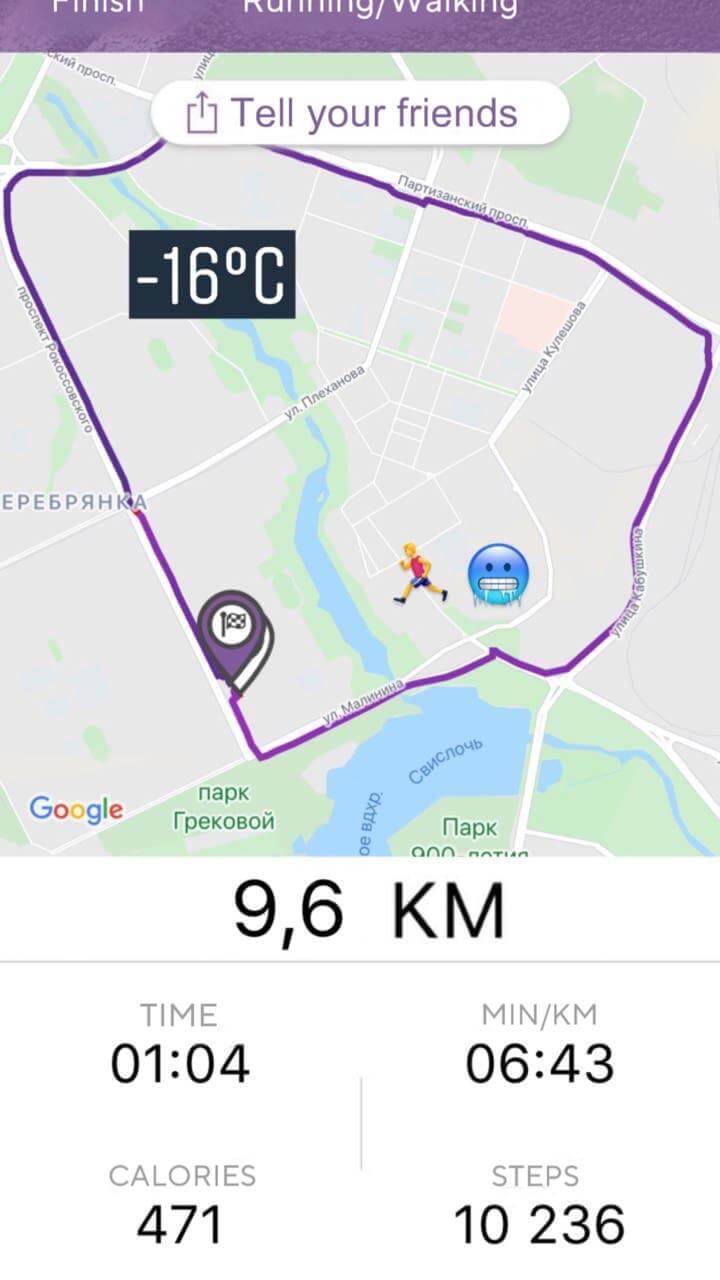
This year, I also kept up the pace and ran even in severe frost, when the thermometer dropped to -16 degrees Celsius. I planned to break my record in the summer when I would reach my peak fitness for the year, but I realized that I could do it by the end of April.
I'm not very familiar with running techniques, but while reading a programming book, I learned about the pose method of running. Yes, I'll reveal a secret: books about programming are not only about programming but also about many other things. After all, how else can you explain complex concepts if not with real-life examples? So, sometimes I tried to mix regular running with the pose method, but most of the time, I ran in a conventional way.
As I conclude this section and answer its main question, "Is it hard to run for a long time?" there won't be a definitive answer. Physically — no. Especially if you find the ideal conditions for running. Psychologically — incredibly difficult. Arriving at the track and knowing that for the next hour or so you will be pushing yourself to the limit doesn't help your motivation.
Ideal Conditions
There are several conditions for running that I have managed to establish for myself over the years:
- Don't run in strong winds. This rule is at the top for a reason. Strong winds drain an incredible amount of energy. Even when running in a circle, where half of the lap the wind helps you and the other half slows you down, the slowing factor is stronger than the helping factor.
- Dress appropriately. In winter, gloves and a hat are necessary, along with a jacket, fleece, or something else warm. In summer, winter, and fall, during warm weather, I run in shorts and a t-shirt.
- Wait 2-3 hours after a heavy meal. The meal itself doesn't significantly affect the quality of my run. For example, last year, I played PlayStation in the morning and won the World Championship (Andrea Pirlo) in the evening; I had dumplings for lunch and set a record in the evening.
- Running in sunny and hot weather during the day is also very difficult.
- Humidity matters as well.
- Psychological mindset, though to a lesser extent, also influences the quality of running.
Record Evening
As I mentioned earlier, running long distances is incredibly hard psychologically. After setting a record last year, I realized two things:
1) I want to improve it, even if just a little.
2) I still don't know how to mentally prepare myself to run that long again.
To jump ahead, I'll say that today I didn't plan to set a record. I thought I would only run 11 kilometers. With each run, I planned to add about 200 meters, aiming to peak in the summer and set a new record. So, off we went. After having a banana, I couldn't wait two hours and went for a run after just 40 minutes. Even after two laps, which I usually complete easily, running still felt tough. Then I realized that to get the energy boost from the banana, I needed to eat it, not shove it in my backside and run. But yes, jokes aside. I started with the pose method, which turned out to be slightly faster than my usual pace, and I wasn't ready for that speed at the beginning of the run. Then I switched to my regular mode and ran like that until about 12 kilometers, after which I began to alternate my running styles periodically.
Despite my breathing leveling out closer to the third kilometer, and not feeling any discomfort in my legs or hearing my heartbeat, I still caught myself thinking that I had an incredibly long way to go. In such moments, time doesn't just slow down for you; it stops. There are only two things that help you distract from running: music and going within yourself (completely tuning out from running). At that point, you can rack up kilometers without even noticing. The most important thing during such times is not to look at your phone to see how far you've run, because then your brain starts calculating how many laps are left, you refocus on running, time stops again, and it becomes psychologically tough once more.
Regarding physical condition: after about 5-6 kilometers, you reach a level where it doesn't matter whether you run 10 kilometers or 15, as long as you don't think about running and don't count each lap. It's also very important, when reaching such a state, not to stop and rest. Resuming your run is harder than just silently pushing through.
Honestly, Deceive Yourself
On both evenings when I set my records, I deceived myself. It was a sincere lie that I naively believed in. Last summer, running felt just as tough for me (more physically than psychologically). After the first 6 laps (to give you an idea, 15-16 kilometers is about 35-40 laps), when I arrived at the stadium, I genuinely thought I would take a few breaks after every 6-8 laps. I planned to take 3-4 breaks and run a total of about 30 laps before heading home. However, after completing 6 laps, I forbade myself from resting and told myself I would take a break after the 7th lap. After running 7 laps, I pushed the break to the 8th. From the 8th to the 9th. After running 9 laps, I deceived myself in the same way, catching myself thinking that I wasn't tired enough and could run another lap, and that I couldn't allow myself to stop. I kept deceiving myself until the 15th lap, after which I realized there was no point in taking even one break, and I could run the entire distance without stopping (physically, my body accepted running, and psychologically, I tried more and more to distract myself). Similarly, I forbid myself to rest on any running day, and when I go out for a run, I already know in advance that I probably won't sit down to rest and will run the entire distance in one go.
Today was a different kind of deception. I hadn't planned any breaks and hadn't taken them for a year. However, when I set out for my run, I planned to run 12 kilometers and then go home. More than once during the run, I caught myself thinking that if 12 kilometers felt so psychologically difficult, how did I manage to run 15, and how would I run even more this year? I tried to suppress those thoughts with music and periodically tuned out, not thinking about running. Sooner or later, I pulled out my iPhone to check how much distance I had left to reach 12 kilometers, as I already had a rough idea of the distance, and there were about 6 laps left, but I wanted to know for sure. At that moment, I had already run 9.5 kilometers, and I realized I was almost completely un-tired, and I asked myself, "Why not set a record today?" The realization that I didn't have to wait until summer and could do it now gave me even more enthusiasm and psychological strength. After all, I only had to run 6 kilometers to break my record, not 15. Not an hour and a half, but just about 30 minutes. That's how I deceived myself for the second time and broke my record again.
Features of My Running
Let's start with speed. It's difficult to assess my actual running speed (even with the help of an app). Of course, I'm not sprinting around the track, but my running can't be called jogging either. A bit faster than average—that's how I would describe my pace. If you want to compare it to yours, you won't have any trouble doing so. Usually, on warm late evenings, there are many people running on the track. Out of 10 people running simultaneously, my speed allows me to overtake about 5-6 of them. Another 2-3 are running at a similar pace to mine, and only 1-2 people can actually outrun me. There's a slight sense of satisfaction when I pass slower runners on the second or even third lap, or when people who come to run after you still leave before you do.
Nutrition. I've partially written about nutrition already. What I eat doesn't influence my running much; the main thing is to ensure that some time has passed since I last ate. Otherwise, you're guaranteed to experience side stitches and mild burps that taste like what you just ate.
Bath After Running. Yes, a bath, not a shower. I spend at least 30 minutes soaking in it, like Maslow in a barrel of apples. Perhaps this is one of the reasons why I don't get sore throats even after winter runs.
City or Track. Initially, I ran on the streets for the first year and a half, then switched to the track. I prefer running on the track, although both methods have their advantages and disadvantages. Here are the drawbacks of each:
For the City:
- Often uneven surfaces: sometimes uphill, sometimes downhillli>
- Cars and traffic lights are a distraction
- Dogs can be a nuisance
- Puddles after rain in some places
For the Track:
- Circular running can negatively affect your psychological state
- If someone is training, you regularly hear the phrase "pass the ball" (which is why my laps on the track aren't perfectly even)
Running in parks is comparable to running in the city: uneven surfaces, dogs, puddles. Therefore, I almost always choose the track for my runs lately.
So, What's Next?
I don't have an answer to that question yet. Physically, I was probably ready to run even 20 kilometers, but I didn't want to push my body too hard and double my distance after running 10-11 kilometers. Will I set a new record? That's also an open question. If I overcome myself psychologically, find a new way to deceive myself, or purposefully aim to run more than 16.2 kilometers, perhaps one day I will achieve it. However, I don't share the opinion that an ordinary amateur programmer should challenge professional runners and run 30-40 kilometers or more. Although physically, I probably could. Part of me wonders why I don't participate in various amateur marathons. There are two reasons for that. (Somewhere, Igor Nikolaev is crying that it's not five reasons.) First, I run for myself, not for any marathons. Second, marathons always take place on weekends in the first half of the day. Normal people are sleeping at that time.
One thing I know for sure: I'm not going to give up running, and you'll still see plenty of oval stories (with the element of "pass the ball") on my Instagram.
I'll finish with what I started. Has running given me anything? I think so! Running is beneficial for the body as a whole, and I won't list all its advantages that can be found online, from improving the cardiovascular and respiratory systems to boosting lymphatic flow. The most important thing is that I no longer have tachycardia; I feel like a teenager again in terms of physical activity when walking and running. I can confidently go up and down stairs without getting out of breath. After aging, youth has returned, and I won't let myself rust anymore.
Update from 29.10.21
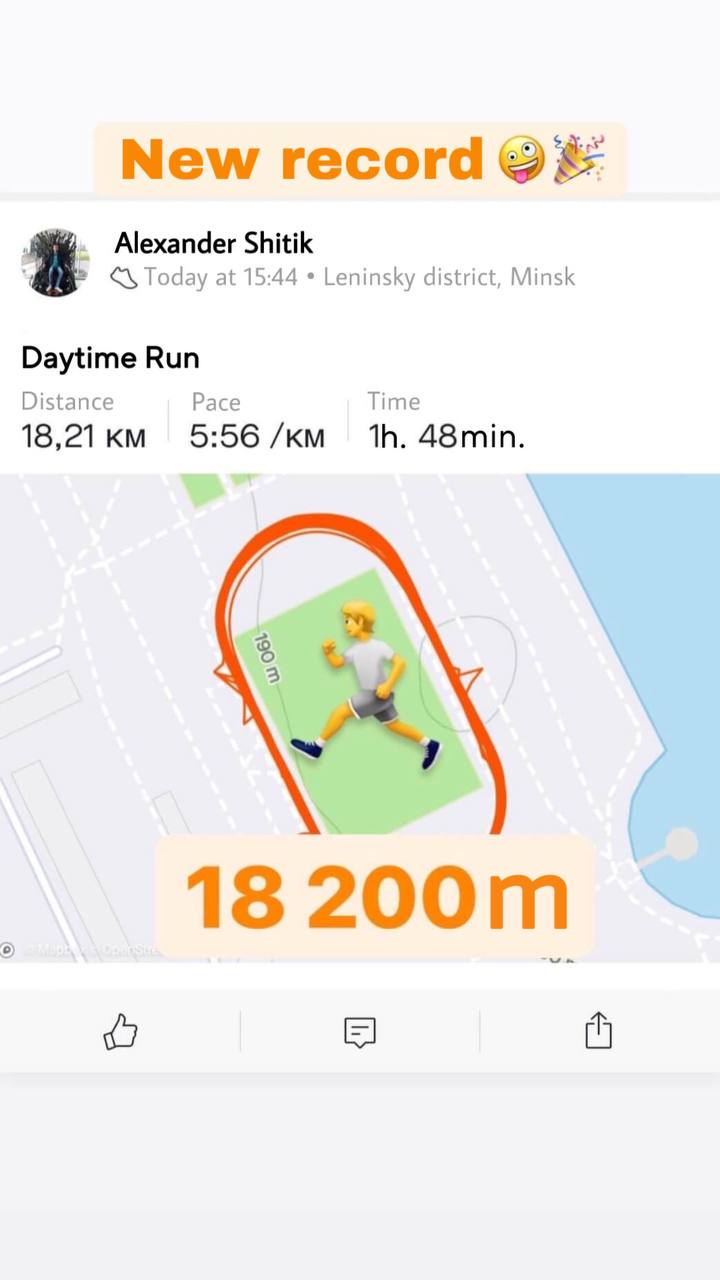
18.2 km! 🔥🎉 My new running record.
Not even a week has passed since my vaccination 🤷♂️😄, and in the sunny weather of late October, I was out there like an idiot, running laps in a tank top and shorts to improve my previous achievement 😋🤪. Now it's exactly 2 kilometers more.
16.2 → 18.2 🏃