
As you lie in bed before sleep, how often do you ask yourself questions like, "How does today differ from the others?" and "What useful thing did I do today to achieve my goals?"
Even if you don’t possess strategic thinking, I hope this article helps you get closer to it and fall in love with planning. Below, I will outline my list of methods that personally help me stay aligned with my goals.
Planning Yearly:
A few years ago, at the end of the year, I started setting several goals for the upcoming year. The number can vary, but typically consists of 3-6 goals per year. Among them, I always highlighted the most prioritized one and named the entire year after it, just as is customary in many countries. For example, I will compare and present below my main goals alongside the goals of my country. Don’t try to find correlations :)
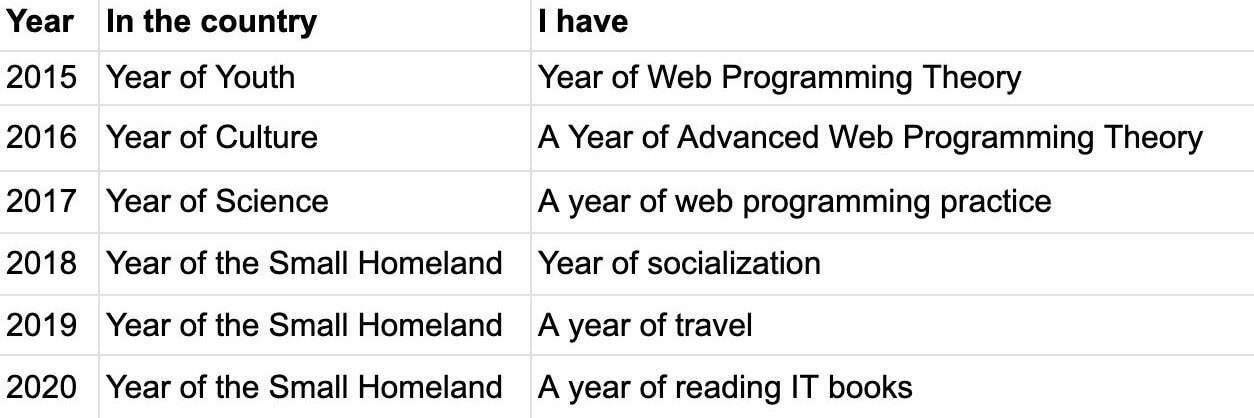
While typing this article, I noticed a somewhat strange phenomenon: my country pays three times more attention to maintaining the "past" (since the process of urbanization is, to some extent, normal and even irreversible for many countries) than to the "future" (referring to science). But this is not the topic of this article, so let’s move on.
About six months ago, I decided to further detail and delve into my goals and planning to better control the overall process of execution.
Notes
Notes are always necessary. I’m not so obsessed that I buy and use magnetic boards, but from time to time, I use paper sticky notes. Most often on weekends, when I need to tackle a large volume of small and medium tasks. However, aside from paper sticky notes, I use virtual ones much more frequently. In my case, I create three sticky notes and place them in the corners of my desktop. These sticky notes display short-term plans (for the day), medium-term plans (for the week), and long-term plans (for the month). The sticky note program is always running on my desktop, allowing me to check them at any moment. Typically, the month has the largest list of tasks recorded, and then some of them are transferred to the weekly list, after which, throughout the week, tasks are sequentially moved from the weekly list to the daily list. If I plan to work on a task several times a week (for example, learning dolphin language), I shouldn’t remove that item from the weekly list after the first transfer to the daily list. Similarly, if I plan to study dolphin language every day, this entry will always remain on the daily list, simply marked as completed or removed, but then returned at the end of the day. At the end of the day, it’s important to make a list for tomorrow so that when I wake up in the morning, I don’t have to spend time organizing and compiling it.
Anti-Degeneration Map
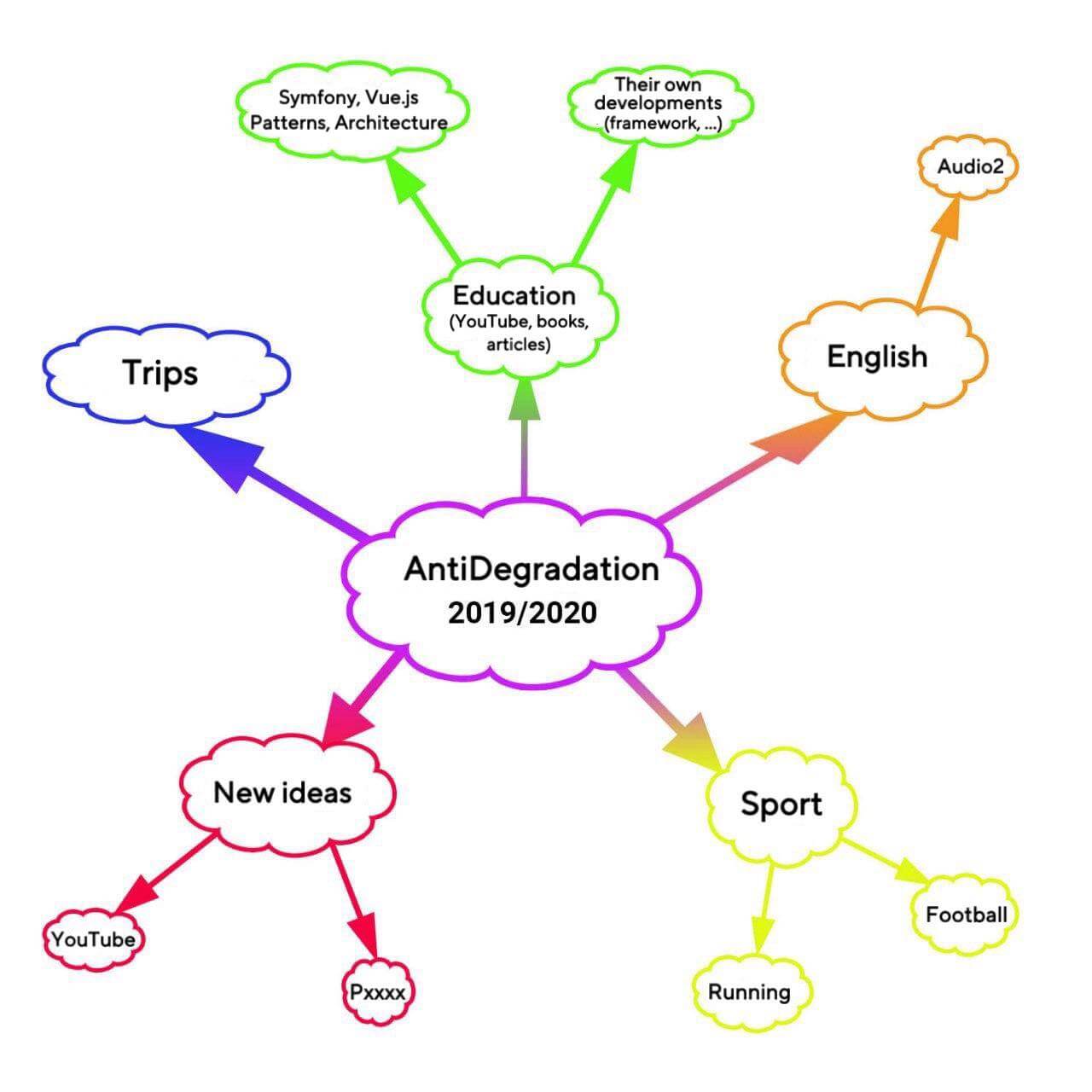
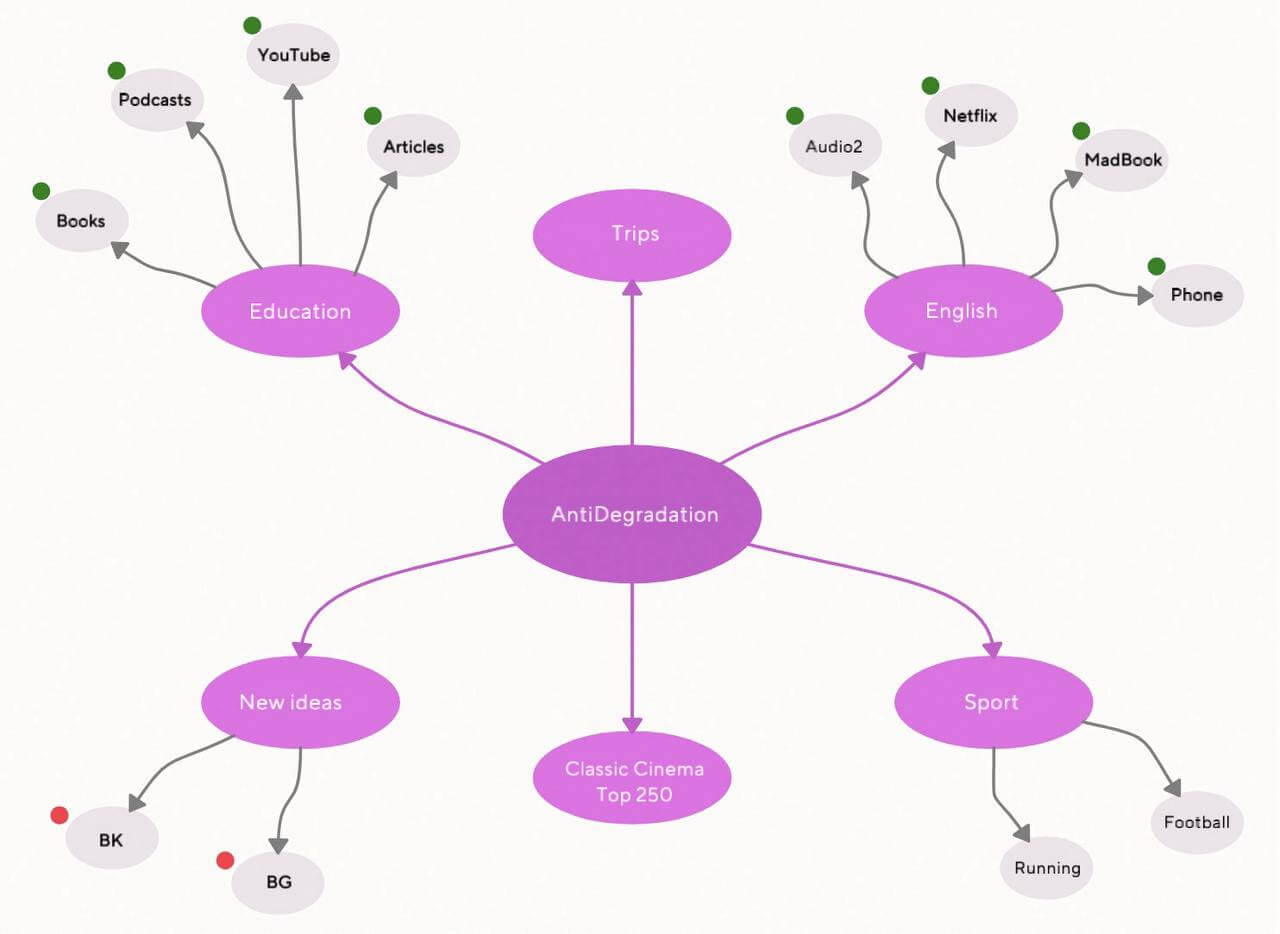
Another important element of planning, alongside goals, is my anti-degeneration maps. They may partially overlap with goals, but the main purpose of these maps is not achievement, but rather reminder. Such a map can be set as a wallpaper on your desktop to keep all your goals, plans, and areas of development in mind. Some goals can also be represented on the map. For example, I don’t have any goals related to sports, but I do enjoy football and running. While I could potentially set a yearly goal for running (like running 20 km without stopping), it’s unlikely for football. Nevertheless, it’s extremely important to keep something similar in mind or in front of your eyes for a better understanding of what you want. For instance, my map looked like this last year. Don’t ask me to decode it, as it’s personal information :)
Here is what the current map looks like.
Reminders on Calendars
Some of my friends regularly use their smartphone calendars to record various events. I’ll say right away that I don’t do this. Perhaps not yet. I don’t record specific events (like a Saturday trip to the bar) in calendars because I won’t forget about these activities anyway, and I consider writing down a bunch of daily events a waste of time, as they ultimately won’t align with the times you specify in the calendar. Therefore, when I list my tasks in the notes for the current day, I never tie them to specific times, but I always try to estimate the total available time (taking into account the time spent working, sleeping, and walking).
Cyclic Processes
Any large task typically cannot be completed in one go. For example, it’s impossible to read a large book all at once. In my daily notes, the same tasks may appear every day: watch an episode in Uzbek, read N pages of a book, deal with aliens. Over time, small daily tasks that repeat from day to day accumulate into a cycle of processes (even though these tasks may come from completely different areas). If for some reason I quickly complete all the tasks for the day (including those that make up the daily cycle), I can move on to a new iteration of these tasks (watch another episode in Uzbek, read N pages again, save the galaxy from aliens once more).
Composite Goals
One of my goals might be to learn and practice a programming language, or a more abstract one, like improving my programming skills. However, when setting annual goals, I almost never specify the ways to achieve them (the paths to solutions). Sometimes you can reach a goal through different means, and often choosing multiple directions is even a more correct solution. Despite having 8 years of education in college and university, as well as about 5 years of practical experience in programming, I always set one of my goals related to programming. For example, to improve my programming skills, I can outline a whole range of actions:
- Reading books
- Listening to podcasts
- Watching video courses
- Attending/viewing conferences and meetups
- Reading articles
- Analyzing links (I’ll talk about this another time)
- Studying the code of open-source projects
- Practicing (writing personal projects, participating in open-source projects)
- Communicating with friends/acquaintances/colleagues
- Analyzing current job vacancies on job search websites to understand which technologies are currently relevant and in demand.
Thus, when creating an anti-degeneration map, it’s important to include not just the ultimate goal of “learning the programming language Karasik,” but rather this list, to understand that the goal can be achieved through various paths and subsequently combine these directions.
Generative and Consumer Goals
There are probably many groups into which goals can be classified, but aside from simple and composite goals, I want to briefly discuss another classification that I use for my goals. This classification distinguishes between generative and consumer types of goals. Generative goals are those that result in the creation of some product or item. For example, creating my own framework or simply working on a project is a generative goal. I am making something that others can use. Consumer goals, on the other hand, are related not to the production of something new, but to the consumption of ready-made materials created by others. For instance, goals related to reading books, watching classic films, or taking video courses are consumer goals. When planning my daily goals, I try to alternate between consumer and generative goals, allowing my brain to rest and switch between different processes (first writing code, then reading, etc.). Sometimes I may set several consumer goals in a row, but completing several generative goals consecutively is not always easy.
What Else
- Allocate at least half an hour for unforeseen circumstances and at least an hour for household tasks. Since I always work remotely, I don’t spend time commuting to and from work. This saves me some time, which I can use, for example, for a walk or to start a new iteration of a cyclical task.
- Set clear goals. I mentioned earlier the example of the goal “improving programming skills,” but this is not a very good example, as it is too abstract and vague. A more accurate and specific goal would be something like “Read 30 books” or “Master Spring and complete a project with it,” etc.
- Specific goals are easier to evaluate in terms of their progress.
- Don’t set unattainable goals and don’t get lost in dreams. Ambition is good, but goals should not take up all your personal time.
- The number of goals, as well as their scope, is highly individual for each person.
Planning is the key to discipline.
I :)
The better you approach planning your tasks, the easier it is to execute them and the easier it is to achieve your goals.
