
Dislike for Books
I hardly read books—I feel like it's a waste of time. I know people will want to kill me for saying this.
Freddie Mercury
It's hard to add anything to these words. I completely agree with them. Sometimes it seems to me that only lazy people read books. It's always easier to open a book than to do something useful around the house or to go somewhere. On the other hand, one could defend book lovers, as it’s always easier to turn on a movie or a series as an alternative to books or just go to sleep.
Why Did I Even Need This?
When I declared 2020 as my personal year of "reading books," I didn’t set specific goals for the number of books. I wanted to further enhance my programming skills, as among the many resources (podcasts, articles, meetups and conferences, official documentation, YouTube), learning from books had previously been something new for me that I hardly touched. Moreover, I was curious to feel like someone who actively reads books, even if just for a short time.
E-books or Paper Books?
I have nothing against paper books. It’s especially nice to hold a new book in your hands and smell it (unless, of course, you have COVID-19). But my preferences definitely lean towards e-books. They are at least versatile in terms of portability and reading on different devices (you can read from a monitor or from your phone), there are no issues reading in the dark since you can always adjust the backlight. They don’t take up space in your backpack. After all, many modern books can be uploaded to online readers and listened to when you don’t feel like reading.
What Did I Read?
The majority of my books are focused on IT topics, but I also found a couple of books that develop me in other areas, often overlapping with economics, politics, sociology, and science. In 11 months (I’ll explain below why I don’t read books in December), I managed to read 32 books. You can see the list of all the books below.
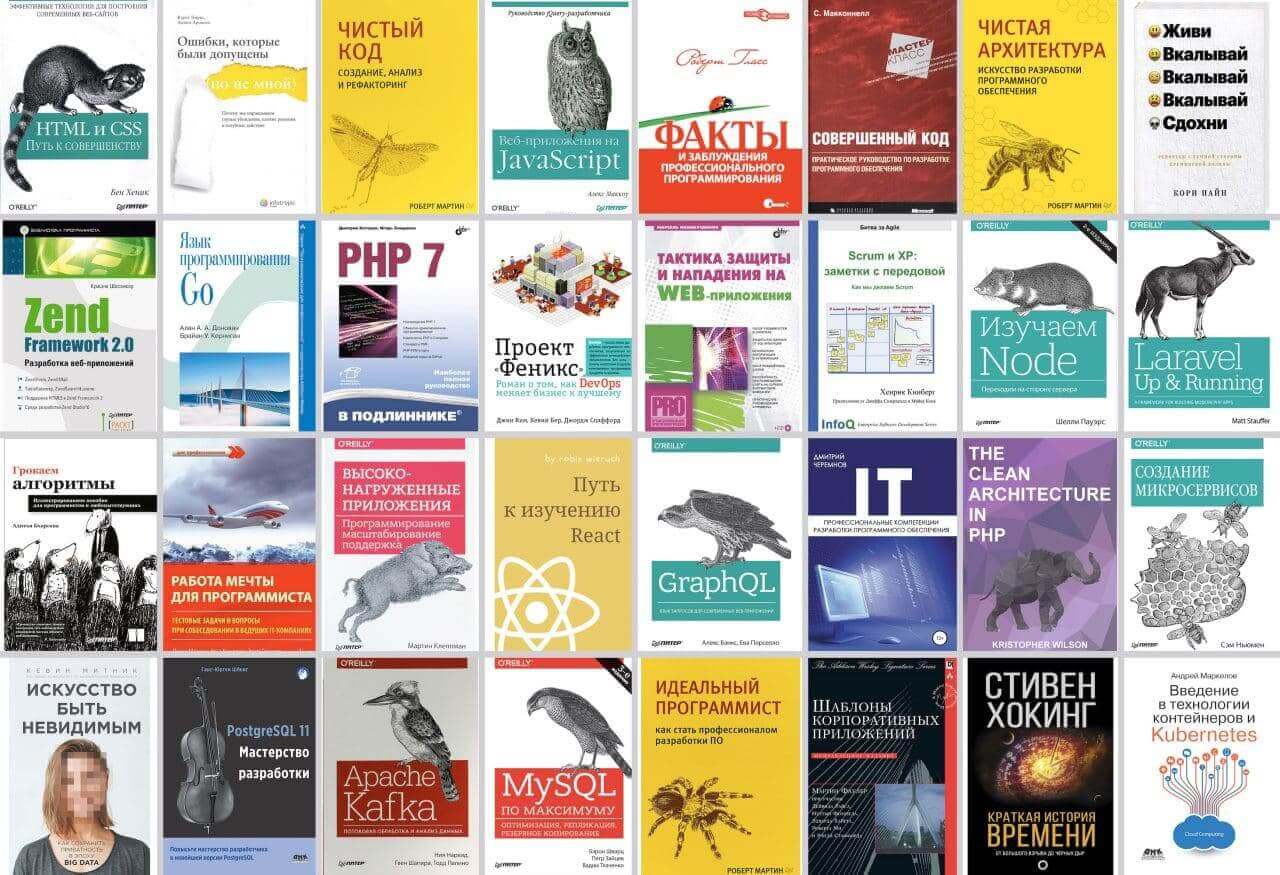
Long-Awaited Explanation
Of course, like everyone (probably everyone), I keep track of everything I read. Moreover, I keep track of almost everything that can be recorded, but that's not the topic right now. I decided to maintain a record of the books I read in a regular Excel file. There's nothing unusual about it. Perhaps the only unique aspect is the rating fields. But these are purely for my convenience. In the "rating" field, I assign a score to the book I read. This score reflects the value of the information for me at the current moment. If the rating is low, it means one of two things: either I didn't understand much from the book (which can happen when you haven't worked with a particular technology at all, and its description without examples feels rather dry), or the book I read didn't provide me with any valuable information, and I already knew all of it. Conversely, books with high ratings indicate that I learned something new from them, and that new information is clear to me. If I know a particular technology and give a book a low score, it doesn't mean the book won't be useful to others. Similarly, giving a book a high score doesn't mean that the entire book is a complete revelation for me, and I knew nothing before. Therefore, my ratings should always be taken individually.
I only assign a "rating for the author" when the author has done an enormous amount of work in writing the book. For example, in cases where they have gathered and analyzed a vast number of real-life examples and sources.
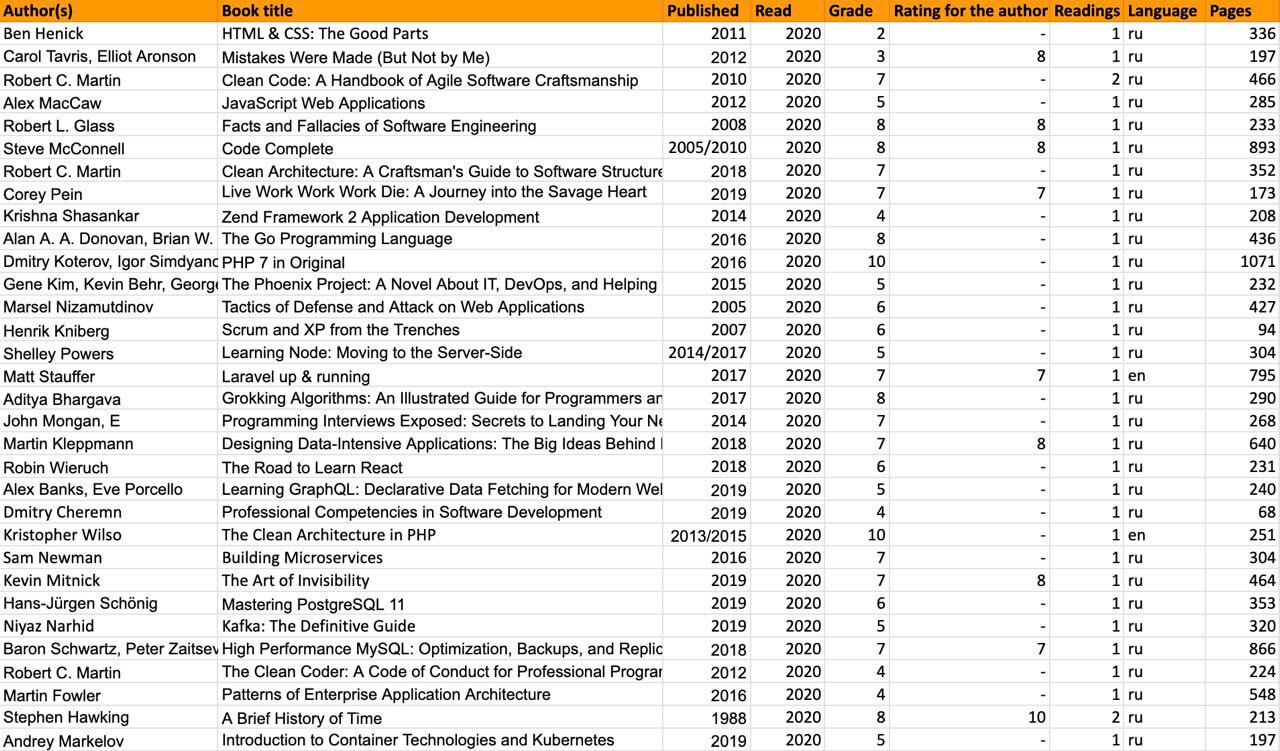
In addition to the two rating fields, there are also fields for the number of readings, the language in which the book is written, and the number of pages.
All these fields are purely conditional (especially the ratings), and it’s possible that in the future they may change or I may even abandon them altogether.
Unconventional Tips
The majority of my observations and recommendations will primarily focus on IT books.
My Rules for Reading Books:
- Read several books at the same time so that they don’t become monotonous, allowing you to switch between them. For example, read one book this evening and another one tomorrow.
- When you finish reading on a given day, don’t read a chapter/section all the way to the end; instead, leave a small part for the next time. This way, when you read, your memory of the "previous" section is partially refreshed, and the likelihood of remembering it is higher. In other words, if you plan to read 50 pages today and finish the entire chapter, leave a few pages unread so that you can complete them tomorrow.
- Take notes on the most important and new material. This is a very important and valuable point that I definitely try to follow. To avoid forgetting important things after reading, write them down in a separate file—a summary of the book. The final summaries for each book may differ. For one book, the summary might be 5-7 A4 pages, while for another, it could be 30-35. Include not only text in the summary but also code, tables, graphs, images—everything you find necessary. Then, you need to set aside time to periodically review this material. In my case, I plan to reread all my summaries in December, dedicating an entire month to it.
- Read books without translation in two tabs/windows. My level of English is far from good enough to read books in their original language and fully understand the author's thoughts. In such situations, I often translate the book into Russian, split my monitor screen into two equal parts, and open both versions of the book to read them simultaneously.
- Sometimes, it’s helpful to read the chapter summary first and only then move on to reading the actual chapter. This is particularly true for complex books that cover new technologies. Since the summaries always highlight the most important points of the chapter, you can familiarize yourself with them in advance and later perceive them differently during regular reading, giving them special attention.
- If you don’t understand something, open YouTube or the official documentation. This usually applies to specific chapters. A different perspective on the issue can often help you understand what the author is trying to convey in that section of the book.
- Read using online text-to-speech tools. Programmers are lazy people, and I am no exception. Laziness breeds genius, so I copy some books (or rather chapters) into online readers and listen to them from there. You can set the playback speed above average and adjust the tone and voice to your preferences. This advice is more suitable for general books, as it’s pointless to throw code snippets into a reader. Moreover, not all eBooks can be copied.
- Do everything possible to keep large books interesting. This can sometimes be a challenge if the book is too long or confusing. To address this, you can use the tips for alternating books (reading several books simultaneously) and look for unclear questions in other sources (YouTube, official documentation, articles).
Reading Style
This section would not exist at all if, after showing a preview of the article (which was ready before the article itself) to friends and acquaintances, some of them hadn’t raised questions about my reading style. Even though the books varied, my approaches were completely universal for all of them.
- Even if I was familiar with the technology or language being studied, I never skipped any chapter. Of course, the reading speed for such chapters or even entire books was significantly higher. I didn’t have to stop to rethink the information I had read or to take notes for the book summary. Overall, my reading coverage ranged from about 90 to 99 percent. Naturally, I skipped the lists of sources at the end of the book, the glossary of terms, and sometimes some appendices. However, I never skipped any chapters or subsections.
- I tried to read almost every day. Nevertheless, there were times when I didn’t open any book for several consecutive days.
- The volume of daily reading could vary from book to book and ranged from 25 to 50 pages. On weekends, I generally managed to read more than on weekdays.
- I almost never
sat down(this word should be replaced in Belarus in 2020) with the intention of reading half or all of a book in a day or over the weekend. My main reading approach throughout the year was to read several dozen pages every day.
Conclusions
Thanks to Anton Okolelov for his comments on the previous article. Because of him, this article includes a conclusions section.
- They say that to make something a habit, you need to do it for a month. Reading books has not only become a habit for me; I’ve become addicted to them like a drug. I will definitely continue reading books in the future. I gain not only knowledge from books but also a sense of satisfaction from each book I finish and “put on the shelf,” meaning I record it in my file. I want to collect as many O'Reilly animals as possible to decorate my virtual library. This is not just about this publisher, but also about some others that release entire series of books that are interesting to follow.
- However, on a broader scale, reading books has not changed my opinion regarding genres. I would never read science fiction, thrillers, horror, or detective stories. I don’t want to waste my planned time on such materials or fill my mind with that kind of literature. I am primarily talking about IT books, and from time to time, I read a couple of general development books. Therefore, I will continue to feed on knowledge from books in piles and stacks, regardless of what primary goals I set for myself each year. Having determined my approximate reading speed over 11 months plus a month for notes, I plan to read at least 25 books annually.
- What have books given me? Since most of my books are about programming, this point will be particularly useful for programmers. Books greatly broaden your horizons. No YouTube programming blogger can provide you with as much information in their course as a good book can. Additionally, books are excellent for in-depth study of specific technologies, languages, and concepts. I often encountered moments where authors explored a topic in depth, while official documentation only mentioned it briefly. However, books are not well-suited for quickly getting started with a new technology. In this case, I would prefer YouTube, some template open-source solutions, or official documentation. A good solution is to combine several approaches at once.
